
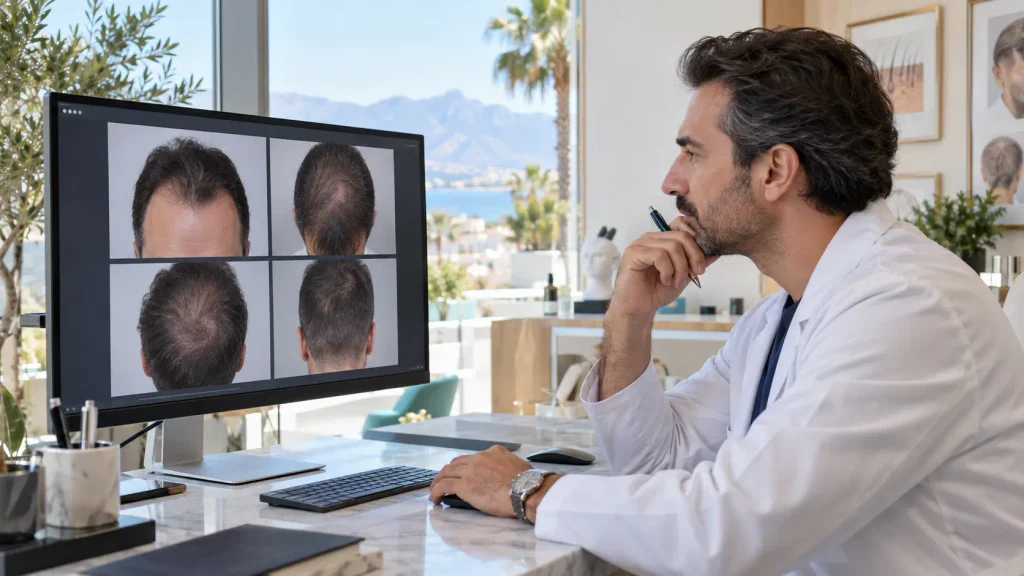
An online hair transplant consultation can provide a surprisingly useful first assessment when the photographs are clear and taken from the correct angles. An experienced hair transplant team can usually identify the pattern of hair loss, evaluate the visible donor area, estimate a possible graft range and suggest which treatment method may be suitable.
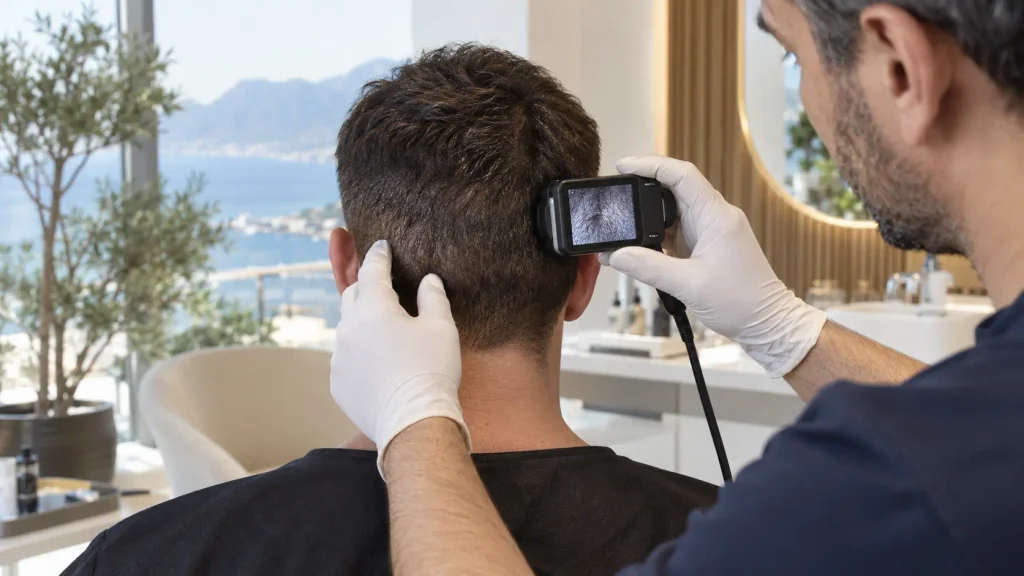
However, photographs cannot reveal everything. They do not allow the medical team to measure donor density precisely, examine the scalp closely or assess the strength and thickness of individual follicles. For that reason, an online assessment should be understood as a preliminary treatment plan not a final medical diagnosis or a guaranteed graft number.
At Hair Legends in Antalya, photographs help us determine whether a patient appears to be a suitable candidate before they book flights or make a reservation. The final plan is confirmed only after an in-person scalp and donor area examination at the clinic.
What Can Be Assessed From Hair Transplant Photos?
Good photographs can provide valuable information about several parts of a potential hair transplant.
The pattern and stage of hair loss
Front, side and top photographs help the medical team see whether the main concern is a receding hairline, thinning through the mid-scalp, crown loss or more advanced baldness. They can also show whether the loss follows a typical male-pattern or female-pattern distribution.
This matters because two patients of the same age may need completely different plans. One may require restoration of only the temples and frontal hairline, while another may need coverage extending from the front to the crown.
The approximate size of the recipient area
Photographs allow the team to estimate the surface area that needs to be covered. This makes it possible to provide a preliminary graft range. For example, a small hairline correction generally requires fewer grafts than rebuilding the front, mid-scalp and crown together.
The estimate is still approximate. Camera angle, hairstyle, lighting and wet hair can all make the thinning area appear larger or smaller than it really is.
Visible donor-area quality
Clear images of the back and both sides of the head can show whether the donor area appears dense, average or visibly weak. They may also reveal previous extraction marks, scars or signs of overharvesting from an earlier procedure.
What photographs cannot reliably show is the exact number of follicular units per square centimetre. They also cannot confirm how many hairs are contained in each graft. These details influence both safe extraction and the visual density that can be achieved.
A possible treatment technique
Based on the patient’s hair-loss pattern, hairstyle and goals, the clinic may give an initial recommendation such as Sapphire FUE, DHI or a hybrid approach. A patient who wants to keep the existing hair long may have different requirements from someone who is comfortable shaving the treatment area.
The final technique should not be chosen from marketing claims alone. It should be based on donor quality, the recipient area, the number of grafts required and the surgeon’s treatment plan.
How Accurate Is the Graft Estimate?
A photo-based graft estimate is normally best presented as a range rather than a single fixed number. Saying that a patient may need approximately 3,500–4,000 grafts is more realistic than promising exactly 3,800 grafts before the scalp has been examined.
Several factors can change the final number:
- Donor density and follicle quality
- Hair thickness and texture
- The number of hairs contained in each graft
- The size of the area requiring coverage
- Existing miniaturised hair in the recipient area
- Desired hairline position and density
- Previous hair transplant procedures or scarring
- The need to preserve grafts for future hair loss
A responsible clinic will not attempt to extract a promised number at any cost. If the donor area cannot safely provide the online estimate, protecting the donor area should take priority. The final graft number may therefore be adjusted after the physical examination.
Why Photos Can Sometimes Be Misleading
Photographs are useful, but small differences in how they are taken can change the assessment considerably.
Strong overhead lighting can make the scalp look more visible, while dark or distant photographs may hide diffuse thinning. Hair fibres, styling products and comb-over hairstyles can also conceal the actual recipient area. Similarly, a close-up donor photograph may appear dense even when the wider donor zone is limited.
This is why sending only one photograph is rarely enough. A clinic needs consistent images of the entire scalp rather than a single angle showing only the area that concerns the patient.
Which Photos Should You Send?
For a useful online hair transplant consultation, ask someone to take the photographs for you whenever possible. Use natural daylight or bright, even indoor lighting and avoid filters, portrait mode or flash reflections.
Send clear photographs of:
- The front hairline with your face visible
- The top of the scalp
- The crown from above
- The left temple and side
- The right temple and side
- The back of the head and full donor area
- A wider rear view showing the donor area from ear to ear
Keep the hair dry and free from concealers or fibres. If you have long hair, lift it so the scalp and donor region can be seen. Patients who have undergone a previous hair transplant should also include close photographs of the recipient area, donor area and any scars.
What Information Should Accompany the Photos?
Photographs alone do not provide enough information for a responsible preliminary assessment. Patients should also share:
- Their age
- How long they have experienced hair loss
- Whether the hair loss is stable or continuing
- Any previous hair transplant procedures
- Current medications and hair-loss treatments
- Relevant medical conditions and allergies
- Whether they smoke or vape
- Their preferred treatment dates
- The result they hope to achieve
Honest medical information is important. Some conditions, medications or active scalp problems may affect suitability, healing or the timing of the procedure. Additional medical approval or tests may be required in certain cases.
What Cannot Be Confirmed Online?
Even excellent photographs cannot replace a physical examination. An online consultation cannot conclusively confirm:
- Exact donor density
- Hair calibre and graft quality
- The precise number of safely extractable grafts
- Scalp elasticity and skin condition
- The degree of follicle miniaturisation
- The presence of certain scalp disorders
- The final hairline position
- The exact technique and graft distribution
It also cannot guarantee a particular density or result. Hair transplantation involves biological healing and growth, which can vary between individuals.
What Happens During the In-Person Examination?
When the patient arrives at the Antalya clinic, the team reviews the online plan and examines the scalp directly. The donor area is assessed for density, coverage and signs of previous damage. The recipient area is reviewed under proper lighting, and the patient’s long-term pattern of hair loss is considered.
The hairline is then designed according to facial proportions, age, available grafts and the possibility of future hair loss. This is an important stage: lowering the hairline too aggressively can consume grafts needed for the mid-scalp or crown and may create an unnatural appearance as hair loss progresses.
Only after this examination should the final graft plan and distribution be confirmed.
Warning Signs During an Online Consultation
Patients should be cautious if a clinic:
- Promises an exact graft number from one unclear photograph
- Guarantees a specific result before examining the scalp
- Recommends the same technique and graft number to everyone
- Ignores the donor area and discusses only the bald area
- Promises an extremely low hairline without considering future loss
- Refuses to explain who will perform each stage of the procedure
- Pressures the patient to pay immediately without answering medical questions
A useful online consultation should be personalised, transparent and realistic. It should explain both what may be possible and what must still be confirmed at the clinic.
Can an Online Consultation Confirm That You Are a Good Candidate?
It can indicate whether you appear to be a potential candidate. Patients with a clearly defined recipient area and a visibly healthy donor region may receive a preliminary positive assessment. However, suitability depends on more than the amount of visible hair loss.
Age, progression of hair loss, medical history, expectations and the long-term availability of donor grafts must all be considered. In some cases, the responsible recommendation may be to delay surgery, stabilise ongoing loss or seek evaluation for an underlying condition.
Online Hair Transplant Consultation at Hair Legends Antalya
Hair Legends offers an initial photo assessment for international patients considering a hair transplant in Antalya. After reviewing the photographs and medical information, our team can provide:
- A preliminary assessment of the hair-loss pattern
- An estimated graft range
- An initial technique recommendation
- Advice about the areas that should receive priority
- Package and accommodation information
- Suggested travel and treatment dates
This assessment helps patients understand their options before travelling. It does not replace the final face-to-face examination, and the treatment plan may be adjusted when the scalp is examined at the clinic.
Frequently Asked Questions
Is an online hair transplant consultation free?
Hair Legends provides an initial photo-based hair assessment without charge. Patients can send the required photographs and basic medical information for review.
Can I receive an exact price after sending photos?
In many cases, the clinic can provide a package quotation based on the preliminary treatment plan. The medical plan and graft number remain subject to confirmation during the in-person examination.
Can the clinic tell whether my donor area is strong from photos?
The team can make an initial visual assessment, but exact donor density and safe extraction capacity cannot be confirmed from photographs alone.
What if the final graft number is different?
The final number may change after the scalp is examined. Safe donor management and a natural long-term result should take priority over reaching an online estimate.
Can I have a consultation without shaving my hair?
Yes. Photographs can be taken without shaving, but longer hair should be lifted or separated so the thinning and donor areas are clearly visible.
Get Your Preliminary Hair Assessment
An online hair transplant consultation is a practical first step for patients travelling to Antalya. When clear photographs and accurate medical information are provided, it can produce a useful preliminary plan and graft estimate. The most trustworthy assessment, however, is one that remains realistic about the limitations of photographs and confirms the final plan in person.
Send clear photographs of your hairline, top, crown, sides and donor area to Hair Legends for a free preliminary assessment. Our team will review your case and explain the possible graft range, suitable treatment options and the next steps for planning your hair transplant in Antalya.