
One of the most important questions in hair transplantation is not simply how many grafts a patient wants, but how many grafts the donor area can safely provide.
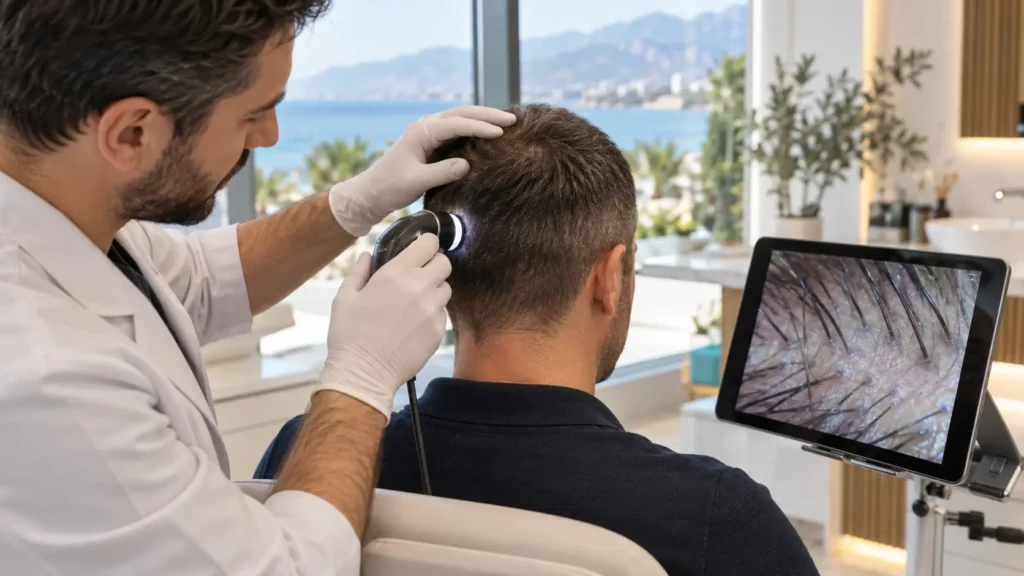
The donor area is a limited resource. Once follicular units are extracted, they do not regenerate in the extraction points. A responsible hair transplant plan must therefore balance the desired coverage with the need to preserve a natural appearance at the back and sides of the head.
Some patients may be suitable for a large session, while others may need a more conservative approach even when their bald area is extensive. The correct number cannot be decided from a standard package, a price list or a promise made before the donor area has been examined.
This guide explains what donor area capacity means, how it is assessed and why safe extraction matters for both the immediate result and the patient’s future.
What Is the Donor Area in a Hair Transplant?
The donor area is the region from which healthy follicular units are collected for transplantation. In most patients, the main donor zone is located at the back and sides of the scalp, where follicles are generally more resistant to the hormonal process associated with androgenetic hair loss.
However, not every hair at the back of the head is equally permanent. The safe donor zone varies from person to person. Extracting follicles too high, too low or too far forward may involve hairs that could thin in the future.
For this reason, the donor area should not be viewed as one large uniform field. Its borders, density and long-term stability must be assessed individually.
What Does Donor Area Capacity Mean?
Donor area capacity is the approximate number of grafts that can be removed without leaving the donor region visibly thin, patchy or depleted.
Capacity depends on more than the total number of follicles present. The medical team must consider how many grafts can be removed while leaving enough surrounding hair to maintain natural coverage.
The safe number can be influenced by:
- The size of the stable donor zone
- Follicular-unit density
- The number of hairs contained in each graft
- Hair thickness and texture
- Hair-to-skin colour contrast
- Current hairstyle and preferred future hair length
- Previous FUE or FUT procedures
- Scars, scalp conditions or signs of miniaturisation
- The likely progression of future hair loss
Two people with apparently similar donor areas may therefore have very different extraction limits.
How Is Donor Density Measured?
During an in-person consultation, the donor region is examined under appropriate lighting and, when needed, with magnification or digital scalp-analysis equipment. Different sections of the back and sides should be assessed because density is not identical throughout the scalp.
The clinician evaluates follicular units within a measured area and considers how many hairs those units contain. A donor region with many two-, three- and four-hair grafts may produce stronger visual coverage than one containing mostly single-hair grafts, even if the graft count is similar.
Hair calibre also matters. Thick hair generally creates more visual coverage than fine hair. Curly or wavy hair may cover the scalp efficiently, while straight, fine hair with a strong contrast against the skin may require more careful planning.
Density is only one part of the calculation. The extraction pattern and the percentage of follicles removed from each area are equally important.
How Many Grafts Can Be Safely Extracted?
There is no universal safe graft number. Claims that every patient can provide 5,000 or 6,000 grafts should be treated cautiously.
Some patients with a wide, dense and stable donor zone may be suitable for a larger extraction. Others may have a safe capacity of considerably fewer grafts. A patient who has already undergone one or more procedures may have an even more limited remaining supply.
The correct approach is to calculate an individual range after examining the scalp. The goal should not be to reach the highest possible number in a single day. It should be to obtain enough grafts for meaningful improvement while preserving a natural donor appearance and, where possible, maintaining options for future treatment.
An online consultation can provide an initial estimate from photographs, but the final extraction plan should be confirmed at the clinic.
Why Is the Number of Hairs per Graft Important?
A graft is a naturally occurring follicular unit and may contain one, two, three or sometimes more hairs. This means that graft count and hair count are not the same.
Single-hair grafts are particularly valuable for creating a soft and natural frontal hairline. Multi-hair grafts can provide greater visual density behind the hairline and through the mid-scalp or crown.
A treatment using 3,500 well-selected grafts with a strong average hair count may produce better coverage than a higher number made up largely of fine, single-hair units. For this reason, patients should not judge a treatment plan only by the advertised graft total.
The quality, survival, distribution, direction and design of the transplanted follicles are just as important as the number.
What Is Donor Overharvesting?
Overharvesting occurs when too many follicular units are extracted or when extraction is concentrated unevenly in a limited area. It can leave the back and sides looking thin, patchy or moth-eaten, particularly when the hair is worn short.
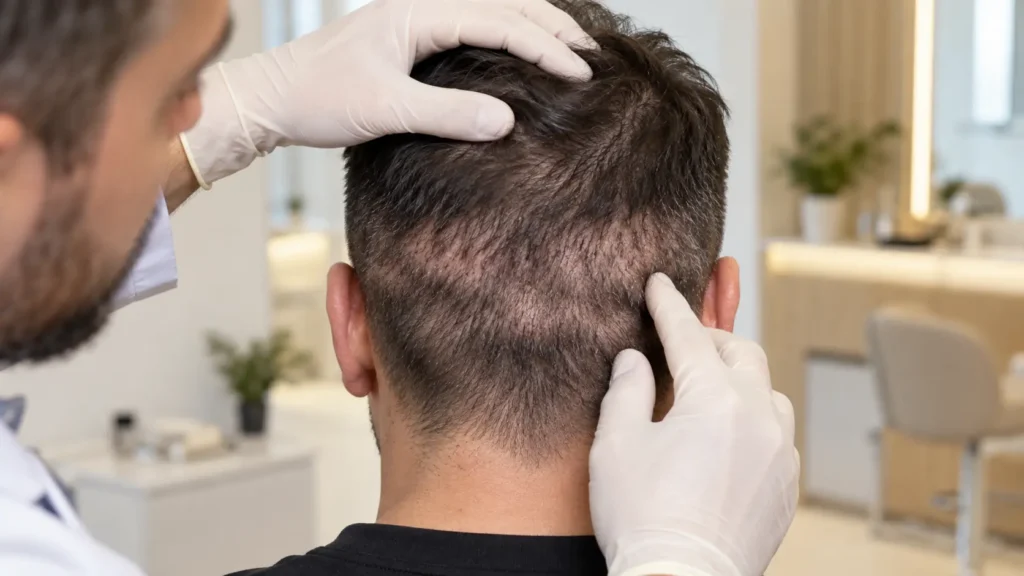
Possible signs include:
- Visible gaps or irregular thinning
- Areas where scalp visibility is significantly increased
- An unnatural difference between extracted and untouched zones
- Patchy density behind the ears or near the neckline
- Extensive dot-like scarring that becomes noticeable with short hair
Overharvesting can be difficult to correct because the remaining donor supply is already reduced. In some cases, longer hairstyles, scalp micropigmentation or a carefully planned repair procedure may improve the appearance, but prevention is far preferable.
Extraction Pattern Matters as Much as Graft Count
Safe extraction is not achieved merely by staying below a particular number. Grafts must be distributed across the suitable donor zone in a balanced pattern.
If too many grafts are taken from one small section, the area may appear depleted even when the total number is not unusually high. A carefully dispersed pattern helps the remaining hair provide even coverage.
The medical team must also consider the direction and spacing of existing follicles, previous extraction points and the natural density differences between the central, lateral and lower donor regions.
This is one reason why the experience and judgement of the team performing the extraction are essential.
Can Beard or Body Hair Increase Donor Capacity?
In selected cases, beard or body hair may be considered as an additional donor source, particularly for repair procedures or advanced hair loss. Beard follicles can sometimes provide useful density in areas behind the hairline.
These follicles are not identical to scalp hair. They may differ in texture, growth cycle, calibre and appearance. Body hair can be even less predictable. Alternative donor sources should therefore be used selectively and should not automatically be treated as a substitute for a weak scalp donor area.
The frontal hairline normally requires the most natural and refined graft selection. Scalp grafts, particularly single-hair units, are generally preferred for this region.
What If the Bald Area Needs More Grafts Than the Donor Can Provide?
When demand exceeds donor capacity, prioritisation becomes necessary. Trying to cover every area at low density may create a weak result while unnecessarily exhausting the donor supply.
A more effective plan may focus first on the frontal hairline and frontal third because these areas frame the face and usually provide the greatest visual change. The mid-scalp can then be blended according to the available grafts. Crown coverage may be treated more conservatively or planned for a later session.
The correct priority depends on the patient’s hair-loss pattern, age, goals and available donor supply. A natural, age-appropriate hairline is often more sustainable than an aggressively low design that consumes an excessive number of grafts.
One Large Session or Two Smaller Sessions?
The answer depends on donor quality, recipient-area size and the long-term treatment plan. A large session may be reasonable for a suitable patient, but dividing the treatment into stages may offer better control in advanced cases.
Staged treatment can allow the team to evaluate growth from the first procedure before deciding how the remaining grafts should be used. It may also help preserve future options. However, a second operation means another recovery period and should not be presented as necessary for every patient.
The decision should be based on medical planning rather than a fixed clinic package.
Can the Donor Area Recover After FUE?
The tiny extraction points usually heal, and surrounding hair can make the area appear full again when the extraction has been planned carefully. However, the removed follicles themselves do not grow back in their original locations.
Redness, small crusts and temporary changes in appearance can occur during early healing. Some patients may also experience temporary shedding around the donor area. Recovery time and visibility vary according to skin type, healing response, extraction technique and the number of grafts taken.
Patients should follow their clinic’s aftercare instructions and contact the medical team if they experience worsening pain, spreading redness, discharge or another unexpected symptom.
How Do Previous Hair Transplants Affect Capacity?
Previous procedures reduce the available donor supply. The team must determine how many grafts were taken, where they were extracted and whether the area shows thinning or scarring.
Patients are encouraged to share previous operation reports and graft counts when available. Clear photographs of the donor area with both short and longer hair can also be helpful.
A repair case requires particularly careful planning. The priority may be to soften an unnatural hairline, camouflage scarring or improve a visibly depleted donor region rather than simply adding the largest possible number of grafts.
Can Donor Capacity Be Judged From Photos?
Photos can show whether the donor area appears visibly strong, average, weak or previously overharvested. They are useful for deciding whether further assessment is worthwhile and for providing an initial graft range.
They cannot reliably measure exact follicular density, hair calibre, miniaturisation or the number of hairs per graft. Lighting, hair length and camera distance can also change the way density appears.
For an online assessment, patients should send clear images of the entire donor region from the back, left side and right side. The hair should be dry, without fibres or concealing products. The final safe graft number must still be confirmed in person.
Questions to Ask a Hair Transplant Clinic
Before booking, patients should ask:
- How will my donor density be assessed?
- What is my estimated safe extraction range?
- Is the proposed number based on my donor area or a standard package?
- Who will perform the extraction?
- How will the grafts be distributed across the donor zone?
- Are you preserving grafts for possible future hair loss?
- Which areas will receive priority if coverage is limited?
- How do you reduce the risk of overharvesting?
Clear answers can reveal whether the clinic is planning for the patient’s long-term appearance or focusing only on the largest possible session.
Donor Area Assessment at Hair Legends Antalya
At Hair Legends, the online photo review is used to provide a preliminary assessment for international patients considering a hair transplant in Antalya. The final plan is confirmed after the donor and recipient areas have been examined at the clinic.
The objective is not to extract the maximum number at any cost. It is to use the available donor supply strategically, achieve a natural improvement and protect the appearance of the donor region.
Depending on the patient’s case, the plan may include:
- An estimated safe graft range
- Priority planning for the hairline, front, mid-scalp or crown
- Selection of suitable grafts for different areas
- Sapphire FUE, DHI or a combined approach
- A staged plan when one session would not be appropriate
- Conservative recommendations when donor capacity is limited
Frequently Asked Questions
Do extracted donor hairs grow back?
No. Follicles removed through FUE do not regenerate at the extraction points. The area can still look naturally covered because surrounding hair remains, provided extraction is carefully distributed.
Is 5,000 grafts safe for everyone?
No. A 5,000-graft procedure may be possible for some patients but unsafe or unrealistic for others. The decision requires an individual donor assessment.
Does thick hair reduce the number of grafts needed?
Thicker hair can create stronger visual coverage, but the graft plan also depends on the size of the recipient area, hair-loss pattern, hair texture and desired result.
Can a weak donor area still be used?
Sometimes a limited procedure may be possible, but expectations and treatment priorities must be adjusted. In other cases, surgery may not be recommended.
Can overharvesting be repaired?
Some cases can be improved with carefully selected treatments, but options depend on the remaining donor supply, scarring and degree of thinning. Complete restoration is not always possible.
Protecting the Donor Area Protects the Final Result
Donor management is the foundation of a responsible hair transplant. A high graft number may sound attractive, but it has little value if the donor area becomes visibly depleted or if no follicles remain for future hair loss.
The safest plan is individual, realistic and designed around the patient’s long-term appearance. Before travelling to Antalya, patients can send clear photographs of the hairline, top, crown and donor area to Hair Legends for a preliminary assessment. The final graft range and treatment plan will be confirmed after an in-person examination.