

Afro hair transplant grafts are planned according to hair-loss level, curl pattern, donor density and the coverage required.
One of the first questions patients with Afro-textured hair ask is:
“How many grafts will I need for my hair transplant?”
The answer depends on much more than the amount of visible hair loss. Afro-textured hair can provide strong visual coverage because of its curl and natural volume, but the follicles may also follow a curved path beneath the scalp. This means the donor area, follicle shape, hair calibre, treatment zone and extraction plan all need to be considered together.
There is no single graft number that is suitable for every Afro hair transplant patient.
A patient who wants to rebuild only the hairline may need a very different plan from someone hoping to improve the hairline, mid-scalp and crown. Likewise, two patients with a similar Norwood pattern may have different donor densities and different numbers of hairs within each graft.
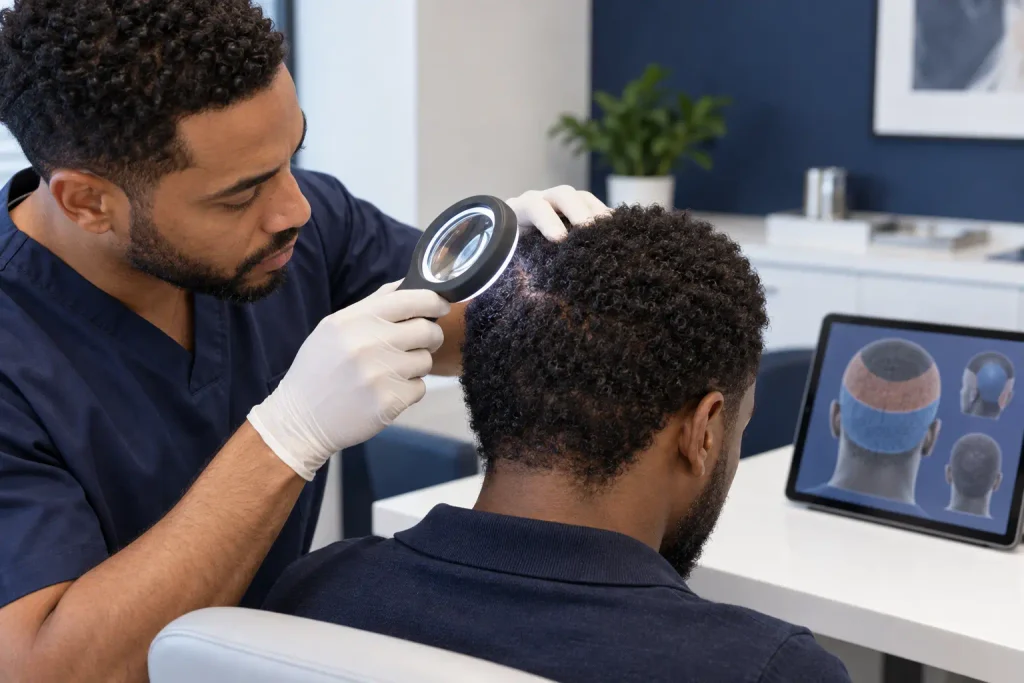
At Hair Legends Antalya, we use photographs for an initial discussion, but the final graft plan depends on a proper clinical assessment of the recipient and donor areas.
What Is a Graft?
A graft is a naturally occurring follicular unit containing one or more hairs. A graft may contain:
- One hair
- Two hairs
- Three hairs
- Occasionally more hairs
This is why graft count and hair count are not the same thing.
For example, 2,500 grafts do not necessarily mean 2,500 hairs. The final number of hairs depends on the follicular-unit composition of the donor area.
Single-hair grafts are often useful for creating a softer, more natural-looking frontal hairline. Grafts containing two or more hairs may be more suitable behind the hairline, where the main objective is visual coverage and density.
When comparing quotations, do not look only at the largest graft number. Ask whether the clinic has considered:
- The number of hairs per graft
- The density of the donor area
- The size of the area being treated
- The condition of the recipient scalp
- The long-term availability of donor hair
A smaller, carefully planned session may create a more balanced result than an aggressive extraction based only on a maximum-graft promise.
How Many Grafts Does Afro Hair Usually Need? How Many Afro Hair Transplant Grafts Do You Need?
The following figures are broad planning ranges, not fixed treatment recommendations.
| Treatment area | Possible planning range |
|---|---|
| Hairline or temples only | Approximately 800–1,600 grafts |
| Frontal third or moderate frontal loss | Approximately 1,500–3,000 grafts |
| Hairline and mid-scalp | Approximately 2,500–3,800 grafts |
| Advanced loss including the crown | Approximately 3,500–5,000+ grafts |
These ranges should not be used as a substitute for a clinical assessment.
Some patients may need fewer grafts because they have a limited treatment area, strong donor density or thick, tightly curled hair that provides good visual coverage. Others may require more grafts because the treatment area is larger, the hair is finer, the donor density is lower or the crown is also included.
A treatment plan should explain exactly what the proposed graft number is intended to cover.
Why Can Afro-Textured Hair Provide More Visual Coverage?
Afro-textured hair often has a naturally curved or coiled shaft. Once it grows, the curl can occupy more visible space than a straight hair shaft. The hair may also stand away from the scalp instead of lying flat.
This can create a fuller appearance with fewer grafts in some cases.
However, this does not mean that every patient with Afro-textured hair automatically needs fewer grafts. Hair texture is only one part of the assessment. Visual coverage is also influenced by:
- Hair-shaft thickness
- Natural hair density
- Curl pattern
- Hair-to-scalp colour contrast
- The size of the thinning area
- The presence of native hair between the transplanted grafts
- The patient’s preferred hairstyle
A patient with thick, tightly curled hair may achieve good coverage with a moderate number of grafts. A patient with finer hair, extensive thinning or a large crown area may need a more extensive plan.
The appropriate number must be based on your own hair characteristics rather than a general percentage.
Why Is Afro Hair Transplant Planning Technically Different?
The visible direction of a curly hair does not always show the complete direction of the follicle beneath the skin.
During extraction, the follicle may curve or change direction under the scalp. If the punch is inserted without considering that path, the follicular unit may be damaged. This is known as transection.
Research on Afro-textured hair has explored modified extraction tools and techniques because the natural curl of the follicle can make extraction more technically demanding. You can read a peer-reviewed example of this work in the Comparative Study of a Novel Tool for Follicular Unit Extraction in Afro-textured Hair.
For the patient, the practical questions are:
- Has the team treated Afro-textured hair before?
- How will the donor area be assessed?
- How will the extraction approach account for follicle direction?
- Who will perform the clinical stages of the procedure?
- How will the hairline and recipient sites be planned?
- How will the donor area be protected for the future?
The technique name alone does not answer these questions. FUE, Sapphire FUE and DHI describe methods or tools used in the procedure, but the quality of planning and execution remains essential.
How Does the Donor Area Affect the Number of Grafts?
The donor area is a limited resource.
For most patients, the main donor zone is located at the back and sides of the scalp. These follicles are generally more resistant to pattern hair loss, but not every follicle in that region is equally suitable for extraction.
The number of grafts that can be harvested safely depends on:
- Donor density
- The size of the stable donor zone
- Hair calibre
- Follicular-unit composition
- Miniaturisation
- Previous hair transplant procedures
- Scarring or scalp conditions
- The patient’s preferred future hairstyle
- The likely progression of future hair loss
Our guide on donor area capacity and safe graft extraction explains why there is no universal safe number for every patient.
Afro-textured hair may provide strong coverage per graft, but this does not create unlimited donor capacity. The main objective is to improve the areas that matter most while preserving a natural appearance at the back and sides of the head.
Is 5,000 Grafts Always Better?
No.
A large graft number may be appropriate for a patient with advanced hair loss and a strong donor area. But it is not automatically better for everyone.
If too many grafts are removed, the donor area may become visibly thin or patchy. This can be especially difficult to hide with shorter hairstyles.
A responsible plan considers both:
- What can improve the appearance now?
- What donor supply should be preserved for the future?
Some patients may benefit from concentrating grafts on the frontal hairline and mid-scalp rather than spreading a limited number thinly across the entire scalp. Others may need a staged plan in which different areas are treated at different times.
The best graft number is not necessarily the highest number a clinic can quote. It is the number that matches your goals while respecting your donor capacity.
How Does the Treatment Area Change the Graft Estimate?
The same patient may receive different recommendations depending on which zones are included.
Hairline only
A patient with a stable hairline recession or temple loss may need a relatively focused plan. The design should account for facial proportions, age and possible future hair loss.
Hairline and frontal third
This requires more grafts because the treatment area extends behind the hairline. The transition between single-hair grafts at the front and fuller grafts behind them needs to look natural.
Mid-scalp
The mid-scalp can require additional grafts, particularly when the area has become visibly thin and the patient wants improved coverage under normal lighting.
Crown
The crown can be graft-intensive because hair grows in changing directions around the whorl. The size of the crown, the remaining native hair and the patient’s priorities all affect the estimate.
If the donor area is limited, the hairline and frontal region may be prioritised first. Your clinician should explain why one zone is being treated before another.
Can Afro Hair Grafts Be Estimated From Photos?
Photos can support an initial estimate, but they cannot accurately measure every factor.
Clear photographs may help the team understand:
- Your visible hairline
- The extent of thinning
- Whether the crown is involved
- The condition of the donor area
- Your current hairstyle
- Whether a previous procedure has affected the donor zone
However, photographs cannot reliably measure donor density, follicular-unit composition or the precise curve of each follicle beneath the skin.
This means an online estimate should be treated as a preliminary range, not a final promise.
When you send photographs, include:
- A front view
- Both temple areas
- The top of the scalp
- The crown
- The back of the donor area
- Both sides
- A photo with the hair separated if possible
Also tell the team whether you have had any previous hair transplant, scalp surgery, keloid scarring or diagnosed hair-loss condition.
What About Women With Afro-Textured Hair?
Women with Afro-textured hair may experience different causes and patterns of hair loss, including traction alopecia, diffuse thinning and scarring alopecia.
The Norwood scale is not suitable for every woman. A widening part or diffuse thinning pattern needs an area-based assessment rather than an automatic graft number taken from a male-pattern chart.
Before surgery is considered, the cause of hair loss should be assessed carefully. If there are symptoms such as pain, itching, inflammation, scalp scaling or ongoing progression, a dermatology review may be appropriate before planning a transplant.
A graft estimate should follow the diagnosis, not replace it.
What Should You Ask a Clinic Before Accepting a Graft Quote?
Before paying a deposit, ask:
- How many grafts are being proposed?
- Which areas will those grafts cover?
- Is the quote based on photographs or an in-person assessment?
- How was the donor area evaluated?
- How many hairs are expected per graft?
- What happens if the donor area provides fewer grafts than expected?
- Who will design the hairline?
- Who will perform each stage of the procedure?
- Is one session realistic, or might staged treatment be safer?
- What areas should be prioritised if the donor supply is limited?
- Is the quotation in GBP and what does it include?
A professional clinic should be able to explain the reasoning behind the plan rather than simply offering the largest number available.
Afro Hair Transplant Assessment in Antalya
Hair Legends Antalya provides personalised assessments for patients considering hair transplantation with Afro-textured hair.
The initial review can help discuss:
- The areas you want to improve
- Your approximate graft range
- The quality and apparent limits of the donor area
- Whether the hairline, mid-scalp or crown should be prioritised
- Possible FUE, Sapphire FUE or DHI options
- What needs to be confirmed during an in-person assessment
- A personalised quotation in GBP
You can also visit our main guide to Afro hair transplant in Antalya for broader information about treatment planning.
The final graft number should be confirmed by the responsible clinical team after assessing your scalp. Individual suitability, treatment stages, growth and recovery vary from patient to patient.
Request a Personalised Afro Hair Transplant Graft Assessment
If you are considering an Afro hair transplant in Antalya, send clear photographs and tell us which areas you want to improve.
A useful first message could be:
Hello Hair Legends, I am considering an Afro hair transplant in Antalya. I would like to understand how many grafts I may need, which areas should be prioritised and whether my donor area appears suitable. Please provide a personalised assessment and quotation in GBP.
Request a personalised Afro hair transplant assessment on WhatsApp
The right question is not simply, “What is the maximum number of grafts?”
It is:
“How many grafts can improve my priority areas while protecting my donor area and respecting the natural characteristics of my hair?”
That is the basis of a more individual and responsible Afro hair transplant plan.