
Choosing a hair transplant clinic should involve more than comparing prices, package details or before-and-after photographs. The quality of your consultation can tell you a great deal about how carefully your procedure will be planned and managed.

A responsible consultation should assess your type of hair loss, donor area, medical history, expectations and possible future hair loss. It should also explain who will perform each stage of the procedure, what the proposed graft number means and what support will be available after you return home.
Use this hair transplant consultation checklist before booking your procedure in Antalya or anywhere else.
1. Is a Hair Transplant Suitable for My Type of Hair Loss?
Not every form of hair loss should immediately be treated with surgery.
The clinic should consider:
- The pattern and progression of your hair loss
- Your age and family history
- The stability of the donor area
- Whether there is active or diffuse thinning
- Previous hair transplant procedures
- Current medication and medical conditions
- Your expectations for the final result
An online assessment can provide an initial opinion, but the treatment plan may need to be confirmed after an in-person examination.
2. Who Will Assess My Case?
Ask who reviews your photographs, medical history and treatment goals before the procedure.
You should understand whether your initial assessment is completed by a patient coordinator, clinical team or doctor and when the doctor becomes involved in confirming the surgical plan.
At Hair Legends Antalya, the preliminary online assessment helps us understand your hair loss pattern and expectations. The final hairline, graft distribution and treatment plan are confirmed following the clinical examination.
3. How Should I Take Photographs for an Online Assessment?
Clear photographs make the preliminary assessment more useful.
A clinic will generally need photographs showing:
- The front hairline
- Both temples
- The top of the scalp
- The crown
- The back of the donor area
- Both sides of the donor area
Photographs should be taken in good natural light, without hair fibres, concealers or styling products. Wet and dry photographs may sometimes be requested when diffuse thinning is suspected.
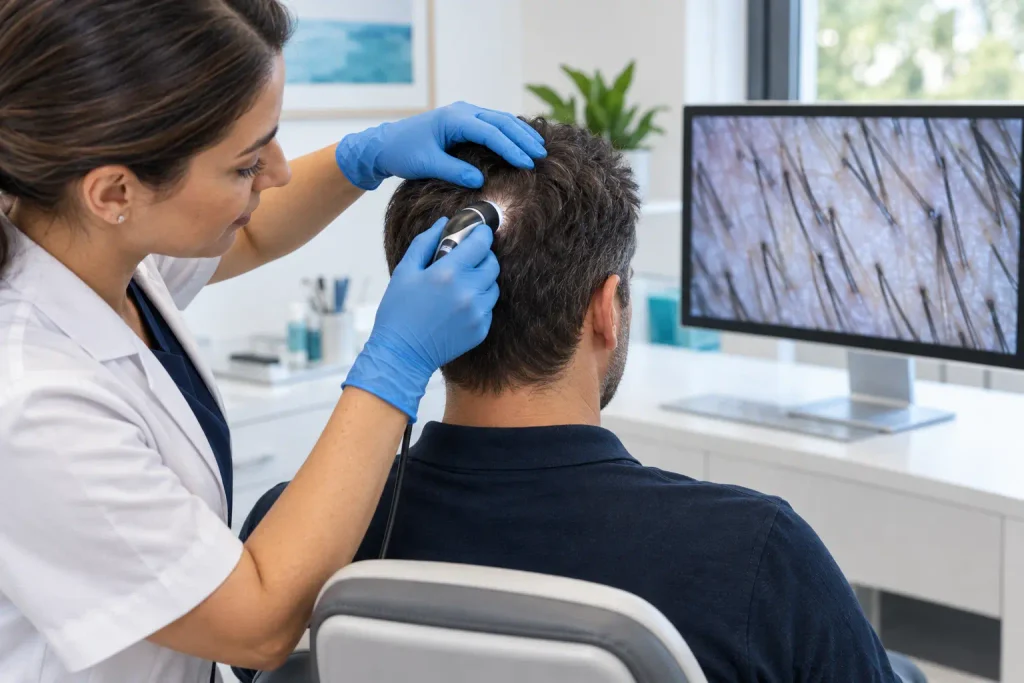
Photos can support planning, but they cannot fully replace an in-person examination of hair density, scalp condition and follicle quality.
4. How Many Grafts Do I Need and Why?
A graft estimate should be based on your individual case rather than a standard package number.
The clinic should explain:
- Which areas will be treated
- How the grafts will be distributed
- Whether the hairline, mid-scalp and crown can be treated together
- Whether one or more sessions may be necessary
- How your donor capacity limits the plan
The largest possible graft number is not automatically the best plan. The objective is to achieve suitable coverage while protecting the donor area for the future.
5. How Is My Donor Area Evaluated?
The donor area is a limited resource. Its density, hair calibre, distribution and previous extraction history should be considered before surgery.
Ask whether the assessment considers:
- Donor density
- Hair thickness and texture
- Safe extraction zones
- Signs of miniaturisation
- Previous FUE or FUT procedures
- The possibility of future hair loss
- The visual effect of extraction after healing
A responsible plan should aim for balanced extraction rather than removing excessive numbers of grafts from concentrated areas.
6. Who Performs Each Stage of the Procedure?
This is one of the most important questions in any hair transplant consultation.
Ask who will be responsible for:
- Medical examination
- Hairline planning
- Local anaesthesia
- Graft extraction
- Opening the recipient channels
- Graft implantation
- Post-operative examination
Do not rely only on general terms such as “doctor-led” or “medical team.” Ask for a clear explanation of the doctor’s and clinical team’s roles during your specific package.
7. Why Is This Technique Recommended for Me?
FUE, Sapphire FUE and DHI are not interchangeable marketing labels. Each method may be more appropriate for particular areas, graft numbers and patient priorities.
Your clinic should explain why it recommends a technique based on:
- The size of the treatment area
- Required graft distribution
- Existing hair in the recipient area
- Hairline design
- Whether shaving is acceptable
- Donor characteristics
- The possibility of combining techniques
At Hair Legends Antalya, Sapphire FUE, DHI or a combined approach may be considered after reviewing the patient’s donor area, existing hair and treatment objectives.
8. Is the Proposed Hairline Appropriate for My Face and Future Hair Loss?
A hairline should not be planned only for how it will look immediately after surgery.
Its height, shape and density should take into account:
- Facial proportions
- Age
- Existing hair
- Donor capacity
- Family hair-loss history
- Possible future thinning
- The number of grafts available
An excessively low or dense hairline may consume grafts needed for other areas. The final design should be agreed upon during the in-person consultation before the procedure begins.
9. Can the Hairline and Crown Be Treated in One Session?
This depends on the extent of hair loss and the available donor capacity.
For some patients, treating the front, mid-scalp and crown in one session may spread the available grafts too thinly. Prioritising the frontal area can sometimes provide a stronger visual improvement while preserving options for a second session.
Ask the clinic:
- Which area should be prioritised?
- What density is realistically achievable?
- Would dividing the treatment into two sessions be safer?
- How long should you wait before considering another procedure?
The answer should be based on your individual examination not a fixed graft promise.
10. Are My Expectations Realistic?
A hair transplant redistributes existing follicles; it does not create an unlimited new supply of hair.
Results can be influenced by:
- Donor quality
- Hair thickness and curl
- Contrast between hair and skin
- Size of the recipient area
- Ongoing hair loss
- Healing characteristics
- Post-operative care
The clinic should explain both the potential improvement and the limitations of your case. No responsible provider should guarantee a specific density or identical result for every patient.
11. Can I See Comparable Before-and-After Results?
Ask to see cases that are genuinely similar to yours.
Useful comparisons include patients with:
- A similar hair-loss pattern
- Comparable donor quality
- Similar hair texture
- A similar treatment area
- Approximately the same number of grafts
- Results photographed after a suitable growth period
Consistent lighting, angles, hair length and styling make before-and-after photographs easier to evaluate. Remember that individual results vary.
12. What Is Included in the Quoted Price?
Before paying a deposit, request written confirmation of the package.
Check whether the price includes:
- Consultation and medical planning
- Hair transplant procedure
- Blood tests
- Medication
- Initial wash
- Aftercare products
- Hotel accommodation
- Airport and clinic transfers
- Interpreter or patient coordinator
- Post-operative follow-up
- Taxes or card-payment fees
Also ask what is not included. A clear quotation helps prevent misunderstandings after arrival.
13. What Medical Information Must I Provide?
Your clinic should request an accurate medical history before confirming surgery.
You may be asked about:
- Regular medication
- Allergies
- Previous operations
- Blood-pressure conditions
- Diabetes
- Heart or circulation problems
- Bleeding or clotting disorders
- Infectious diseases
- Smoking and alcohol use
- Hair-loss medication or supplements
Never stop prescribed medication without speaking to the relevant doctor. Concealing medical information can create avoidable risks and may affect whether the procedure is appropriate.
14. What Are the Risks and Limitations?
Hair transplantation is a surgical procedure and should not be presented as risk-free.
Your consultation should discuss possible issues such as:
- Bleeding
- Infection
- Swelling
- Temporary numbness
- Folliculitis
- Temporary shedding
- Scarring
- Uneven growth
- Poor graft survival
- Overharvesting
- The possible need for corrective treatment
The purpose is not to create unnecessary concern. It is to ensure that your consent is based on realistic and complete information.
15. What Aftercare Will I Receive After Returning Home?
International patients should know how follow-up will work once they leave Antalya.
Ask:
- Who will answer aftercare questions?
- How often should photographs be sent?
- When should washing begin?
- When are the crusts expected to be removed?
- When can you return to work, exercise and normal activities?
- What symptoms require urgent medical attention?
- What happens if healing does not progress as expected?
- How long will the clinic continue monitoring the result?
Hair growth develops gradually, so follow-up should continue beyond the first few days after surgery.
Warning Signs to Consider Before Booking
Take additional care if a clinic:
- Promises a guaranteed density or identical result
- Gives a very high graft number without assessing the donor area
- Avoids explaining who performs each surgical stage
- Pressures you to pay immediately
- Provides unclear or changing package details
- Dismisses your medical history
- Refuses to discuss complications or limitations
- Uses only heavily edited before-and-after photographs
- Has no clear system for post-operative support
Price matters, but it should not replace medical planning, transparency and appropriate follow-up.
Your Final Hair Transplant Consultation Checklist
Before booking, make sure you understand:
- Why you are considered suitable for surgery
- How many grafts are proposed and why
- How your donor area will be protected
- Which areas will be treated
- Which technique is recommended
- Who performs each stage
- What result is realistically achievable
- What the package includes
- What risks and limitations apply
- How aftercare will be provided
Request Your Personalised Hair Assessment
If you are considering a hair transplant in Antalya, you can send Hair Legends Antalya clear photographs of your hairline, temples, top, crown and donor area.
Our team will review your photographs, hair-loss history and treatment goals before preparing a preliminary assessment. Your final suitability, hairline and graft plan will be confirmed after an in-person clinical examination.
Send Your Photos for a Free Hair Assessment
Medical disclaimer: This article provides general information and does not replace an individual medical examination or professional medical advice. Suitability, graft estimates, technique and expected results vary between patients.