
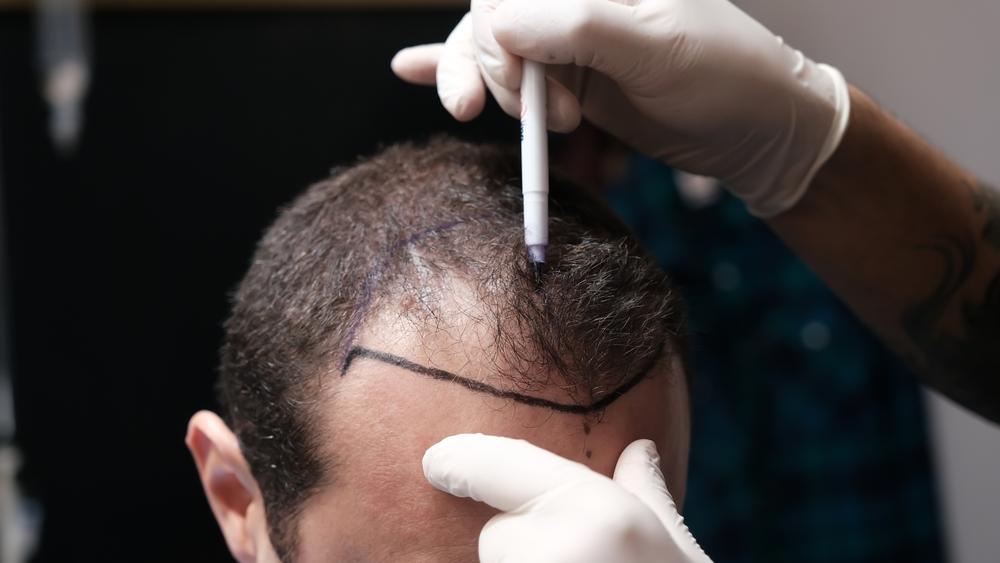
The Art of the Hairline; For decades, the hair transplant industry has been plagued by a fundamental misunderstanding: that hair restoration is merely a surgical task of moving follicles from Point A to Point B. This reductionist approach has fueled the proliferation of high-volume “hair mills,” where efficiency is prioritized over artistry, and where success is measured in graft count rather than aesthetic harmony. The result is a global epidemic of “cookie cutter” hairlines unnaturally straight, aggressively low, and mathematically jarring barriers of hair that shout “transplant” from across a room.
At Hair Legends Antalya, we reject this industrialized model entirely. We operate on a foundational philosophy that a hair transplant is an irrevocable artistic intervention. It is the restoration not just of hair, but of the architectural frame of the human face. A legendary result is one that is invisible; it is a design so harmonious with the patient’s unique skeletal structure, age, and ethnicity that it appears to have always been there.
This masterclass is a deep dive into the complex world of bespoke hairline design. It is an exploration of how we use craniofacial anatomy, mathematical ratios, and artistic intuition to create results that defy detection and define “European Aesthetic” excellence.
I. The Philosophy of the Frame: Why “One-Size-Fits-All” Fails
The human face is a complex landscape of curves, angles, and planes. When hair loss recedes this landscape, it doesn’t just remove hair; it dismantles the primary structure that defines the upper third of the face. The purpose of a hairline is not simply to “cover baldness.” Its true function is to provide balance, proportion, and a youthful frame to the eyes and forehead.
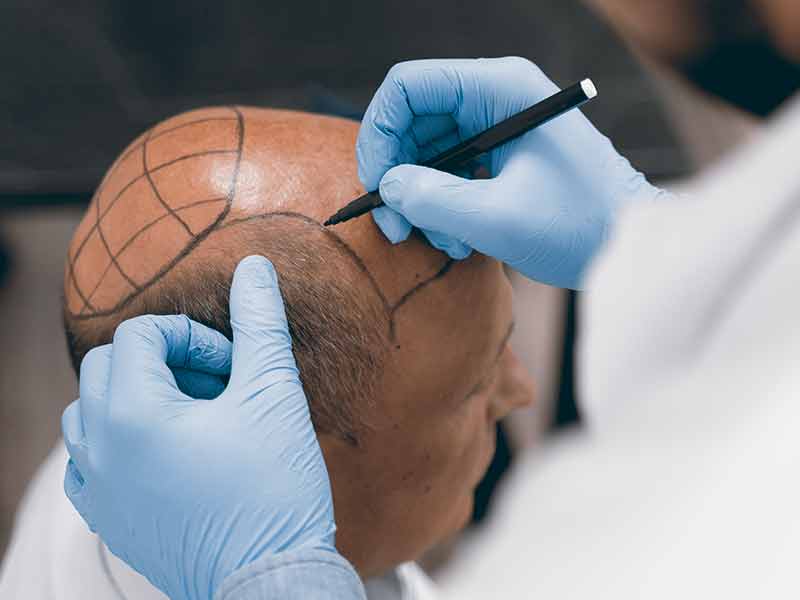
The Failure of the Template
“Hair mills” rely on templates predefined shapes that are quickly sketched onto a patient’s scalp. These patterns (often a simple low semi-circle or a severe, straight horizontal line) ignore the fundamental diversity of human anatomy. A template hairline fails for three reasons:
- It Ignores Bone Structure: A straight hairline placed on a curved forehead creates a jarring, artificial shelf.
- It Defies Aging: A 20-year-old’s hairline placed on a 45-year-old man looks ridiculous and unnatural. As we age, our bone structure changes, and our natural hairline should reflect a soft, graceful recession (Norwood 2). A template locks a patient into an immobile, adolescent look that does not age well.
- It Lacks Negative Space: Natural hairlines are defined by micro and macro irregularities. They have tiny gaps, slight protrusions, and varied densities. A template hairline is often too dense and too uniform (the dreaded “wall of hair”), creating an unnatural barrier.
The Vision of the Artist
Bespoke design, the core of the Hair Legends philosophy, requires the surgeon to be both an anatomist and an artist. The surgeon must visualize the final result in three dimensions, predicting how the hair will fall, how it will look under different lighting, and how it will frame the face when the patient smiles or frowns. This is the difference between an industrialized service and a tailored masterpiece.
II. The Anatomy of Facial Harmony: The Golden Ratio and Face Shapes
The foundation of a natural hairline is craniometrics—the measurement of the skull. A successful surgeon doesn’t guess where a hairline should go; they use anatomical landmarks and mathematical principles to guide their design.
Leonardo da Vinci’s “Divine Proportion” (The Golden Ratio)
Since antiquity, artists and architects have used the Golden Ratio (phi, or 1.618) to define perfect proportion. In facial aesthetics, this translates to the Rule of Thirds. The face is ideally balanced when it can be divided into three equal vertical segments:
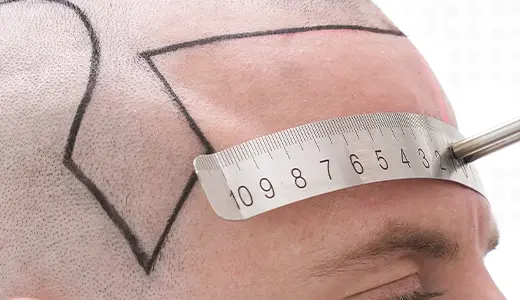
- The Lower Third: From the bottom of the chin (menton) to the base of the nose (subnasale).
- The Middle Third: From the base of the nose to the point between the eyebrows (glabella).
- The Upper Third: From the glabella to the natural hairline (trichion).
This mathematical rule provides the primary starting point for our bespoke design. We don’t “lower” a hairline arbitrarily. We restore it to its ideal anatomical position based on the proportions of the middle and lower thirds. However, this is only the blueprint; the final design must be adapted to the patient’s unique face shape.
Designing for Diversity: Face Shapes
A “one-size-fits-all” design fails because it ignores that hairlines must complement, not clash with, the existing face shape:
- The Oval Face: Often considered the aesthetic ideal, oval faces can handle a variety of hairline shapes. The goal is to maintain the smooth, balanced curves. An aggressively straight hairline would make an oval face appear overly long and severe.
- The Round Face: The design goal is to create angles and definition to counter the lack of underlying bone structure. A slightly more angular, masculine hairline with clearly defined (but natural) temporal peaks helps to “sharpen” the facial features. A rounded hairline would only emphasize the roundness of the face.
- The Square Face: Characterized by a strong, angular jawline. A square hairline on a square face creates a boxy, overly aggressive “Frankenstein” appearance. The objective is to design a softly curved hairline that balances the strong jaw, adding a touch of softness and refinement while maintaining masculinity.
- The Heart-Shaped Face: Features a wide forehead and a narrow chin. A bespoke hairline must restore balance by avoiding an excessively wide or low design, which would make the forehead appear even broader. The temporal areas must be carefully filled but not over-extrapolated.
- The Oblong/Long Face: A high, vertical forehead. The instinct might be to lower the hairline significantly, but this often requires too many grafts and can look unnatural. A better bespoke strategy is to focus on rebuilding the temporal peaks to create horizontal width, visually “shortening” the face without making the hairline artificially low.
III. The Frontal Hairline: Micro and Macro Irregularities
Once the ideal height is determined, the real artistry begins with the creation of the frontal hairline zone itself. This is the transition area from the smooth skin of the forehead to the dense hair of the scalp. It is arguably the most scrutinised 2 square centimeters on the human body.
A common mistake in non expert clinics is making this line too solid and too defined. A natural hairline is NOT a line; it is a gradient.
The Concept of the Transition Zone
A natural hairline is composed of several zones with varying characteristics:
- The Sentinel Zone: This is the absolute foremost boundary. It consists of very fine, single follicles (“sentinel hairs”) that are sparsely placed. Their purpose is to “soften” the approach of the main hairline.
- The Micro-Irregular Zone: Moving 2-3mm back, we begin creating tiny, chaotic clusters of single and some fine 2-hair follicles. This zone creates the subtle “zigzag” that is the key to invisibility.
- The Macro-Irregular Zone: The next 5-10mm features larger, natural protrusions and recesses, mirroring the innate asymmetry of the patient’s original hair.
- The Standard Density Zone: Only well behind the frontal 1-2cm does the maximum density of 2, 3, and 4-hair follicular units begin.
The Key to Invisibility: Asymmetry and Chaos
If you look closely at any non-receded, natural hairline, you will not see a perfectly straight line. You will see chaos. The key to our bespoke design is recreating this natural irregularity.
Our surgeons manually design every sentinel hair to ensure:
- Natural Follicle Selection: Using ONLY single-hair follicles (often extracted specifically from the nape of the neck for their finer texture) for the foremost 1-2cm.
- Variable Spacing: follicular units are never placed in a grid-like pattern. We vary the distance between grafts to create the “organized chaos” found in nature.
- Strategic Gaps: Tiny recesses are intentionally designed into the hairline to create depth and eliminate the “solid wall” appearance.
- Chaotic Implantation Angles: Natural hair doesn’t emerge from the scalp like a field of corn. Hair angle and direction must vary subtlely in the sentinel zone to create a soft, feather-like effect.
IV. The Temporal Peaks: The Frame Within the Frame
While the frontal hairline is the primary focal point, the vital secret to a truly natural result lies in the restoration of the temporal peaks (the “corners” of the hairline). This is where the hairline meets the temples and curves downward towards the ears.
In high-volume clinics, this area is often completely ignored, resulting in the dreaded Norwood 3V pattern: a full frontal hairline that stops abruptly, leaving a large, receded temple gap. This looks artificial and creates a jarring disconnect.
The Strategic Role of the Temples
The temporal peaks are essential for:
- Providing Horizonal Balance: For patients with long or oblong faces, rebuilding the temporal peaks is the key to creating horizontal balance. It visually “shortens” the face by adding width at the temple level, which is a far more natural approach than aggressively lowering the frontal hairline.
- Aesthetic Continuity: A natural hair restoration must have a continuous flow. The temporal peaks “connect” the frontal design to the side of the face, ensuring the hairline “wraps around” the head in a unified curve.
- Masculine Frame: A well-designed temporal peak creates a strong, defined, yet natural frame for the eyes, which is a hallmark of youthful masculinity.
The Challenge of Designing Temporal Hairs
Designing and implanting temporal hair is exceptionally difficult because:
- The Angle is Acute: Hair in this area grows at an almost vertical angle, virtually flush with the scalp. Implantation angles must be incredibly low (10-15 degrees), requiring advanced technical skill (like DHI).
- Direction is Complex: Hair direction here often curves backwards and downwards towards the ear. Recreating this swirl (whorl) is essential for invisibility.
- Fine Hair is Required: Using thick donor hair in the temples looks dense, unnatural, and “pluggy.” Fine single-hair follicles must be selectively used and implanted with precision.
At Hair Legends Antalya, temporal peak restoration is a standard component of our bespoke design, not an optional extra. Our surgeons use DHI (Direct Hair Implantation) to achieve the ultra-low angles and perfect directionality required to integrate these delicate “corners” seamlessly with the main frontal hairline.
The Art of the Hairline — The Crown, Donor Ethics, and the Masterclass Verdict
In Part 1, we deconstructed the architectural framing of the frontal hairline and the critical role of the temporal peaks. However, a truly legendary restoration does not stop at the forehead. To achieve a result that is indistinguishable from nature, the surgeon must master the most complex geometric challenge of the human scalp: The Crown (Vertex). Furthermore, they must do so while acting as a steward of the patient’s limited “Genetic Capital” the donor area.
V. The Crown and the Whorl: The Geometry of Nature
The crown is often the most neglected area in high-volume clinics because it is technically demanding and requires a high number of grafts to achieve perceived density. In nature, the crown is defined by the “Whorl” (Vertex Rose) a spiral pattern where hair radiates outward in a 360-degree circle.
The Challenge of the Spiral
Recreating a whorl is a mathematical and artistic puzzle. If the hairs are implanted in a uniform direction (as seen in template-based clinics), the result looks like a “patch” of artificial grass. It lacks the natural “flow” and movement of real hair.
- Variable Angles: The angle of the hair changes constantly as you move around the spiral. At the center of the whorl, hair stands almost vertically, but as it radiates outward, the angle becomes more acute (flatter to the scalp).
- The Center Point: A natural whorl usually has a single, slightly off-center point of origin. Finding this original “epicenter” (even in a bald crown) is vital for a bespoke restoration.
- Density Illusion: Because hair in the crown fans out in all directions, it is naturally less dense than the frontal area. A bespoke design uses a “shingling” technique layering the hairs so they overlap like roof tiles—to create the illusion of maximum coverage with a strategic number of grafts.
At Hair Legends Antalya, we treat the crown as a separate artistic project. We meticulously map the patient’s original spiral pattern, ensuring that every graft follows the exact 360-degree rotation required for a natural, seamless look that blends perfectly with the surrounding hair.
VI. Donor Management: Protecting Your “Genetic Capital”
One of the most dangerous hallmarks of a “hair mill” is the “Maximum Grafts” trap. These clinics market high graft counts (e.g., “5,000 grafts for one low price”) to lure patients. From a medical and ethical standpoint, this is often a disaster.
The “Over-Harvesting” Epidemic
The donor area (the back and sides of the head) contains a finite number of follicles that are genetically resistant to DHT (the hormone that causes balding). This is your Genetic Capital.
- The Hair Mill Approach: They extract as many grafts as possible in a single session to show a “full” result quickly. This often leaves the donor area looking “moth-eaten” or “see-through.” Even worse, if the patient continues to lose hair in the future, there is no donor hair left for a second “touch-up” procedure.
- The Hair Legends Approach: We practice Strategic Stewardship. We calculate exactly how many grafts are needed to achieve an elite aesthetic result while leaving enough “reserve capital” in the donor area for the future.
The Science of Extraction Patterns
Bespoke donor management requires a “diffuse extraction” pattern. Instead of taking hair from a concentrated patch, our surgeons skip follicles in a calculated matrix. This ensures that the overall density of the donor area remains uniform. When the hair grows back to a few millimeters in length, the extraction sites are completely invisible. This is the difference between a “harvest” and a “theft.”
VII. The European Aesthetic: Why Natural Beats “Perfect”
There is a specific look often associated with premium European clinics: The Art of the Imperfect. In a “hair mill” design, the goal is often a “perfect” wall of hair straight, thick, and low. In a Hair Legends design, the goal is natural harmony.
- The Age-Appropriate Hairline: A 45 years old man should not have the hairline of a 15 years old. We design hairlines with a very slight, graceful recession at the temples (Norwood 2). This looks distinguished, mature, and most importantly believable.
- The Transition Zone: As discussed in Part 1, we use single-hair follicles to create a soft, “feathered” edge. A natural hairline is a blur, not a sharp line.
- Color and Texture Matching: We don’t just move hair; we move the right hair. Finer hairs from the lower nape are used for the hairline, while thicker, multi-hair grafts are used for the “core” density behind the front.
VIII. The Final Verdict: Why Bespoke is the Only Choice
Choosing a hair transplant clinic is a choice between a Service and a Legacy.
| Feature | The Industrial Template (Hair Mills) | The Hair Legends Bespoke Masterclass |
| Design | Pre-drawn shapes (one-size-fits-all) | Anatomical blueprints based on the Golden Ratio |
| Execution | High-volume, technician-led | Surgeon-led with elite artistic oversight |
| Hairline | Straight, low, and “wall-like” | Irregular, feathered, and age appropriate |
| Donor Area | Aggressive “over harvesting” | Strategic stewardship and preservation |
| The Result | Looks “better” but often “fake” | Looks natural, invisible, and “Legendary” |
Conclusion: The Masterclass of You
At Hair Legends Antalya, we believe that the best hair transplant is the one no one ever realizes you had. It is a transformation that restores your confidence without compromising your identity. By rejecting templates and embracing the complex, beautiful chaos of human anatomy, we create results that aren’t just medical procedures they are masterpieces.
A legendary hairline is not bought by the graft; it is designed by the artist. Your face is the canvas, and your future confidence is the masterpiece we are committed to protecting.