
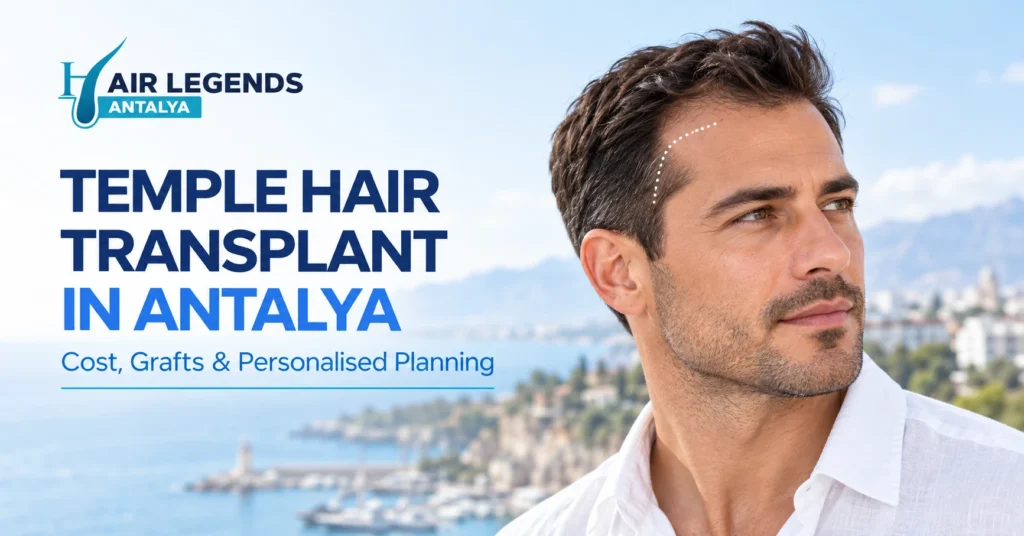
The Importance of Temple Peaks in Facial Harmony
A temple hair transplant in Antalya may be an option if you are concerned about receding corners of your hairline or thinning temple points. Planning starts with identifying which area needs attention, assessing your remaining donor hair and considering how your hair loss may change over time.
Some patients want to restore only the temples. Others need a combined plan for the temples and frontal hairline. The appropriate approach depends on your existing hair, facial proportions and clinical assessment.
Hair Legends helps international patients arrange a personalised assessment and understand their proposed treatment and costs before travelling to Antalya.
Request a Temple Hair Transplant Assessment
Receding Temples or Temple Points: Which Area Do You Mean?
Patients often use “temples” to describe two different areas:
- Receding hairline corners: The upper corners of the forehead, where recession can create an M-shaped hairline.
- Temple points: The triangular areas of hair along the sides of the forehead, above the sideburns.
These areas require different designs. Restoring the hairline corners does not automatically mean rebuilding the temple points. During your assessment, explain which area concerns you and provide photographs from the front and both sides.
Can You Have a Hair Transplant Just for Your Temples?
In selected patients, treatment can focus on the temples without transplanting the entire frontal hairline. However, a small area of concern still requires a complete assessment.
The clinician should consider the cause and progression of your hair loss, your existing hairline and whether your donor area can support the proposed design. If neighbouring hair continues to thin, an isolated transplant may look less balanced over time.
The aim is a design that suits your face now and remains appropriate as you age. Surgery may not be the best first step for everyone.
How Many Grafts Does a Temple Hair Transplant Need?
There is no single graft number that applies to every temple transplant. A small adjustment to the temple points is different from rebuilding both receding corners and part of the frontal hairline.
Your proposed graft count should account for:
- The size of the areas being restored.
- Existing hair within and around those areas.
- Hair thickness, texture and growth direction.
- The intended outline and coverage.
- Available donor hair and possible future treatment needs.
Ask whether your estimate covers both sides combined and whether frontal hairline work is included. A graft count without a clearly defined treatment area makes it difficult to compare quotations.
The plan should also explain graft selection and placement. Fine, single-hair grafts at the visible edge and appropriate growth angles are important considerations for temple-point reconstruction.
Challenges in Temple Peak Hair Transplantation
Temple peak restoration is often considered more challenging than frontal hairline or crown transplants. The reason lies in the angle, density, and direction of the hair in this region. Unlike the central hairline, temple peaks require hairs to be placed at an extremely acute angle (often as low as 10–15 degrees).
If this angulation is not replicated, the results can appear unnatural, with hair sticking out rather than lying flat. Furthermore, temple hair is usually finer than other regions, demanding careful graft selection.
Clinics in Antalya have developed advanced techniques, especially with Sapphire FUE and DHI hair transplant Antalya methods, to replicate the delicate architecture of the temple peaks. The availability of experienced surgeons and high-end tools reduces the margin of error, ensuring natural and seamless integration.
Planning the Temple Peak: Consultation and Analysis
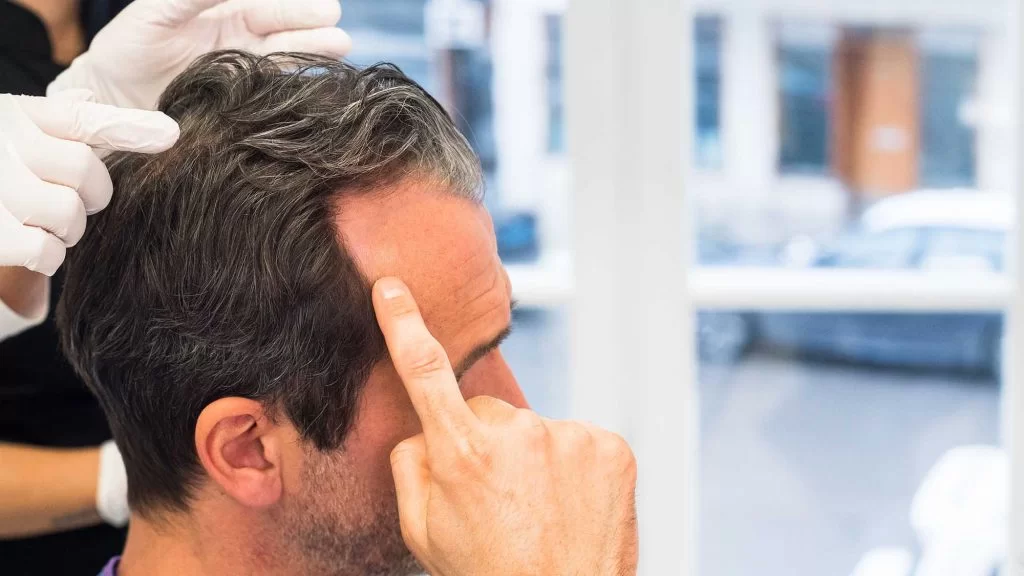
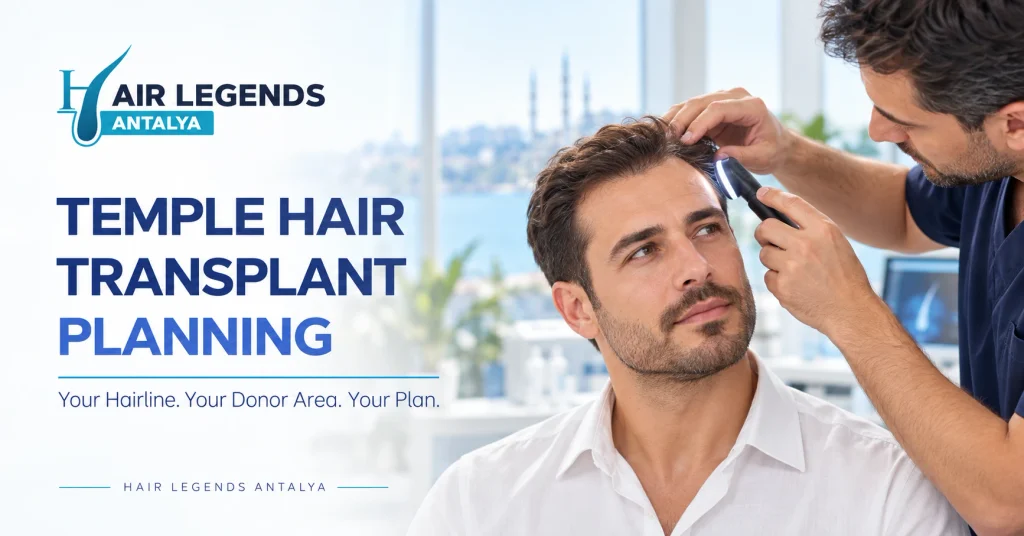
Every temple peak transplant begins with a thorough consultation and facial analysis. Surgeons in How Much Does a Temple Hair Transplant in Antalya Cost?
The cost depends on whether you need temple-point refinement, restoration of receding hairline corners or a combined procedure. The technique, clinical team’s involvement and package inclusions also affect the quotation.
For UK patients, request a written quotation in GBP with a clear breakdown of:
- The areas included in the treatment plan.
- The estimated graft count.
- Who will perform each stage of the procedure.
- Medication, washing products and follow-up arrangements.
- Whether accommodation and airport transfers are included.
- Any additional charges or payment conditions.
A smaller treatment area does not necessarily mean a proportionally lower price. Clinical assessment, surgical preparation and follow-up are still required.
You can also read our guide to hair transplant costs in Antalya before requesting your individual quotation.
Ask Hair Legends for a Personalised Quote
Hair Direction and Temple Peak Angulation
Temple hair grows extremely flat against the skin. This makes the angulation process the single most important technical step. If grafts are placed too upright, the outcome will never blend naturally with the existing side hairs.
Surgeons in Antalya use ultra-fine sapphire blades or implanter pens that allow for micro-incisions at the correct direction. Each follicle is oriented not just in the right angle but also the right flow – temple hair tends to sweep backward toward the ears.
Correct angulation is also vital for female temple peaks, where hair needs to blend with finer frontotemporal strands. Patients who travel to Antalya often choose clinics that have mastered this level of detail, ensuring that results are indistinguishable from natural growth.
Before and After Hair Transplant: Temple Restoration Results
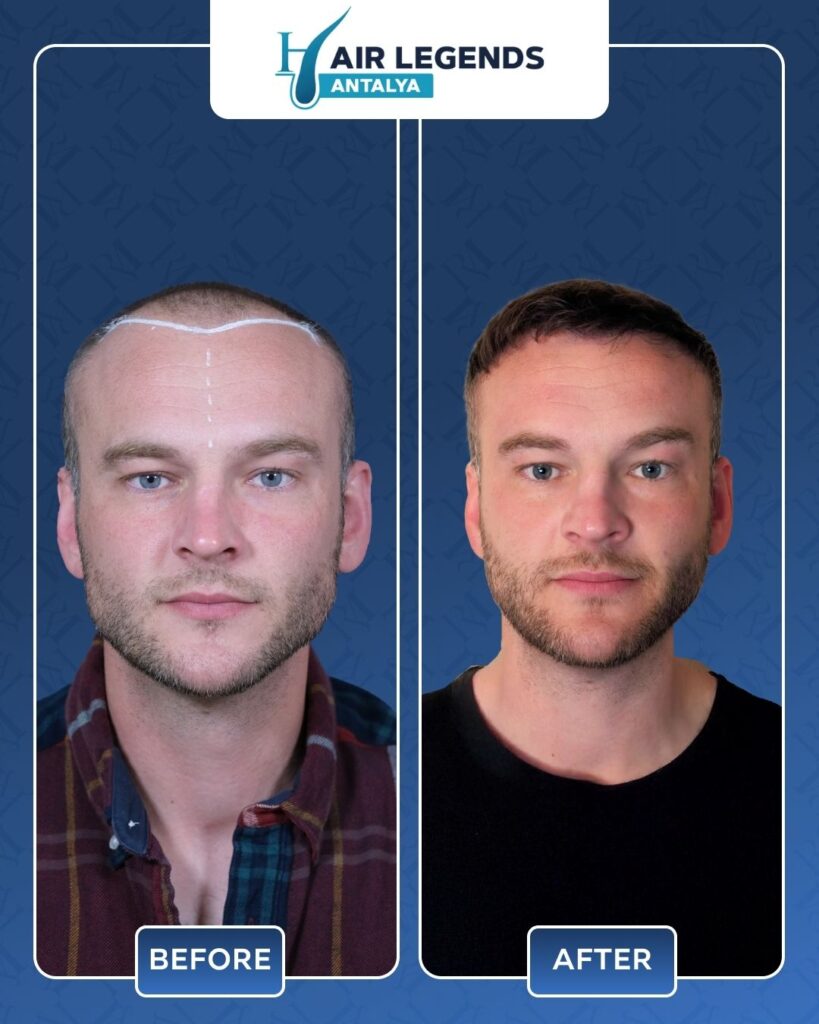
Before a temple transplant, patients typically show:
- A hollowed or concave appearance on the sides of the forehead
- Loss of the sharp triangular outline of the temple
- A disconnected look between the sideburns and frontal hairline
After transplantation in Antalya, results include:
- A youthful and angular frame around the forehead
- Restored symmetry between left and right temples
- A smoother connection with the frontal hairline and side hair
High-resolution before-and-after photos from Antalya clinics reveal the dramatic improvement temple transplants can bring. International patients often share reviews praising not only the natural look but also the affordability compared to their home countries.
Managing Hairline Symmetry Across Both Temples
One of the most important temple peak strategies is achieving bilateral symmetry. A slight mismatch in angle, density, or height between the left and right sides can make the hairline appear unbalanced.
Surgeons in Antalya typically design both temples simultaneously during the consultation. Using reference lines, proportions of facial thirds, and the golden ratio, they ensure each peak matches harmoniously.
For patients with advanced hair loss, restoring symmetry across both temples can be life-changing. The temples reframe the face, reducing the appearance of a receded hairline and giving a more structured look.
Temple Peak Strategies for Female Hairlines
While temple peaks are often discussed in the context of male hair loss, women also benefit greatly from temple restoration. Female temple thinning often manifests as diffuse hair loss or widening of the part line, particularly around the temples.
Temple transplants for women in Antalya focus on:
- Using finer single grafts for natural blending
- Avoiding overly sharp or masculine designs
- Maintaining softness around the hairline edges
- Addressing postpartum or traction alopecia cases
This procedure not only restores volume but also improves confidence, especially for women who prefer hairstyles pulled back from the face. Antalya has become a hub for women seeking discreet and natural temple transplants, thanks to advanced surgical artistry.
Surgery Day Protocol for Temple Peak Cases
On the day of surgery, patients undergoing temple peak restoration in Antalya can expect:
- Arrival and preparation – including blood tests and scalp shaving (partial or full).
- Design confirmation – surgeon finalizes temple outline with patient input.
- Anesthesia – local or hair transplant with sedation Antalya options for comfort.
- Donor graft collection: In an FUE procedure, follicular units are individually removed from the donor area using a small punch. The clinician should explain how the recipient sites will be created and how the grafts will be placed.
- Incision making – micro-incisions created at acute angles for temple hair.
- Implantation – grafts placed carefully to match natural flow.
- Post-surgery bandaging and instructions – patients are guided on aftercare.
With Antalya’s luxury hair transplant packages, patients often also enjoy private transfers, 5-star hotel stays, and personalized care, making the entire journey comfortable and memorable.
Recovery, Results and Possible Risks
Temporary swelling, tenderness and scabbing can occur after a temple hair transplant. Follow your treating clinician’s instructions for washing, sleeping, exercise and protecting the grafts.
Transplanted hairs often shed in the weeks after surgery before new growth develops. New hair commonly starts to appear around four months, while full results may take approximately 10–18 months. Individual progress varies.
Possible risks include infection, bleeding, scarring and poor graft growth. For temple restoration, the consultation should also address concerns about hair direction, visible density and how the design will blend with surrounding hair. Existing hair may continue to thin after surgery.
Post Surgical Care and Temple Peak Maturation
After temple transplantation, the first two weeks are crucial for graft survival. Patients are advised to:
- Avoid touching or scratching the temples
- Sleep in an elevated position to reduce swelling
- Follow clinic-guided washing protocols
- Protect the temples from direct sunlight
Shedding of transplanted hairs occurs around weeks 2–4, which is completely normal. New growth typically starts at 3–4 months, with temple hairs taking up to 12–15 months to fully mature.
Antalya clinics provide ongoing aftercare, often including PRP therapy or exosome treatment to boost graft survival and improve temple hair quality.
Results Over Time: Achieving Final Temple Aesthetics
Temple transplant results improve gradually:
- 1–3 months: Initial shedding, followed by thin regrowth
- 4–6 months: Noticeable density increase in temple areas
- 9–12 months: Temple outline becomes sharper, blending with natural hair
- 12–15 months: Final maturation, full natural look achieved
Patients who travel to Antalya often return home after surgery and receive virtual follow-ups via photos and video calls. By one year, temple peaks usually look fully integrated, giving patients renewed confidence and a youthful, balanced face.
Conclusion
Discuss Your Temple Hair Transplant with Hair Legends
Would you like to restore your receding corners, improve your temple points or explore both options?
Send Hair Legends clear photographs of your hairline, both temples and donor area. Include your age, any previous hair transplant details and your preferred travel dates.
We can help arrange an initial assessment and explain the proposed treatment and quotation. Photographs support preliminary planning; final suitability and the surgical plan require an in-person clinical examination.