
Norwood 7 represents the most advanced stage of male pattern hair loss. By this point, hair loss has usually progressed far beyond a receding hairline. Most of the frontal scalp, mid-scalp and crown have become bald, while the remaining hair is concentrated around the sides and back of the head.
For men researching a Norwood 7 hair transplant, the biggest question is often whether anything can still be done. In many cases, the answer is yes but the treatment strategy needs to be very different from that used for earlier stages of hair loss.
A Norwood 7 patient cannot simply be treated as someone with a small receding hairline. The available donor hair is limited, the area requiring coverage is extensive, and future hair loss has to be considered. This makes proper planning particularly important.
At Hair Legends in Antalya, advanced hair loss cases are assessed individually. Rather than focusing only on the number of grafts that can be transplanted, the goal is to determine how the available donor hair can be used to create the greatest visible improvement while maintaining a natural appearance.
What Is the Norwood Scale?
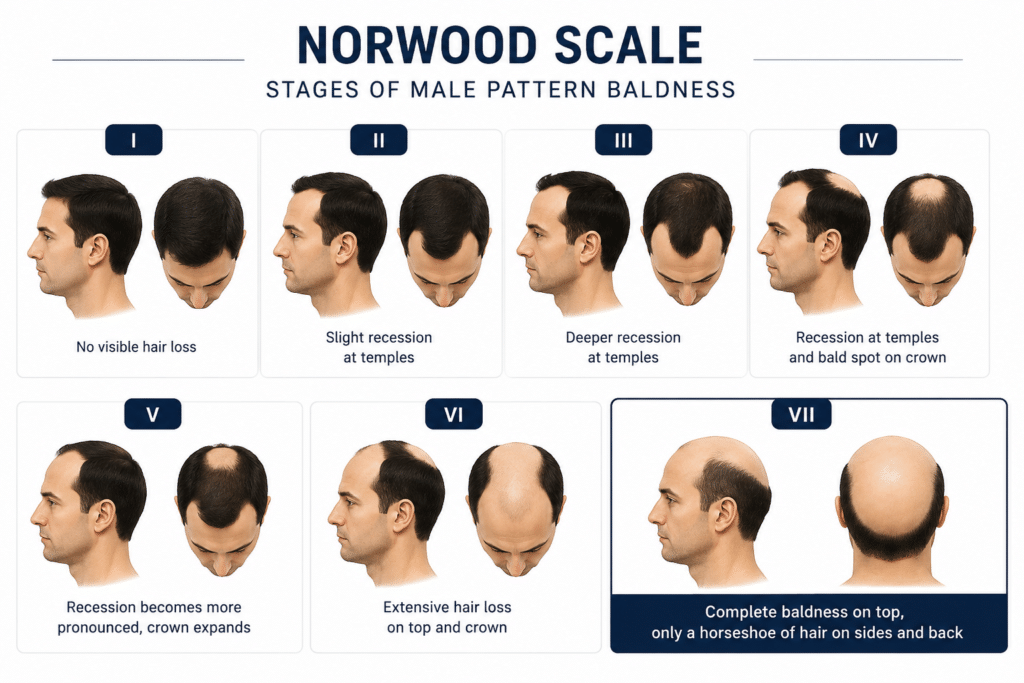
The Norwood Scale is one of the most commonly used systems for classifying male pattern baldness. It divides the progression of androgenetic alopecia into seven stages.
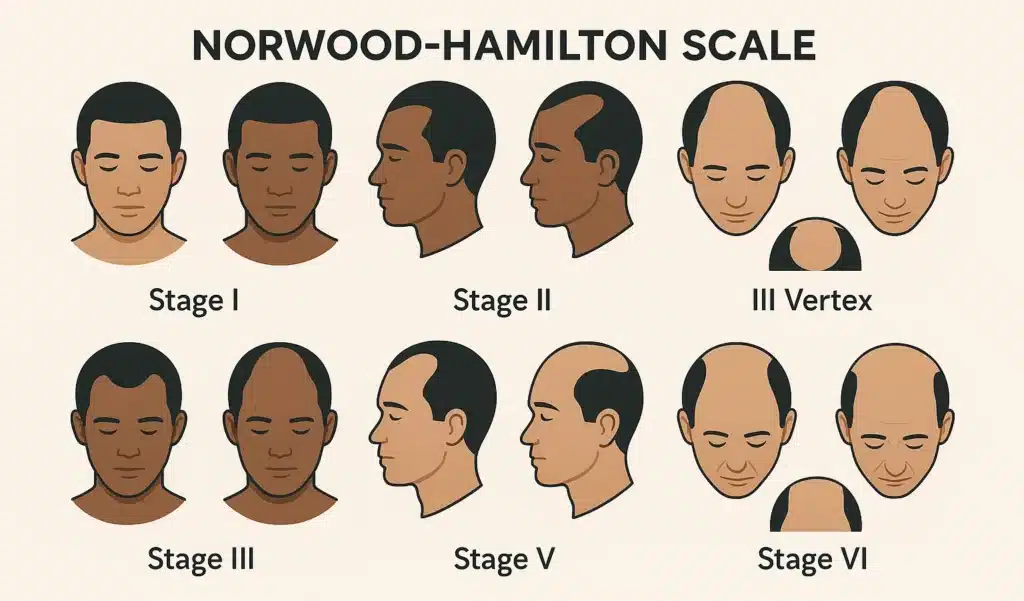
The earliest stages usually involve recession at the temples and changes to the frontal hairline. As hair loss progresses, the thinning area becomes larger and the crown begins to lose density.
At Norwood 6, the frontal and crown areas have generally merged, leaving a large bald region across the top of the scalp.
Norwood 7 is the final stage of the traditional Norwood classification. The remaining hair forms a horseshoe shaped pattern around the sides and back, while the amount of hair available for transplantation may be considerably limited.
However, the Norwood number does not tell doctors everything they need to know.
Two patients classified as Norwood 7 can have very different donor density, hair thickness, scalp characteristics and expectations. One may have enough strong donor hair to achieve meaningful coverage, while another may have very limited options.
This is why a personal assessment is essential before deciding whether a Hair Transplant Antalya procedure is appropriate.
What Does a Norwood 7 Hairline Look Like?
At Norwood 7, there is usually no clearly defined natural frontal hairline remaining.
The front of the scalp is generally bald, and the remaining hair is concentrated around the sides and back. The transition between the bald upper scalp and the remaining donor hair creates the characteristic horseshoe pattern associated with advanced male pattern baldness.
Recreating a youthful teenage hairline is generally not the objective in this situation.
Instead, an experienced hair transplant doctor may design a conservative, age-appropriate frontal hairline that creates a better frame for the face.
This distinction matters.
Trying to place too many grafts into an extremely low hairline can consume a large proportion of the patient’s donor supply. If additional hair loss occurs later, there may be little donor hair left to address it.
For a Norwood 7 patient, a natural result is often more valuable than maximum density.
The goal is to make the improvement look believable rather than trying to recreate the density of someone who has never experienced significant hair loss.
How Long Does It Take to Progress from Norwood 6 to Norwood 7?
There is no standard timeframe.
Some men can remain at approximately the same stage for years, while others experience rapid progression. Genetics, age, hormonal sensitivity and family history can all influence the rate of hair loss.
This makes predicting the exact transition from Norwood 6 to Norwood 7 impossible.
For anyone considering a hair transplant, this uncertainty is important. Surgery should not be planned only around the hair that has already been lost. The doctor also needs to consider what may happen to the patient’s remaining native hair.
This is particularly relevant for younger men with advanced hair loss.
Using a large number of grafts during a single procedure may create an impressive short-term change, but it can also reduce the donor supply available for future treatment.
A good hair restoration plan therefore looks beyond the first year.
How Many Grafts Are Needed for Norwood 7 Hair Loss?
There is no fixed number of grafts that applies to every Norwood 7 patient.
The required number depends on the size of the bald area, donor density, hair calibre, hair characteristics and the level of coverage the patient wants to achieve.
A Norwood 7 patient may require several thousand grafts, but that does not mean that every available donor follicle should be used.
This is where graft planning becomes particularly important.
For some patients, rebuilding the frontal region may create the greatest cosmetic improvement. Another patient may benefit from extending coverage into the mid-scalp. Treating the crown may be considered later because the crown can require a significant number of grafts to produce a noticeable visual change.
Hair characteristics also influence the final appearance.
Thicker hair can provide greater visual coverage, while fine hair may require more strategic placement to create the same impression of density. Curly or wavy hair can also create more coverage than straight hair with the same number of grafts.
For this reason, patients should be cautious about websites that promise an exact graft number based solely on a Norwood classification.
A proper donor-area assessment is far more useful than an online calculator.
How to Treat Hair Loss at Norwood Stage 7?
Treatment becomes more challenging when hair loss reaches Norwood 7.
Medications such as Minoxidil or Finasteride may still have a role in appropriate patients, particularly when there is native hair that can potentially be preserved. However, medication cannot recreate follicles that have already been permanently lost.
For suitable candidates, hair transplantation can provide significant cosmetic improvement.
The first question, however, should always be whether there is enough donor hair.
The donor area is a finite resource. Follicles removed during transplantation cannot simply be replaced. This means aggressive harvesting can create a second problem: a visibly depleted donor area.
At Hair Legends, the treatment plan for advanced hair loss therefore begins with an assessment of the donor region, not with a promise of a particular graft number.
Depending on the individual case, treatment may involve a staged approach. The frontal scalp may be prioritised first, followed by additional coverage if sufficient donor resources remain.
For some patients, the most appropriate recommendation may even be not to undergo surgery until their expectations and hair loss pattern have been properly assessed.
That kind of honesty is important with advanced hair loss.
What Hair Transplant Method Is Used for Advanced Loss?
FUE, or Follicular Unit Extraction, is widely used for advanced hair transplantation. With FUE, individual follicular units are extracted from the donor area and prepared for implantation into the recipient region.
Its flexibility makes it suitable for many patients with extensive hair loss.
DHI, or Direct Hair Implantation, may also be appropriate in selected cases, particularly when precise placement around existing hair or detailed work in the frontal region is required.
The technique itself, however, is only one part of the equation.
For a Norwood 7 patient, donor management, graft handling, hairline design and distribution of available follicles can have a much greater influence on the final result than whether the procedure is labelled FUE or DHI.
This is why Hair Legends does not recommend a technique simply because it is currently popular. The method should be selected according to the patient’s scalp, donor characteristics and treatment objectives.
What Are Realistic Norwood 7 Hair Transplant Results?
Expectations are perhaps the most important part of treating Norwood 7 hair loss.
A successful transplant does not necessarily mean achieving the same density a patient had before experiencing hair loss. There simply may not be enough donor follicles to reproduce that level of coverage.
Instead, the objective is usually to create a noticeable improvement in the areas that matter most.
Rebuilding the frontal hairline can make a particularly significant difference because the front of the scalp has such a strong influence on facial appearance. Strategic coverage through the mid-scalp can then improve the overall balance.
The crown may require a different strategy.
Patients should also understand that the final result takes time. Newly transplanted follicles do not immediately produce mature hair. Shedding during the early months can occur, followed by gradual regrowth and thickening.
Visible improvement commonly develops over several months, while the final result is generally assessed around the twelve-month mark, depending on the individual.
For Norwood 7 patients, realistic expectations often produce the happiest outcomes.
The goal isn’t to promise something that the donor area cannot deliver. It’s to make the most of what is available.
Why Choose Hair Legends for Advanced Hair Loss in Antalya?
Choosing a clinic for a Norwood 7 hair transplant requires more consideration than simply comparing package prices.
Advanced cases need careful planning because the available donor supply has to be distributed intelligently.
At Hair Legends, patients are assessed according to their current level of hair loss, donor capacity, hair characteristics and long-term expectations. The treatment plan is built around what can realistically be achieved rather than simply offering the highest possible graft number.
For international patients considering a Hair Transplant Antalya procedure, this approach can be particularly important. Travelling abroad for surgery is a major decision, and patients should know who will be involved in their treatment, how the donor area will be managed and what kind of result they can realistically expect.
Antalya has become a popular destination for hair restoration because patients can combine specialist treatment with an established medical tourism environment. But the destination is only one part of the decision.
The clinic, doctor, treatment plan and long-term strategy matter just as much.
Final Thoughts
Norwood 7 is the most advanced stage of the traditional Norwood classification, but it does not automatically mean that hair restoration is impossible.
The important question is not simply how much hair has been lost. It is how much suitable donor hair remains and how intelligently that resource can be used.
For some patients, a carefully planned transplant can create a substantial improvement in the frontal region and overall appearance. For others, the limitations of the donor area may mean that expectations need to be adjusted before surgery.
That is why consultation matters so much.
If you are researching Norwood 7 hair transplant Turkey, Norwood 7 hair transplant Antalya, or advanced hair restoration in Turkey, look beyond before and after photographs and advertised graft numbers. Ask how the donor area will be protected, who will design the hairline, which areas will be prioritised and what happens if you continue losing native hair in the future.
At Hair Legends, the focus is on creating a result that looks natural and makes sense for the patient’s long-term hair restoration journey not simply maximising the number of grafts used in one procedure.
For advanced hair loss, good planning isn’t an extra step.
It is the foundation of the entire treatment.