
John Cena has never been particularly shy about talking about his appearance, but his hair transplant journey has been more personal than most of his grooming choices. In 2025, the actor and former WWE star publicly discussed having a hair transplant after years of dealing with thinning hair and the attention it received from fans. In 2026, he revealed that he had undergone a second procedure.
The news is interesting for more than just celebrity reasons. A second hair transplant often raises an obvious question: if the first procedure worked, why would another one be necessary?
The answer isn’t always that something went wrong.
Hair loss can continue after a transplant. A patient may want additional density, a previously untreated area may become more noticeable, or a small section may need refinement. Sometimes a second procedure is even considered part of the original long-term plan.
Cena’s case provides a useful example of this. He has explained that his first procedure addressed a larger area and that, after seeing the result, he noticed a small area that he wanted to improve. He then returned to his doctor for another procedure. At San Diego Comic-Con in July 2026, Cena revealed that his first operation lasted around 13.5 hours and his second around eight hours.
For anyone considering a Hair Transplant Antalya, the story raises some practical questions. How many procedures might a person need? When is a second transplant appropriate? Can careful planning make another surgery unnecessary? And why does donor-area management become even more important when thinking about the future?
What Happened? John Cena’s Second Hair Transplant
John Cena’s second hair transplant became public in June and July 2026, when he appeared with a shaved head and began discussing the procedure openly.
Cena explained that he had returned to the same doctor after being pleased with the first treatment. According to his comments, the first transplant had produced a result he was happy with, but he noticed a small area that he wanted to improve. Rather than treating this as a failure of the original operation, he approached his doctor about whether the area could be addressed.
The second procedure was again an FUE hair transplant. Cena said that the first operation took approximately 13 and a half hours, while the second took around eight hours. The procedures were separated by approximately 15 months.
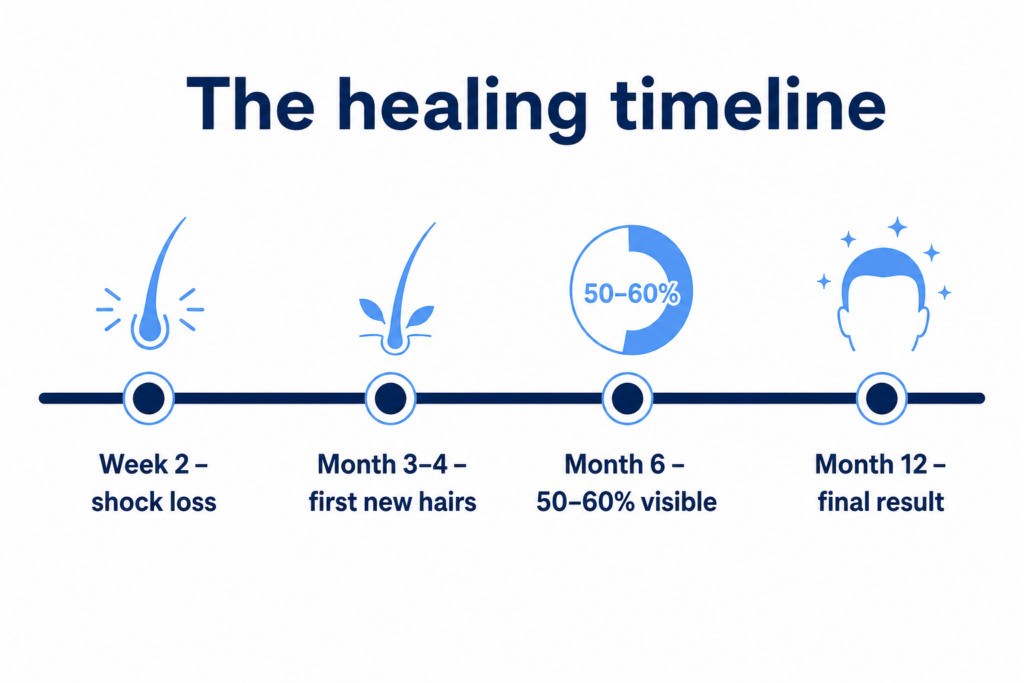
That timing is worth noting. A second procedure isn’t something that should normally be rushed simply because a patient doesn’t immediately see the final result of the first transplant. Hair growth takes time, and the scalp needs to recover before a doctor can properly assess what additional treatment may be useful.
Cena’s comments also highlight another important point: the decision to have another transplant was based on his individual situation. His experience shouldn’t be taken as evidence that every patient needs two procedures.
For some people, one well-planned transplant may be enough for many years. For others, another procedure may eventually make sense.
Cena’s First Hair Transplant: From Being Mocked to Speaking Openly
Cena first publicly discussed his hair transplant in 2025. He explained that his thinning hair had become increasingly noticeable and that WWE fans had even made signs about it during his wrestling career. He eventually decided to stop treating the subject as something embarrassing and began looking into hair restoration.
His openness is significant because male hair loss is still something many men feel uncomfortable discussing. Someone who is confident in almost every other part of their life can still feel self-conscious about a receding hairline or thinning crown.
Cena has also spoken about how the decision affected his confidence and his work as an actor. In a 2026 interview, he said that the procedures had made a major difference to his life and explained that he regretted not looking into treatment earlier.
There is a wider point here. Hair transplantation is no longer something that celebrities necessarily try to hide. Several well-known men have spoken openly about their procedures, and that has helped make hair restoration a more ordinary subject of conversation.
For patients considering treatment, that can be a positive development. Instead of viewing hair loss as something that has to be hidden, men can discuss the available options and make decisions based on realistic expectations.
Why Do You Shave Your Head for a Hair Transplant?
One of the things that attracted attention when Cena appeared in 2026 was his completely shaved head.
For someone who normally wears a very short hairstyle, this may not seem particularly unusual. But shaving is actually an important part of many hair transplant procedures, particularly FUE.
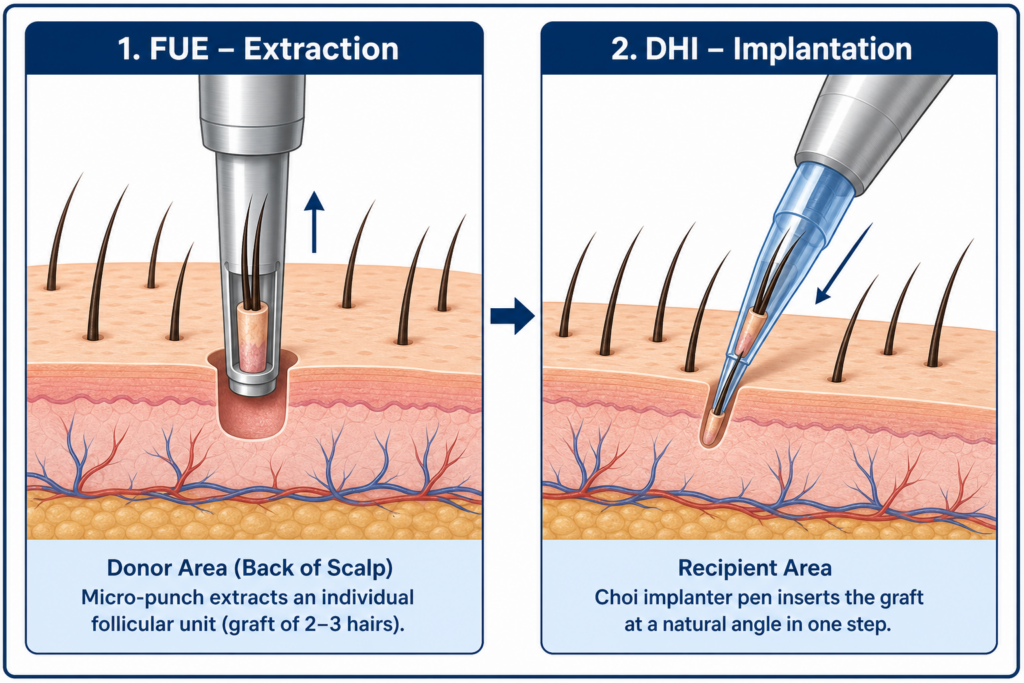
When the hair is shaved, the doctor can see the donor area more clearly and identify individual follicular units more easily. It can also make extraction and implantation more efficient, especially when a significant number of grafts are being treated.
Cena specifically explained that his doctor recommended shaving because it allowed the procedure to be performed more efficiently and helped with follicle preservation. He said that his doctor felt he could achieve the best result if Cena was willing to shave his head.
That doesn’t mean every patient has to shave completely.
Depending on the procedure, hair length, graft number and treatment area, some patients may be suitable for partial shaving or other approaches. DHI is also sometimes offered to patients who prefer a less visible shaving pattern.
However, avoiding a shave shouldn’t automatically be considered a sign of a better procedure.
If shaving gives the medical team better visibility and makes a particular procedure more controlled, it can be the sensible option.
The priority should be the quality of the treatment rather than how discreet the first few days look.
Why a Second Hair Transplant? And Why It Is Not the Norm
A second hair transplant can happen for several reasons, and none of them automatically mean that the first procedure was unsuccessful.
One of the most common reasons is continued native hair loss.
A transplant moves follicles from one part of the scalp to another. It doesn’t necessarily stop the natural progression of male pattern hair loss in the follicles that were not transplanted.
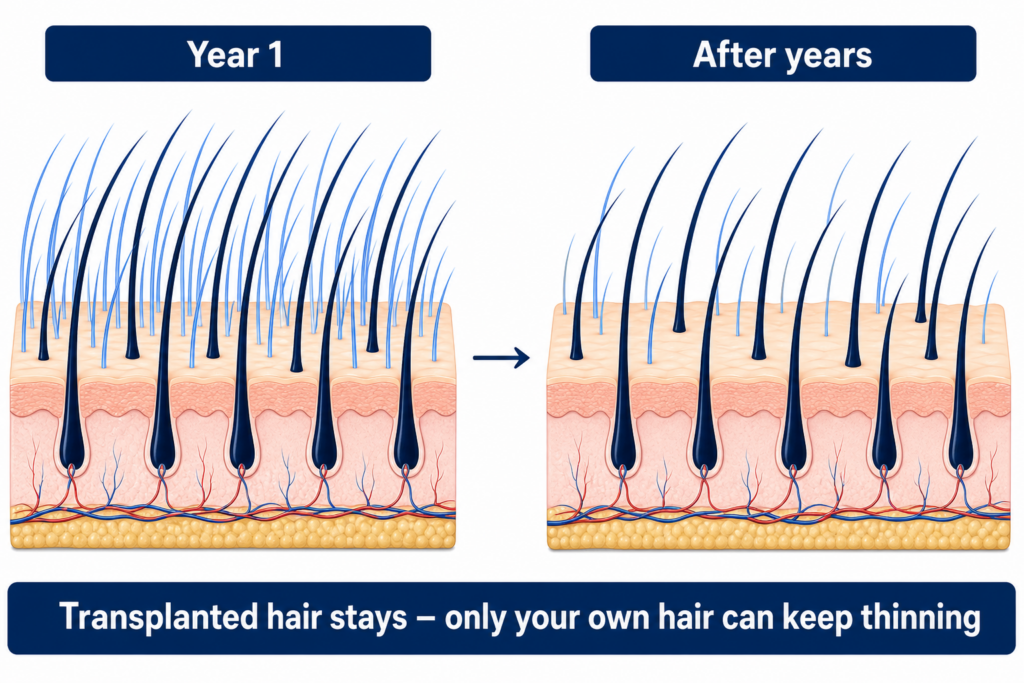
Imagine a patient who has a receding hairline and thinning behind it. The doctor restores the frontal area with a carefully designed transplant. The transplanted follicles remain, but the native hair behind them may continue to thin over the following years.
Eventually, the patient could have a new area of visible thinning behind an otherwise stable transplanted hairline.
Another procedure may then be considered.
That’s not necessarily a failed transplant. It’s a consequence of the original hair-loss condition continuing to develop.
There is also the issue of density.
Some patients are happy with their initial coverage but later decide that they would like more density in a particular area. A second procedure can sometimes be used to reinforce the frontal region, mid-scalp or crown if enough donor hair remains.
A smaller second procedure may also be used for refinement. Perhaps a particular section of the hairline remains thinner than desired, or a small area didn’t develop exactly as expected.
Cena’s explanation fits into this category. He described returning to his doctor after noticing a small spot he wanted to improve.
This is why the number of procedures should not be treated as a measure of success by itself.
One patient may need one procedure.
Another may have two.
Someone with extensive hair loss may eventually have more than two.
The important factor is whether each procedure has a reasonable medical and aesthetic purpose.
How a Well-Planned First Procedure Can Make a Second One Unnecessary
Although a second transplant can be completely reasonable, the goal of a first procedure should not be to create unnecessary future surgery.
Good planning starts with the donor area.
The donor area is a limited resource. Once a follicular unit has been removed, it cannot simply be returned to the scalp. That means the doctor has to think about both the patient’s current appearance and the possibility of future hair loss.
This is particularly important for younger patients.
A 25-year-old with a receding hairline may still have decades of potential hair loss ahead. Designing an extremely low hairline and using a large number of grafts to create maximum density immediately may not be the best long-term decision.
A slightly more conservative hairline may look natural now and remain appropriate as the patient gets older.
The same principle applies to graft numbers.
A patient may ask for 5,000 grafts because they believe more grafts will automatically produce a better result. But if the donor area cannot comfortably support that amount, extracting thousands of additional grafts may create a problem that is much harder to solve later.
A good first procedure should therefore answer three questions:
Where do we need the hair most?
How many grafts can we safely use?
What is likely to happen to the patient’s native hair in the future?
Those questions are more useful than simply deciding on the largest possible graft number.
The Donor Area Is a Lifelong Resource
This is particularly important when discussing second procedures.
Patients tend to judge a hair transplant by looking at the recipient area. They want to see a fuller hairline and better coverage.
The donor area is less visible, so it sometimes receives less attention during consultations.
But it determines how much flexibility a patient has in the future.
During FUE, individual follicular units are extracted from the donor region, usually from the back and sides of the scalp. The extraction needs to be distributed carefully so that the remaining hair can conceal the areas where grafts have been removed.
If the donor area is overharvested during the first procedure, a future correction may become much more difficult.
This is why a clinic should not simply ask whether it is technically possible to extract a certain number of grafts.
The more useful question is whether doing so makes sense for that particular patient.
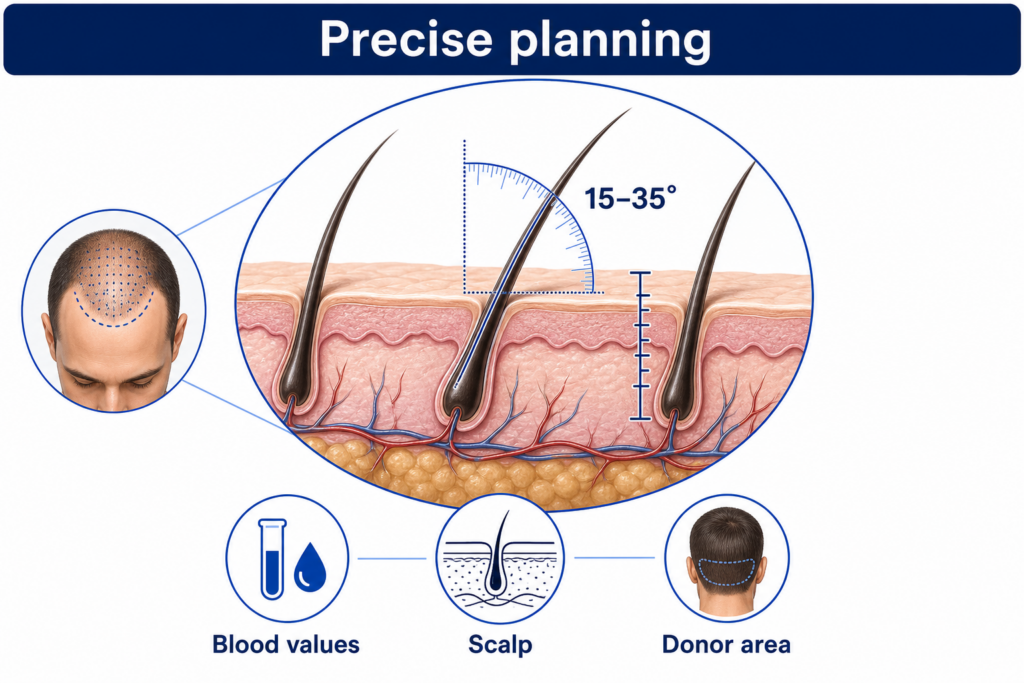
For someone with a strong donor area, a large session may be appropriate.
For someone with limited density, the doctor may need to be more conservative.
That decision can have consequences years later.
Why Future Hair Loss Should Be Part of the First Consultation
A hair transplant should never be planned as though the patient’s scalp will remain exactly the same forever.
This is especially important in male pattern hair loss.
Transplanted follicles are selected because they are generally more resistant to the effects of androgenetic hair loss, but the native follicles around them can continue to change.
This means a patient can have a very good transplant and still experience additional thinning later.
A responsible treatment plan should therefore consider the likely progression of hair loss.
That may mean preserving some donor follicles for future use. It may mean creating a mature hairline rather than an unusually low one. It may also mean discussing non-surgical treatments that can help maintain native hair where appropriate.
The exact approach depends on the patient and should be determined through a medical assessment.
The important point is that the first transplant should fit into a long-term plan.
That is one of the reasons why choosing a clinic based solely on price can be risky. A low-cost procedure may look attractive initially, but donor management and future planning can be much more important than the difference between two package prices.
Not Just Cena: Celebrities Who Speak Openly About Hair Transplants
John Cena is one of the more recent celebrities to discuss hair restoration publicly, but he certainly isn’t the first.
Over the years, several well-known men have talked openly about their experiences. Their stories are interesting because they show that hair transplantation isn’t always a single procedure and that people can approach hair restoration in very different ways.
Wayne Rooney
Wayne Rooney is one of the best-known celebrity examples.
Rooney publicly confirmed his first hair transplant in 2011 after experiencing hair loss at a relatively young age. Two years later, he underwent another procedure.
Importantly, the clinic involved in his treatment describes the 2013 procedure as a pre-planned second phase that had been considered when his original treatment began.
That is a useful example because it shows why a second procedure should not automatically be interpreted as a correction.
Sometimes the second stage is simply part of the treatment strategy.
The exact number of grafts, donor availability and areas treated are individual considerations, but the principle is relevant to anyone thinking about long-term hair restoration.
James Nesbitt
Actor James Nesbitt has also been unusually open about his hair transplant journey.
He has spoken publicly about experiencing hair loss and the effect it had on his confidence and career. In interviews, he explained that he had struggled with the issue and eventually decided to do something about it rather than continue worrying about it.
More recently, his long-term restoration journey has received attention again. Reports in 2026 described multiple procedures over a number of years, illustrating another important point: some patients approach hair restoration as an ongoing process rather than a single operation.
Nesbitt’s story also highlights the psychological side of hair loss.
The decision to undergo a transplant isn’t always about vanity. For some patients, thinning hair changes the way they feel about themselves, particularly when their appearance is closely connected to their profession.
Other Celebrities Have Had More Than One Procedure
John Cena and Wayne Rooney aren’t isolated examples.
PEOPLE recently highlighted a number of male celebrities who have spoken publicly about hair transplantation, including Joel McHale, AJ McLean, Akon and others. Some have discussed multiple procedures, while others have described the effect hair restoration had on their confidence.
The increasing willingness of public figures to discuss these procedures has helped make hair restoration less of a taboo subject.
At the same time, celebrity results should always be treated carefully.
A celebrity’s hair characteristics, donor density, age, budget and medical history can be completely different from those of an ordinary patient. Photographs can also be influenced by lighting, styling and camera angles.
A celebrity story can help explain what is possible.
It shouldn’t be used as a template for deciding how many grafts you personally need.
What Does a Second Hair Transplant Usually Try to Achieve?
The purpose of a second procedure depends on what happened after the first one.
For some patients, the main goal is additional density.
The first procedure may have created a natural-looking foundation, but the patient wants the result to look fuller. If the donor area is healthy and the recipient area is suitable, additional grafts may be used strategically.
For others, the main issue is continued hair loss.
A patient may have lost more native hair behind the original transplant. In this situation, the second procedure isn’t necessarily repairing the first operation. It is addressing a new stage of hair loss.
There are also repair cases.
A patient may have an unnatural hairline, poor graft direction, visible donor thinning or insufficient density following an earlier procedure. Repair surgery can be more complicated because the doctor has to work around existing transplanted follicles and whatever donor supply remains.
Finally, there are refinement procedures.
The patient may simply want to improve a relatively small area after the main result has already been achieved.
Cena’s explanation of his second procedure appears closer to this final category, as he described a small area that he wanted to improve.
When Is a Second Hair Transplant a Good Idea?
The decision should be based on an examination rather than simply on how long it has been since the first operation.
The first result needs enough time to develop.
Hair growth after transplantation is gradual, and patients can become unnecessarily worried during the early months when transplanted hairs may shed before new growth appears.
Once the result has matured sufficiently, a doctor can assess whether additional treatment would actually improve the appearance.
The donor area also needs to be checked.
If the first procedure used a large proportion of the available grafts, there may be little room for another session.
The recipient area matters too.
If there is already good density, adding more grafts may produce little visible benefit. On the other hand, a small area of persistent thinning may respond well to a carefully planned second session.
The patient’s expectations should also be realistic.
Another procedure should have a clear objective.
Can a Second Procedure Be Performed in Antalya?
Yes, patients who have already undergone a hair transplant elsewhere can potentially be assessed for a second procedure in Antalya.
However, the assessment should start with the previous operation.
If you are considering a second Hair Transplant Antalya procedure, take as much information about the first surgery as possible. Knowing the approximate graft number, technique and date of the previous procedure can help the doctor understand your current situation.
Photographs from before the first transplant can also be useful.
The donor area should then be examined directly.
This is particularly important if the previous procedure involved a large number of grafts.
A patient may believe that they still have thousands of grafts available because the donor area looks normal at first glance. But donor capacity is not determined simply by looking at the scalp from a distance.
Density, follicular-unit characteristics and previous extraction all need to be considered.
A second procedure should therefore never be sold simply as “another 3,000 grafts.”
It needs to be planned around what remains.
Why Choosing the Right Clinic for the First Procedure Matters
The first hair transplant can influence every decision that comes afterward.
A well-planned procedure preserves options.
A poorly planned one can reduce them.
This is why patients researching Hair Transplant Antalya should look beyond package prices and graft numbers when comparing clinics.
Ask who performs the procedure.
Ask how the donor area is assessed.
Ask how the hairline is designed.
Ask whether future hair loss is considered.
Ask what happens if you eventually need more density.
These questions are especially relevant for younger patients.
A clinic should not promise a result based only on today’s appearance. The doctor should consider how the patient may look as native hair continues to change.
The goal is not to make the patient look perfect for a photograph taken immediately after the procedure.
The goal is to create a result that remains natural as the patient ages.
Frequently Asked Questions About a Second Hair Transplant
Does needing a second hair transplant mean the first transplant failed?
No. A second procedure can be used for additional density, continued native hair loss, another area of thinning or refinement. John Cena’s second procedure was described as addressing a small area he wanted to improve after being satisfied with his first treatment.
How long should you wait before considering another hair transplant?
There is no single timetable that applies to every patient. The first procedure needs sufficient time to heal and produce its mature result, and the doctor should assess both the recipient and donor areas before recommending another procedure.
Can you have a second transplant to make the hair thicker?
Sometimes. If the donor area has sufficient remaining grafts and the recipient area can accommodate additional follicles, a second session may be used to increase density.
Can future hair loss make another transplant necessary?
Yes. A transplant does not prevent untreated native follicles from continuing to thin. A patient may therefore need additional treatment later even when the first transplant was successful.
Did John Cena have two FUE hair transplants?
Yes. Cena has publicly described both procedures as FUE. His first procedure lasted approximately 13.5 hours and the second approximately eight hours.
Why did John Cena shave his head?
Cena explained that his doctor recommended shaving because it made the procedure more efficient and allowed better handling and preservation of follicles.
Does everyone need a second hair transplant?
No. Many patients can achieve their desired result with one procedure. The need for another session depends on the extent of hair loss, donor capacity, future progression and the patient’s expectations.
Can a second hair transplant repair a bad first transplant?
In some cases, yes. Repair surgery can address issues such as an unnatural hairline, poor density or certain donor-area problems, but the options depend heavily on how much donor hair remains and what was done during the original operation.
Can I have my second hair transplant in Antalya if my first one was somewhere else?
Potentially. A doctor should first assess the previous transplant, current donor area and remaining hair-loss pattern. A second procedure should only be recommended if there is enough donor capacity and a realistic opportunity for improvement.
Conclusion
John Cena’s second hair transplant is a useful reminder that hair restoration doesn’t always follow a simple one-procedure formula.
His first treatment addressed a significant area of concern. After seeing the result, he identified a smaller area that he wanted to improve and returned to his doctor. The second procedure was performed around 15 months after the first, and Cena has described both operations as positive experiences.
For patients, the bigger lesson is that a second procedure should not automatically be viewed as evidence that something went wrong.
Sometimes it is planned from the beginning.
Sometimes native hair continues to thin.
Sometimes a patient wants additional density.
And sometimes a small area simply needs refinement.
What matters is the reason behind the second procedure and whether the donor area can support it.
That is why the first consultation remains so important. A doctor should look beyond the hairline that needs treatment today and consider the patient’s likely future pattern of hair loss. Donor follicles should be treated as a limited resource, and grafts should be used where they provide the greatest long-term benefit.
For anyone considering a Hair Transplant Antalya, this is one of the most important things to understand before choosing a clinic. The best treatment isn’t necessarily the one offering the highest number of grafts or the lowest price. It is the one that makes sense for your current hair loss while preserving options for the future.
John Cena’s experience also shows how much the conversation around male hair loss has changed. Once something that many men preferred to hide, hair transplantation is now openly discussed by actors, athletes and public figures.
A second procedure isn’t something patients should automatically fear.
But it also shouldn’t be something a clinic promises as part of a package.
The aim of a good first transplant is to achieve a natural result, protect the donor area and plan for the future. If another procedure eventually becomes appropriate, it should be because there is a clear reason for it—not simply because the first treatment wasn’t properly planned.