
Hair Transplant Iran vs Turkey: Choosing where to have a hair transplant is a major decision. For international patients, the question is often not simply “How much does a hair transplant cost?” but rather “Where can I get a safe, natural and properly planned result?”
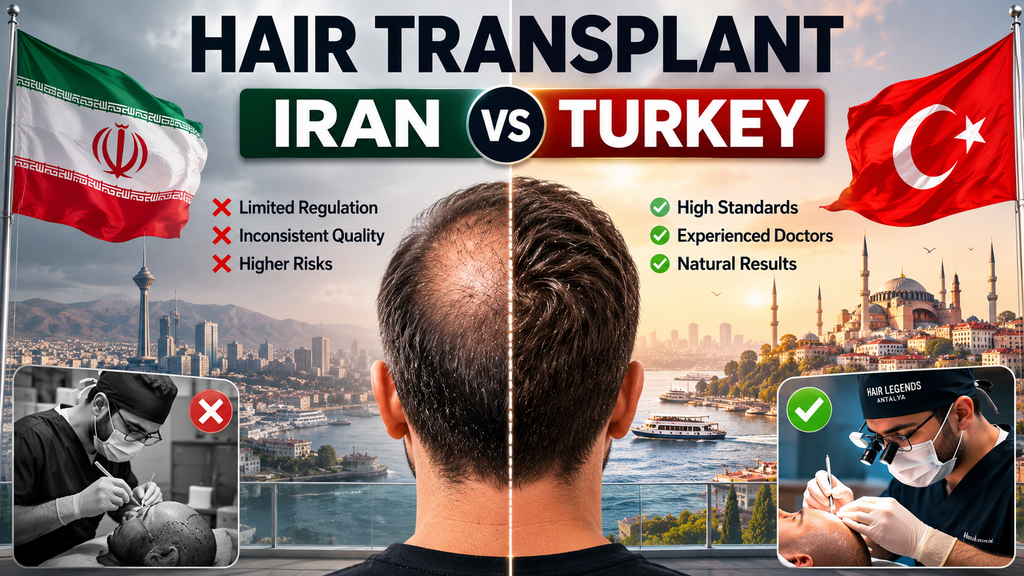
Iran and Turkey are both located in a region with a long history of medical tourism, and patients can find hair-transplant clinics in both countries. However, the experience of an international hair-transplant patient can be very different depending on the country, clinic, medical team and level of regulation.
For patients comparing Hair Transplant Iran vs Turkey, Turkey has become one of the world’s most established destinations for hair restoration. The country has developed a dedicated international health-tourism infrastructure, formal authorisation requirements for facilities treating international patients, and specific regulations governing hair-transplant units. Turkey’s Ministry of Health also maintains lists of healthcare providers authorised for international health tourism.
That does not mean every Turkish clinic is automatically better than every Iranian clinic. Quality can vary significantly within both countries.
The important difference is the overall ecosystem available to an international patient.
For someone travelling specifically for a hair transplant, Turkey offers a particularly mature combination of specialised clinics, experienced medical teams, international-patient services, accommodation, airport transfers, multilingual support and established postoperative systems.
At Hair Legends Antalya, we see this from the perspective of an international clinic: patients are not simply travelling for a medical procedure. They are travelling to another country and need the entire experience to be organised around their treatment.
This guide explains the major differences between hair transplant Iran vs Turkey, including medical regulation, doctor involvement, techniques, international-patient support, aftercare, cost and the potential risks patients should consider before making a decision.
Hair Transplant Iran vs Turkey: The Main Difference
The biggest difference is not necessarily that one country has doctors who can perform hair transplantation while the other does not.
Iran has qualified doctors and clinics offering hair restoration. Some patients may have positive experiences there.
The bigger issue for an international patient is the structure surrounding the procedure.
Turkey has spent years developing itself as a major medical-tourism destination. International healthcare is regulated under dedicated Ministry of Health rules, and healthcare facilities and intermediary organisations providing international health-tourism services require authorisation.
Turkey also introduced specific regulations for hair-transplant units in 2023. These regulations establish requirements concerning the physical environment, personnel, sterilisation, documentation, patient information and inspection of hair-transplant units.
This matters because a hair transplant is not simply a cosmetic appointment.
It is a surgical procedure.
The patient’s safety depends on the environment in which the procedure takes place, the people performing it, sterilisation procedures, medical supervision and postoperative management.
For an international patient, these factors become even more important.
Why Turkey Has Become a Global Hair Transplant Destination
Turkey’s popularity did not happen overnight.
Over the past decade, the country has developed an extensive medical-tourism industry covering hair transplantation, dental treatment, cosmetic surgery and other elective procedures.
Hair transplantation became one of the country’s most visible specialties.
Cities such as Istanbul and Antalya now receive patients from Europe, the United Kingdom, the United States, the Middle East and other parts of the world.
One of Turkey’s advantages is that the healthcare system has developed specific infrastructure for international patients.
The Turkish Ministry of Health requires international health-tourism providers to obtain authorisation, and the Ministry publishes lists of authorised healthcare providers.
Turkey has also introduced additional certification and accreditation requirements for international health-tourism facilities. The Ministry announced that healthcare facilities operating under international health tourism must complete the applicable accreditation or certification process by the end of 2026 to continue serving international patients within the health-tourism framework.
This doesn’t eliminate poor-quality providers.
But it does create a regulatory framework within which international patients can evaluate providers.
Is Iran Bad for Hair Transplantation?
It would be inaccurate to say that every Iranian hair-transplant clinic is unsafe or inadequate.
There are qualified doctors in Iran, and there are patients who receive satisfactory results.
The problem for an international patient is that comparing countries purely on the basis of whether they have doctors who perform FUE doesn’t tell the whole story.
A patient travelling abroad needs to consider:
- Who is legally authorised to provide the treatment?
- Who performs each part of the surgery?
- What standards apply to the facility?
- How is sterilisation managed?
- Who supervises the procedure?
- What happens if a complication occurs?
- How is postoperative care organised?
- Can the patient communicate with the medical team?
- What support is available after returning home?
These questions can reveal a much larger difference than the advertised graft price.
Therefore, the correct argument is not “Iran has no good clinics.”
It is that Turkey offers a more established and structured international hair-transplant ecosystem, which can make the overall process easier to evaluate and organise for overseas patients.
Hair Transplant Regulation: Turkey’s Advantage
One of the strongest points in the Turkey versus Iran comparison is the regulatory framework surrounding international health tourism.
Turkey’s Ministry of Health has specific regulations for international health tourism. Healthcare providers and intermediary organisations must obtain the appropriate authorisation to operate within the international health-tourism system.
Turkey also has specific hair-transplant regulations.
The 2023 regulation establishes requirements for hair-transplant units, including sterilisation facilities or access to sterilisation services, minimum physical standards, qualified personnel and documentation of the procedure. It also states that people without the required hair-transplant practitioner or assistant certification cannot perform hair-transplant procedures under the regulation.
The regulation also requires the procedure to be documented, including information about the technique, number of follicles transplanted, treatment areas and members of the hair-transplant team.
For an international patient, this level of formalisation is valuable.
It means that choosing a clinic should not simply involve looking at Instagram photographs.
The clinic’s authorisation and medical credentials can also be investigated.
Why Choosing the Medical Team Matters More Than Choosing the Country
There is an important caveat here.
A Turkish passport does not make a doctor better.
Likewise, being Iranian does not make a doctor less qualified.
The individual clinic and medical team still matter enormously.
This is why patients should never choose a Turkish clinic simply because it is located in Turkey.
Before booking, ask:
Who is the doctor?
Who designs the hairline?
Who evaluates the donor area?
Who performs graft extraction?
Who opens the recipient channels or sites?
Who performs implantation?
Who supervises the procedure?
The answers should be clear before the patient arrives.
At Hair Legends Antalya, we believe patients should know the structure of their treatment before travelling.
There should be no mystery surrounding who is responsible for the procedure.
Doctor-Led Hair Transplantation in Turkey
One of the major concerns within the international hair-transplant market is the difference between doctor-led and technician-led procedures.
A patient may believe they are booking a surgeon because the website prominently features a doctor’s photograph.
On the day of surgery, however, much of the procedure may be performed by technicians.
This is not something patients should assume.
It should be discussed before booking.
Turkey’s hair-transplant regulations specifically define practitioner and assistant certifications and establish requirements concerning who may perform hair-transplant applications.
For patients considering hair transplant Antalya, this is one of the most important questions to ask.
The issue isn’t whether technicians are involved at all. Hair transplantation can involve a trained medical team with different responsibilities.
The important question is:
What exactly does the doctor do?
A professional clinic should be able to explain this clearly.
Hair Transplant Techniques: Iran vs Turkey
Patients searching for hair transplant Iran vs Turkey will often see clinics advertising FUE, DHI, Sapphire FUE and other techniques.
Turkey has become particularly well known for offering a wide range of modern hair-restoration approaches.
FUE
Follicular Unit Excision involves removing individual follicular units from the donor area before placing them into recipient sites.
It is one of the most widely used modern hair-transplant techniques.
Sapphire FUE
Sapphire FUE generally refers to the use of sapphire blades during recipient-site creation within an FUE procedure.
The blade material itself does not guarantee a better result.
The quality of the planning, incision design, graft handling and implantation remains much more important.
DHI
Direct Hair Implantation generally uses an implantation pen to place extracted follicles into the recipient area.
DHI can be useful in selected cases, particularly where the treatment plan benefits from direct implantation.
Again, it should not be marketed as universally superior to FUE.
The correct technique depends on the patient.
Is Turkey More Advanced Than Iran in Hair Transplantation?
A better question is:
Which country offers the more developed international hair-transplant infrastructure?
In that respect, Turkey has a very strong position.
Turkey has built an entire ecosystem around international hair restoration.
Patients can arrange:
- Medical consultation
- Airport transfers
- Hotel accommodation
- Surgery
- Medication
- Postoperative instructions
- Follow-up
- Translation and communication support
This has become a standard part of the experience offered by many Turkish clinics.
Iran also has healthcare facilities and doctors serving international patients, but Turkey’s international hair-transplant industry is considerably more visible and established as a global destination.
For a patient travelling thousands of kilometres for a procedure, that infrastructure can make the experience considerably easier.
Hair Transplant Iran vs Turkey Cost
Price is naturally one of the biggest reasons patients compare Iran and Turkey.
Iran can sometimes appear cheaper when looking only at the procedure price.
However, the cheapest advertised price is not necessarily the cheapest overall treatment.
Patients should calculate:
Procedure + accommodation + airport transfers + local transportation + medication + follow-up + potential additional treatment.
Some Turkish clinics offer all-inclusive packages that combine several of these services.
This makes comparing headline prices misleading.
For example, a clinic advertising a low surgery price may not include accommodation or transfers. Another clinic may quote a higher figure but include hotel accommodation, transportation and postoperative products.
The patient should compare the complete treatment cost, not just the surgery price.
Why Turkey Can Offer Better Value Even When It Isn’t the Cheapest
Value and price are not the same thing.
A patient might save several hundred dollars by choosing the cheapest available clinic but potentially spend much more later if a repair procedure becomes necessary.
A poor hairline can be difficult to correct.
Overharvesting the donor area cannot simply be reversed.
Incorrect graft placement can require repair.
Insufficient density may lead to another procedure.
This is why the first procedure deserves careful planning.
For many international patients, Turkey’s advantage is not simply that hair transplantation can be affordable.
It is that the country offers a mature market where patients can compare different clinics, doctors, techniques and package structures.
Hair Transplant Antalya vs Hair Transplant Iran
When patients specifically search for hair transplant Antalya, they are often looking for more than a surgical procedure.
Antalya is one of Turkey’s major international tourism destinations, which gives the city a natural advantage for medical tourism.
A patient can combine medical treatment with a short stay in a city that already has a well-developed international tourism infrastructure.
This is particularly convenient for patients travelling from Europe or the United Kingdom.
The city has a large selection of hotels, international flights, private transportation services and tourism infrastructure.
For a patient travelling with a partner, the experience can therefore be considerably more convenient than travelling somewhere solely for medical treatment.
The Importance of Postoperative Care
A hair transplant doesn’t finish when the patient leaves the operating room.
The first days and weeks matter.
Patients need clear instructions regarding:
- Sleeping position
- Washing
- Touching the grafts
- Physical activity
- Sun exposure
- Hats
- Alcohol
- Smoking
- Exercise
- Medication
- Scalp protection
International patients also need access to their clinic after returning home.
This is an area where a well-organised Turkish clinic can provide an advantage.
Many clinics serving international patients already have systems for remote follow-up through photographs, messaging and scheduled check-ins.
The patient doesn’t necessarily need to fly back to Turkey for every routine question.
However, patients should ask about this before booking.
What Happens If Something Goes Wrong?
This is one of the most important questions in any medical-tourism decision.
Most patients have an uncomplicated recovery.
But no surgery is completely risk-free.
Possible complications can include infection, excessive swelling, folliculitis, poor graft growth, overharvesting, scarring or an unnatural hairline.
The question isn’t simply whether complications can happen.
The question is:
Who will manage the problem if it happens?
A patient travelling abroad should have a direct contact person and clear postoperative instructions.
They should know how to contact the clinic.
They should know when they need medical attention.
They should also know what follow-up is available after returning home.
This should be part of the booking discussion rather than something discovered after surgery.
Language and Communication: An Overlooked Risk
Medical communication matters.
A patient needs to be able to explain:
- Their medical history
- Medications
- Allergies
- Previous procedures
- Concerns
- Expectations
They also need to understand postoperative instructions.
Turkey’s international health-tourism regulations include requirements relating to international-patient services and communication capabilities. The regulatory framework specifically includes language competency requirements within the international health-tourism system.
For an English-speaking patient, this can make the experience more straightforward.
At an international clinic in Antalya, communication should be treated as part of patient safety rather than simply customer service.
Travel Convenience: Why Antalya Is Attractive
Another major difference is what happens outside the clinic.
Patients travelling for a hair transplant usually need:
- An international flight
- Airport transfer
- Hotel accommodation
- Clinic transportation
- Surgery
- Postoperative appointments
- Return airport transfer
Antalya is already a major international tourism destination, so these services are widely available.
This is particularly attractive for patients who want a short, organised trip rather than navigating an unfamiliar city while recovering from surgery.
For many European patients, the flight duration is also relatively manageable.
Why Patients Should Be Careful With Extremely Cheap Hair Transplants
One of the biggest risks in the international hair-transplant market is choosing entirely on price.
If a clinic offers a procedure at a dramatically lower price than competing clinics, the patient should ask why.
The explanation may be perfectly legitimate.
But it could also reflect differences in:
- Medical staffing
- Number of patients treated per day
- Doctor involvement
- Facility standards
- Graft numbers
- Accommodation
- Aftercare
- Surgical time
A low price is not automatically a bad sign.
A high price is not automatically a guarantee of quality.
The correct approach is to understand exactly what you are paying for.
What Are the Risks of Choosing an Inadequate Clinic in Iran?
This section requires some balance.
It would be unfair to claim that Iranian clinics as a group are unsafe.
The more useful point is that any international patient should be cautious when choosing a provider in a market where they cannot personally inspect the facility or easily verify the medical team.
The same warning applies to Turkey.
Possible risks include:
Unclear doctor involvement
The patient may not know exactly who is performing the procedure.
Inadequate donor management
Excessive extraction can permanently reduce donor density.
Poor hairline design
A low or overly straight hairline can look unnatural.
Insufficient postoperative support
International patients may find it difficult to obtain advice after returning home.
Communication problems
Misunderstandings can affect both expectations and postoperative care.
Repair surgery
A poor initial result may require another procedure, which can be more complicated than getting the first procedure right.
These risks are not uniquely Iranian.
They are risks associated with choosing an inadequately qualified or poorly organised clinic anywhere in the world.
Why Turkey Is Often the More Practical Choice for International Patients
When all the factors are considered together, Turkey has several practical advantages.
The country has:
A dedicated international health-tourism regulatory framework.
Specific hair-transplant regulations.
A large number of clinics serving international patients.
Established medical-tourism infrastructure.
International airports and tourism facilities.
All-inclusive treatment options.
Multilingual patient services.
Established postoperative communication systems.
Turkey’s Ministry of Health also publishes information about authorised healthcare providers operating within the international health-tourism framework.
For someone travelling from abroad, this combination can make Turkey a particularly practical choice.
Why Antalya Is Different From Simply Booking a Hair Transplant in Turkey
Turkey is a large country.
Istanbul is perhaps the best-known medical-tourism destination, but Antalya has its own advantages.
Antalya combines medical tourism with a highly developed tourism environment.
This means international patients can stay in a comfortable hotel, receive airport transfers, attend their medical appointments and recover in a destination designed to accommodate international visitors.
For patients who prefer a less metropolitan environment than Istanbul, Antalya can also be an attractive alternative.
The key is still choosing the right clinic.
The city itself does not guarantee a result.
Hair Legends Antalya: Our Approach
At Hair Legends Antalya, we believe that international patients should be able to understand their treatment before they book their flight.
We don’t believe a consultation should begin with:
“How many grafts do you want?”
It should begin with:
“What is happening with your hair, and what can realistically be achieved?”
The doctor should assess the donor area, hairline, existing density and pattern of hair loss.
The treatment should then be designed around the patient’s anatomy.
This is particularly important for patients travelling from abroad because they may not have the opportunity to visit the clinic several times before surgery.
The plan needs to be clear.
The patient’s expectations need to be realistic.
And the roles of the medical team need to be explained before the procedure.
Hair Transplant Iran vs Turkey: Which One Should You Choose?
There is no responsible way to say that every Turkish clinic is better than every Iranian clinic.
There are good and bad providers in every country.
But if the comparison is about the overall international hair-transplant ecosystem, Turkey has a significant advantage.
Turkey has built dedicated systems for international health tourism, formal authorisation requirements, specific hair-transplant regulations and a large infrastructure supporting overseas patients.
Iran may offer lower prices in some cases, and individual Iranian doctors may provide good treatment.
However, patients should not select a clinic simply because the price looks attractive.
For an international patient, the quality of the medical team, facility, surgical planning, doctor involvement and postoperative support should carry much more weight.
And within Turkey, the same principle applies.
Don’t choose simply because the clinic is in Turkey.
Choose because you have verified who is treating you and how the procedure will be performed.
Frequently Asked Questions
Is Turkey better than Iran for a hair transplant?
Turkey has a particularly well-developed international hair-transplant and medical-tourism infrastructure. However, the individual clinic and doctor remain more important than the country alone.
Is hair transplantation cheaper in Iran?
Iran can offer lower advertised prices than some Turkish clinics. However, patients should compare complete treatment costs, including accommodation, transfers, medication and aftercare, rather than comparing the surgery price alone.
Why is Turkey so popular for hair transplantation?
Turkey has developed a large international hair-restoration industry supported by medical-tourism infrastructure, dedicated regulations, international-patient services and a large number of specialised providers.
Is Antalya good for a hair transplant?
Antalya is one of Turkey’s established international medical-tourism destinations and offers a combination of healthcare services, international flights, hotels and tourism infrastructure.
Is FUE available in both Iran and Turkey?
Yes. FUE is widely used internationally, including in both Iran and Turkey. The important issue is not simply whether a clinic offers FUE but how the procedure is planned and performed.
Is DHI better than FUE?
Not automatically. The appropriate technique depends on the patient’s hair characteristics, donor supply, recipient area and treatment goals.
How do I check whether a Turkish clinic is authorised?
Turkey’s Ministry of Health publishes lists of healthcare providers authorised to operate within international health tourism. Patients should verify the provider rather than relying solely on advertising or social-media claims.
Should I choose Iran because it is cheaper?
Price should be only one part of the decision. A cheaper initial procedure can become expensive if the patient later requires corrective surgery or additional treatment.
What is the biggest risk when choosing a hair-transplant clinic?
One of the biggest concerns is not knowing exactly who will perform the procedure and how the donor area and hairline will be managed. Patients should establish the medical team’s roles before booking.
Final Verdict: Hair Transplant Iran vs Turkey
When comparing Hair Transplant Iran vs Turkey, the decision should go beyond price.
Iran has doctors and clinics offering hair restoration, and it would be inaccurate to describe the entire country’s hair-transplant sector as inadequate.
But Turkey has developed something much larger: a mature international hair-transplant ecosystem.
The Turkish Ministry of Health has established specific rules governing international health tourism and dedicated regulations for hair-transplant units. Healthcare providers serving international patients are subject to an authorisation framework, and the Ministry publishes lists of authorised providers.
For international patients, this regulatory and logistical infrastructure can make a significant difference.
Turkey also offers an extensive network of clinics, experienced hair-restoration teams, international-patient coordinators, hotels, transfers and postoperative support.
And for patients specifically searching for hair transplant Antalya, the city offers an additional advantage: a highly developed international tourism environment combined with a growing medical sector.
But the most important message remains the same:
Don’t choose a country. Choose the right medical team.
Turkey can offer excellent hair transplantation, but patients still need to research their individual clinic carefully.
At Hair Legends Antalya, our goal is to make that decision as transparent as possible: assess the patient’s hair loss, protect the donor area, design a natural hairline and explain who is responsible for each stage of treatment before surgery.
For an international patient, that transparency can be just as important as the technique itself.
If you are comparing Hair Transplant Iran vs Turkey, Turkey is often the more practical choice because of its established medical-tourism infrastructure, regulatory framework and international patient experience.
And if your search has brought you specifically to Hair Transplant Antalya, the next step should not simply be asking for the cheapest graft price.
Ask who will perform your procedure.
Ask how your donor area will be protected.
Ask how your hairline will be designed.
Ask what happens after you return home.
Those answers will tell you much more about the quality of your potential hair transplant than the country name or package price ever could.