
For many Americans, getting a hair transplant no longer means staying close to home. Over the past decade, more patients have started looking overseas, not simply because they want to save money, but because they’re searching for experienced doctors, honest treatment plans, and results that will still look natural ten or twenty years from now.
Turkey has become one of the world’s best known destinations for hair restoration, and while Istanbul often gets most of the attention, Antalya has quietly built an excellent reputation of its own. The city combines modern medical facilities with a more relaxed atmosphere, making it an attractive option for patients who want high-quality treatment without the pace and crowds of a major metropolitan area.
Choosing a clinic, however, is far more important than choosing a destination.
A successful hair transplant is rarely about who promises the highest number of grafts or the cheapest package. The best results come from careful planning, realistic expectations, and a medical team that looks beyond the surgery itself. Every decision, from evaluating the donor area to designing the hairline, affects how your hair will look years after the procedure.
That philosophy is central to how patients are treated at Hair Legends Clinic. Instead of following a standard formula, every treatment begins with understanding the individual sitting in the consultation room. Hair loss develops differently in every patient, which means no two treatment plans should ever be identical.
In this guide, we’ll explain why more Americans are choosing Antalya for hair restoration, what doctor-led treatment actually means, how modern techniques such as FUE and DHI are used in practice, and what you should know before booking your procedure abroad.
Why Americans Travel to Antalya for Hair Restoration
Only a few years ago, many Americans viewed international hair transplantation as a niche option. Today, it’s become a realistic alternative for people who have spent months comparing clinics, reading reviews, and researching surgeons around the world.

Cost certainly plays a role, but it’s rarely the only reason someone boards a flight to Turkey.
Many patients are looking for something they feel is becoming increasingly difficult to find: enough time with the medical team to discuss their concerns, realistic advice about what surgery can achieve, and a treatment plan that isn’t built around selling as many grafts as possible.
Antalya has become particularly attractive because it offers an established medical tourism infrastructure while providing a calmer experience than many larger cities. Patients arrive at an international airport, stay close to their clinic, and often spend the first few recovery days in comfortable hotels near the Mediterranean coast before returning home.
For American visitors, that convenience makes the journey less stressful than they initially imagine.
Of course, convenience alone doesn’t produce good results.
The real reason experienced clinics in Antalya continue attracting international patients is the quality of planning behind the procedure. Hair transplantation isn’t simply about moving follicles from one part of the scalp to another. It’s about understanding how hair loss will continue over the next decade and making decisions today that will still make sense in the future.
That’s why reputable clinics spend as much time evaluating the donor area and discussing expectations as they do talking about graft numbers.
Many patients are surprised during consultation when they’re told they don’t actually need as many grafts as they expected. While that may seem disappointing at first, it’s often a sign that the clinic is thinking long term instead of trying to maximize the procedure.
What Doctor-Led Treatment Means at Hair Legends Clinic
The phrase “doctor-led hair transplant” has become increasingly common in marketing, but it isn’t always used consistently.
Some clinics describe every procedure as doctor-led even when the physician’s involvement is limited to a brief consultation before technicians carry out most of the surgery.
Naturally, this leaves many international patients wondering what the term actually means.
At Hair Legends Clinic, doctor-led treatment begins long before the first graft is extracted.
The consultation is where many of the most important decisions are made. Your doctor evaluates the pattern of hair loss, examines the quality of your donor area, reviews your medical history, and discusses what kind of result is realistically achievable. Just as importantly, they explain what should not be done.
One of the biggest misconceptions in hair transplantation is that more grafts always produce better results.
In reality, every patient has a limited donor supply. Once follicles are removed from the donor area, they cannot simply be replaced. Using too many grafts during a first procedure may leave fewer options if additional hair loss develops later in life.
For that reason, experienced doctors often recommend a more conservative approach than patients initially expect.
The same principle applies to hairline design.
Many first-time patients ask for the lowest hairline possible because it looks appealing in edited photos online. However, a hairline that appears attractive at thirty may look unnatural at fifty if surrounding native hair continues to thin.
A well-designed hairline should complement your face today while still looking believable many years from now.
That balance comes from experience rather than templates.
Throughout the planning stage, every recommendation is based on preserving long-term results rather than creating the most dramatic transformation for social media photographs.
The Donor Area as a Lifelong Resource
If there’s one part of hair transplantation that deserves more attention, it’s the donor area.
Patients naturally focus on the front of the scalp because that’s where they’ll see the biggest cosmetic improvement. Yet the success of every hair transplant depends on the quality and careful management of the donor area.
Think of it as a lifelong resource rather than an unlimited supply.
The follicles taken from the back and sides of the head are genetically more resistant to the hormone responsible for male pattern baldness. That’s why they’re selected for transplantation. However, even these permanent follicles exist in limited numbers.
Once they’re used, they’re gone.
This is one reason experienced surgeons don’t automatically recommend harvesting the maximum possible graft count during a first operation.
Instead, they ask a different question:
“What if this patient needs another procedure ten years from now?”
Planning with the future in mind helps preserve donor density and keeps additional treatment options available if hair loss progresses.
Patients are sometimes surprised when they learn that a slightly smaller procedure today may actually produce better long-term results than an aggressive approach.
Hair transplantation isn’t about winning the first year after surgery. It’s about looking natural throughout the decades that follow.
Hairline Design for American Patients
A natural hairline is one of those details people rarely notice until it’s done poorly.
The goal isn’t to create a perfectly straight line across the forehead. In fact, nature doesn’t work that way. Real hairlines contain tiny irregularities, subtle asymmetry, and gradual transitions that make them look effortless.
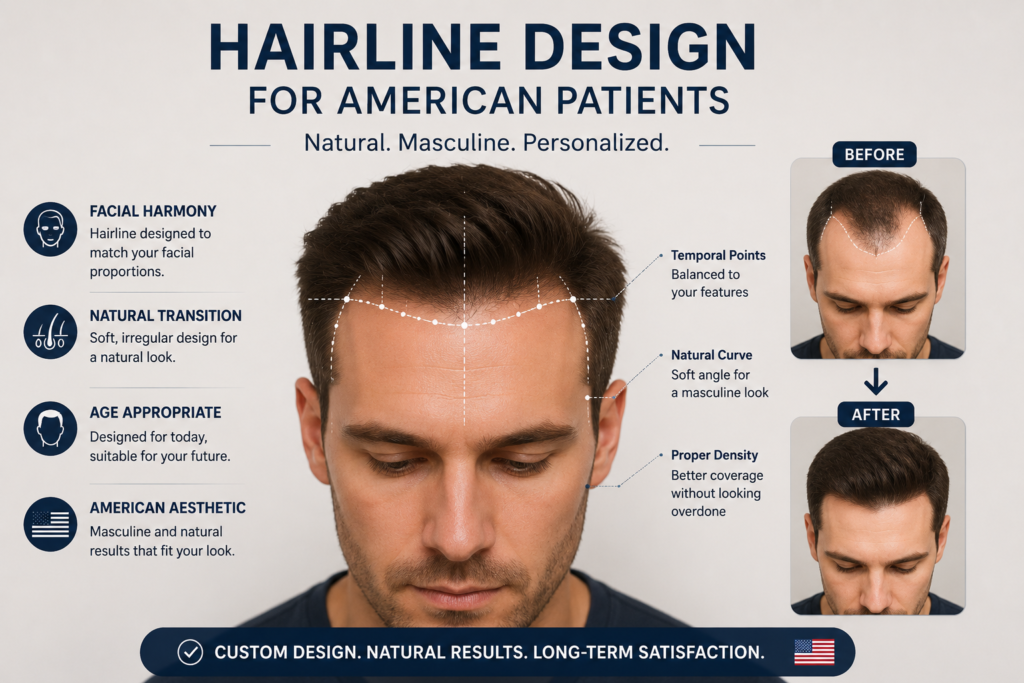
Designing a convincing hairline requires far more than artistic ability. It also involves understanding age, facial proportions, ethnicity, hair characteristics, and the likelihood of future hair loss.
American patients often tell us they don’t want anyone to know they’ve had surgery.
That’s exactly the point.
The best hair transplant is usually the one nobody notices.
Someone may simply comment that you look younger, healthier, or more rested without being able to identify why.
Creating that effect starts long before implantation begins.
Every follicular unit must be placed at the correct angle, depth, and direction so that new growth blends naturally with existing hair. Even a technically successful transplant can appear unnatural if those small details are ignored.
Rather than chasing unrealistic density at the very front of the scalp, experienced surgeons focus on creating the illusion of fullness through strategic placement and natural transitions.
The result is a hairline that fits the individual rather than following the same design used for every patient.
FUE and DHI in Practice
Patients researching hair restoration often find themselves comparing FUE and DHI before they fully understand what either technique actually involves.
Online discussions sometimes suggest that one method is universally better than the other, but the reality is more nuanced.
Both techniques can produce outstanding, natural-looking results when they’re performed for the right patient by an experienced medical team.
FUE, or Follicular Unit Extraction, remains the most widely used method worldwide. Individual follicular units are carefully removed from the donor area before being implanted into carefully prepared recipient sites. The technique is versatile, reliable, and particularly effective for treating larger areas of hair loss.
DHI, or Direct Hair Implantation, follows the same principle of transplanting individual follicles but uses a specialized implantation pen that allows grafts to be placed with exceptional precision. In selected patients, this can be especially useful when working between existing hairs or refining delicate areas such as the hairline.
Despite what some advertisements claim, the success of a hair transplant depends far less on whether the procedure is called FUE or DHI than on the quality of planning behind it.
A beautifully designed hairline, careful donor management, gentle handling of grafts, and thoughtful long-term planning will always have a greater impact on the final result than the name of the implantation technique itself.
At Hair Legends Clinic, the decision between FUE and DHI is never made for marketing purposes. Instead, it’s based on your pattern of hair loss, the condition of your donor area, your existing hair, and the outcome you’re hoping to achieve.
For some patients, FUE is clearly the better choice. For others, DHI offers specific advantages. In many cases, combining elements of both techniques provides the most natural and balanced result.
The technique should adapt to the patient not the other way around.
How U.S. and Antalya Pricing Actually Compare
One of the first questions American patients ask is, “Why is a hair transplant so much less expensive in Turkey?” It’s a fair question, especially when the difference can seem surprisingly large.
The explanation, however, isn’t as simple as many people think.
A lower price does not automatically mean lower quality, just as a higher price doesn’t always guarantee a better result.
Several economic factors influence the cost of a hair transplant. Labor costs, clinic operating expenses, insurance, taxes, salaries, and the overall cost of running a medical practice are significantly different in Turkey than they are in the United States. These differences allow reputable Turkish clinics to offer comprehensive treatment packages at a lower overall cost without necessarily compromising medical standards.
That said, patients should be cautious about choosing a clinic based on price alone.
If one clinic charges considerably less than every other reputable provider, it’s worth asking why. Sometimes the explanation is perfectly reasonable. Other times, extremely low prices may reflect rushed procedures, limited physician involvement, outdated equipment, or an emphasis on treating as many patients as possible in a single day.
The goal should never be to find the cheapest clinic.
It should be to find the clinic that offers the best balance between safety, medical expertise, transparency, and long-term value.
Many American patients who visit Hair Legends Clinic tell us they initially began researching Turkey because of pricing, but ultimately chose the clinic because they felt comfortable with the consultation process and appreciated the emphasis on realistic planning rather than sales tactics.
A hair transplant is something you’ll see every morning for the rest of your life. When viewed that way, the most important investment isn’t simply the procedure itself—it’s choosing the right team to perform it.
Stay Duration and the Return Flight Home
Another concern for many American patients is how much time they should plan to spend in Turkey.
The answer depends slightly on the treatment plan, but most patients do not need an extended stay.
A typical visit lasts around three to four nights. This schedule usually provides enough time for the consultation, surgery, the first postoperative examination, and the initial hair wash before travelling home.
Many patients arrive the day before surgery, giving themselves time to settle into the hotel, meet the medical team, and ask any remaining questions.
The procedure itself generally occupies most of the following day. Since hair transplantation requires patience and precision, surgery can take several hours depending on the number of grafts being transplanted.
The following morning is often dedicated to checking the scalp, reviewing aftercare instructions, and performing the first professional wash. This appointment is particularly important because patients learn exactly how to care for both the donor and recipient areas once they return home.
Flying after a hair transplant is usually possible once your doctor confirms that you’re ready to travel.
Most patients are pleasantly surprised by how manageable the recovery feels during the journey home. While some swelling and redness are entirely normal during the first few days, serious discomfort is uncommon when postoperative instructions are followed carefully.
Patients are generally advised to avoid pressure on the transplanted area during travel, remain hydrated, and continue following the medication schedule provided by the clinic.
Structured Aftercare After Returning Home
Many people assume that treatment ends when they leave the clinic.
In reality, successful hair transplantation continues long after the flight home.
The weeks and months following surgery are when the transplanted follicles begin adapting to their new location, making proper aftercare just as important as the procedure itself.
At Hair Legends Clinic, patients receive detailed written instructions before returning home, covering everything from washing techniques and sleeping positions to exercise restrictions and medication schedules.
Just as importantly, communication doesn’t stop after departure.
International patients often have questions during recovery.
Is this redness normal?
Why are some hairs falling out?
When can I exercise again?
Can I wear a hat?
These questions are completely normal, particularly for patients travelling thousands of miles from home.
Ongoing communication allows patients to receive reassurance and guidance throughout each stage of recovery instead of trying to interpret conflicting advice from internet forums.
The first few months often require the greatest patience.
Transplanted hairs commonly enter a temporary resting phase before new growth begins. Although this can be worrying for first-time patients, it forms part of the normal recovery process.
Gradually, new hairs begin emerging, becoming stronger and thicker over time.
Final results usually continue developing for up to twelve months, with some patients noticing subtle improvements even beyond that point.
Hair restoration should always be viewed as a process rather than a single day of treatment.
Realistic Results and Long-Term Planning
One of the biggest differences between an experienced clinic and an aggressive marketing campaign is how expectations are managed.
It’s understandable that patients want dramatic before-and-after photographs. Social media has created an environment where instant transformations often receive the most attention.
Hair restoration simply doesn’t work that way.
Even the most successful transplant follows biology, not marketing timelines.
The transplanted follicles require time to heal, rest, and begin producing new hair. Growth happens gradually, often so gradually that patients only appreciate the difference when comparing photographs taken several months apart.
Equally important is understanding that surgery doesn’t stop the natural ageing process.
If native hair continues to thin over the coming years, future treatment may eventually become appropriate.
This is why responsible surgeons think beyond the first procedure.
They consider donor preservation, future hair loss patterns, and how today’s decisions will affect tomorrow’s options.
Patients sometimes arrive hoping for an extremely low hairline combined with maximum density across the entire scalp.
While technically possible in certain situations, it isn’t always the most sensible long-term strategy.
A slightly more conservative approach often produces results that continue looking natural as patients move through different stages of life.
Ultimately, the best hair transplant isn’t the one that receives the most attention.
It’s the one that quietly becomes part of your appearance without anyone realizing surgery was ever performed.
Questions Worth Asking Any Clinic Before Booking
Choosing a clinic should involve far more than comparing prices or scrolling through social media photographs.
The consultation is your opportunity to understand how the clinic approaches treatment and whether their philosophy matches your expectations.
Some useful questions include:
Who designs the hairline?
Hairline design should never be treated as a routine step. It requires experience, aesthetic judgment, and careful planning.
How involved is the doctor during the procedure?
Understanding exactly who performs each stage of surgery helps avoid misunderstandings later.
How is the donor area evaluated?
A responsible clinic should explain not only how many grafts are available today but also how donor preservation influences future treatment possibilities.
What happens after I return to the United States?
Aftercare should extend beyond the day of surgery. Ask how follow-up communication is handled and who you should contact if questions arise during recovery.
What results are realistic for my level of hair loss?
Be cautious of guarantees that sound too good to be true.
An experienced clinic is usually more willing to discuss limitations than promises.
Honest conversations before surgery often lead to happier patients afterwards.
Why American Patients Choose Hair Legends Clinic
Every patient arrives with different expectations.
Some are mainly concerned about achieving a natural hairline.
Others want to preserve their donor area for the future.
Many simply want honest advice without feeling pressured into making immediate decisions.
Hair Legends Clinic has built its approach around those priorities.
Rather than following a high-volume model, the focus remains on careful planning, doctor involvement, and treatments designed for long-term success rather than short-term marketing.
Patients appreciate knowing that their consultation isn’t based solely on graft numbers.
Instead, discussions often include future hair loss, facial balance, donor management, recovery, and realistic expectations.
That level of planning helps patients understand not only what can be achieved today but also how today’s procedure fits into the future of their hair restoration journey.
For Americans considering a Hair Transplant in Antalya, confidence comes from knowing exactly who will be involved in the procedure, why certain recommendations are made, and what to expect once they return home.
Hair transplantation is ultimately about trust.
The surgery lasts only a day, but the results remain with you for years. Choosing a clinic that values transparency, individualized care, and long-term thinking can make all the difference—not only in how your hair looks, but in how confident you feel about the decision you made.
Frequently Asked Questions
Is Antalya safe for a hair transplant?
Yes. Antalya is considered one of Turkey’s leading medical tourism destinations and welcomes thousands of international patients every year. The city has a modern healthcare infrastructure, an international airport with direct and connecting flights from many countries, and a well-established hospitality industry.
That said, your experience depends far more on the clinic you choose than on the destination itself.
Before booking, take time to research the medical team, verify the clinic’s credentials, read independent patient reviews, and make sure you understand exactly who will perform each stage of the procedure.
At Hair Legends Clinic, international patients receive detailed guidance before arriving in Antalya, including travel assistance, accommodation arrangements, airport transfers, and postoperative instructions. Having a structured plan in place helps patients focus on their recovery rather than worrying about logistics.
Why is the procedure less expensive in Antalya than in the United States?
This is probably the question American patients ask most often.
Many people assume that a lower price means lower quality, but that isn’t necessarily true.
Hair transplantation costs are influenced by much more than the surgery itself. Clinic operating expenses, staff salaries, taxes, insurance costs, and general business overhead are significantly lower in Turkey than in the United States. These differences allow many reputable clinics to provide comprehensive treatment packages at a more accessible price.
However, lower costs should never be the only reason for choosing a clinic.
It’s important to look at what is included in the treatment plan, how involved the doctor will be, what level of aftercare is provided, and whether the clinic has a reputation for producing consistent, natural-looking results.
The value of a hair transplant should always be measured by the quality of the outcome rather than the price tag alone.
How many days should I plan to stay in Antalya?
Most international patients stay between three and four nights.
This schedule generally allows enough time for the initial consultation, surgery, postoperative examination, and the first professional hair wash before travelling home.
Some patients choose to stay an additional day simply because they prefer a more relaxed recovery before taking a long flight.
Your exact itinerary may vary depending on your treatment plan, but most patients are pleasantly surprised by how efficiently the process is organized.
Before leaving Antalya, your medical team should make sure you understand how to wash your hair, take your medications, protect the transplanted area, and recognize the normal stages of recovery.
Is DHI better than FUE?
There isn’t a simple yes or no answer.
One of the biggest misconceptions in hair restoration is that one technique is automatically superior to another.
Both DHI and FUE can produce outstanding results when performed by an experienced medical team.
FUE is an excellent option for many patients who require larger areas of coverage, while DHI may offer advantages in selected cases where precise implantation between existing hairs is important.
Rather than asking which technique is better, it’s more helpful to ask which technique is better for your specific pattern of hair loss.
An experienced doctor will recommend the method that best suits your donor area, existing hair density, long-term goals, and expected outcome.
How many grafts will I need?
There is no universal answer because every patient’s scalp is different.
The number of grafts required depends on several factors, including:
- The size of the thinning area
- Hair characteristics
- Donor availability
- Hair density
- Future hair loss
- Desired level of coverage
Some patients achieve excellent cosmetic improvement with fewer grafts than expected, while others require larger sessions to restore multiple areas.
A responsible clinic will never recommend a graft number without first examining your donor area and discussing your long-term treatment plan.
At Hair Legends Clinic, graft planning focuses on achieving natural density while preserving donor resources for the future whenever possible.
How long does it take to see the final result?
Patience is one of the most important parts of the hair transplant journey.
Although the surgery itself is completed in a single day, hair growth follows a natural biological process that cannot be rushed.
During the first few weeks, transplanted hairs often shed before entering a temporary resting phase.
This stage is completely normal and should not be mistaken for treatment failure.
New growth usually begins to appear between the third and fourth month.
By six months, many patients notice significant improvement in density.
The most noticeable transformation often occurs between nine and twelve months after surgery, although subtle maturation may continue beyond the first year.
Looking at monthly photographs rather than checking your hair every day often provides a much clearer picture of progress.
What happens if I have a problem after returning home?
One of the biggest concerns for patients travelling internationally is what happens after they leave Turkey.
This is where communication becomes extremely important.
A reputable clinic should remain available to answer questions throughout your recovery rather than ending contact once you board your flight home.
Whether you’re concerned about swelling, temporary shedding, redness, washing techniques, or medication, having direct access to your medical team provides reassurance during every stage of healing.
At Hair Legends Clinic, follow-up care continues after patients return home. Recovery guidance, progress evaluations, and ongoing support help ensure that patients feel confident throughout the months following surgery.
Hair transplantation doesn’t end when you leave the clinic.
The relationship between patient and medical team continues until the final result has fully developed.
Final Thoughts
Choosing to travel abroad for a hair transplant is a significant decision, especially when you’re travelling thousands of miles from home. It’s natural to compare destinations, techniques, prices, and clinics before deciding where to place your trust.
While Antalya has earned its reputation as one of the world’s leading hair restoration destinations, the city itself is only part of the equation. The experience you have and ultimately the result you achieve depends on the people planning and performing your procedure.
A successful hair transplant isn’t measured by the number of grafts alone. It’s measured by how natural your hairline looks, how well your donor area has been preserved, and how confidently your results age over the years. Those outcomes come from careful planning, honest communication, and a medical team that prioritizes long-term success over short-term promises.
At Hair Legends Clinic, every treatment is planned with the future in mind. From your first consultation to your final follow-up, the focus remains on individualized care, realistic expectations, and creating results that complement your facial features rather than chasing temporary trends.
If you’re considering a Hair Transplant in Antalya, take the time to ask questions, compare clinics carefully, and choose a team that values transparency as much as technical skill. The right clinic won’t simply tell you what you want to hear it will help you make the decision that’s best for your hair, your appearance, and your long-term confidence.
Your hair transplant is only one day.
Your results should last for many years.