
Hair Transplant by Doctor: In the rapidly expanding world of hair restoration, a dangerous trend has emerged: the rise of the Technician Only clinic. In these high volume facilities, often referred to as hair mills, the most critical, life altering phases of the surgery are delegated to unlicensed assistants with minimal medical oversight. At Hair Legends Antalya, we believe this is not just an aesthetic risk but a medical failure. A truly successful hair transplant is a symphony of two distinct disciplines: Surgical Science and Artistic Vision. While technicians play a vital role in the labor intensive task of graft sorting and placement, the architectural blueprint of your new hair must be executed by a specialized surgeon. This masterclass explores why Surgeon Led Channel Opening is the invisible boundary between a pluggy transplant and a legendary masterpiece.
The Hierarchy of the Operating Room: Surgeon vs. Technician
To understand why the surgeon’s hand is indispensable, one must understand the three primary stages of an FUE or Sapphire FUE procedure. First is the Extraction, which is the removing of individual follicular units from the donor area. Second is the Channel Opening (Incision), which is the creating of the tiny sockets where the hair will live. Third is the Implantation, which is the placing of the grafts into those sockets.
In a hair mill, the surgeon might only appear for five minutes to draw a hairline and then disappear to manage five other simultaneous surgeries. The technicians then perform the extraction and, crucially, the channel opening. The Hair Legends Difference is our philosophy that the surgeon is the lead architect. While an elite team of technicians assists in the labor intensive placement, the Surgeon Led Protocol ensures that the doctor is the one who makes every single incision. This is because the channel opening stage is where the DNA of your future look is determined.
Channel Opening: The Blueprint of Naturalness
If the extraction is the harvesting of the seeds, then channel opening is the plowing of the field. If the holes are made at the wrong angle, the wrong depth, or in a rigid, unnatural pattern, no amount of high quality hair will save the result. There are four technical variables that only a surgeon’s trained hand and medical judgment can master.
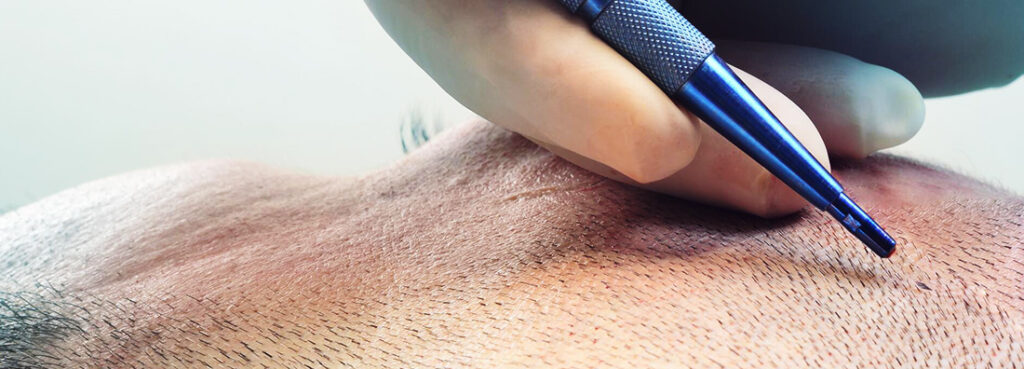
1. The Angle of Emergence (Elevation)
Hair does not grow straight up at a 90 degree angle. Depending on the zone of the scalp, hair emerges at angles ranging from 10 to 45 degrees. The frontal hairline requires an ultra low angle of about 15 to 20 degrees to create a soft, forward leaning look. The temples require an almost flat angle of 10 degrees to hug the skin of the face. The crown requires a complex, shifting angle that follows a 360 degree spiral. Technicians often use a standard 45 degree angle because it is easier and faster, but the result is picket fence hair that stands stiffly and cannot be styled naturally. A surgeon led approach ensures that every incision respects the natural elevation of your original hair.
2. Directionality (The Compass)
Every hair on your head has a compass heading. On the left side, hair might lean slightly toward the ear; in the center, it points forward; at the cowlick, it swirls. A surgeon uses their anatomical knowledge to read the scalp and mimic these subtle shifts. If the direction is off by even 5 degrees, the hair will clash with your existing follicles, making it impossible to comb or style. A technician following a generic pattern can never replicate the intricate flow of a natural scalp.
3. Distribution and Density (The Mosaic)
A surgeon understands that density is an illusion created by strategic placement. Instead of a grid like pattern, which looks artificial, a surgeon creates a stochastic mosaic. This involves placing grafts in a deliberate, irregular cluster pattern that mimics the natural density gradients of a human scalp. This technique ensures that the eye does not perceive a line of hair but rather a field of natural growth.
4. Depth Perception and Tissue Health
If a channel is too deep, it can cause pitting where the graft sinks into a small crater. If it is too shallow, it causes cobblestoning where the graft sits on a visible bump. A surgeon’s tactile feedback and years of experience allow them to hit the perfect depth in the dermis every single time. This ensures a smooth, skin level finish and protects the underlying vascular structure of the scalp.
The Sapphire Advantage: A Surgeon’s Precision Tool
At Hair Legends Antalya, we utilize Sapphire FUE technology specifically because it enhances the surgeon’s ability to execute these variables. Traditional steel blades are flat and lose their sharpness quickly, leading to larger incisions and more tissue trauma. Sapphire blades, made from synthetic gemstone, are V shaped and incredibly sharp.
The V shaped incisions allow the surgeon to place grafts closer together for high definition density without compromising blood flow. Because the blades are so sharp, the surgeon uses less pressure, which means less swelling, less bleeding, and a faster recovery for the patient. The antimicrobial properties of the smooth sapphire surface also reduce the risk of infection, which is a critical component of our medical safety standards.
The Danger of the Technician Only Model
Why do hairmills avoid surgeon led procedures? It is a matter of economics, not medicine. A surgeon is expensive and can only perform one or two procedures a day with the required focus. A technician led clinic can run assembly line surgeries, maximizing profit at the expense of the patient’s donor area and aesthetic future. The risks of technician led channel opening include over harvesting, tissue necrosis, and the dreaded pluggy look. Inexperienced hands may create incisions too close together, compromising blood flow and leading to graft failure.
The Architecture of Implantation — DHI Mastery, Graft Survival, and the Final Medical Verdict
While the first part of this masterclass established the critical importance of surgeon-led channel opening and the structural superiority of Sapphire FUE, the second phase of a legendary hair restoration involves the complex science of biological integration. At Hair Legends Antalya, we believe that once the “soil is prepared” through precise channel opening, the “planting of the seeds” requires an equal level of medical rigor. This second part explores the revolutionary DHI (Direct Hair Implantation) technique, the physiological requirements of graft survival, and the operational ethics that separate a boutique clinic from an industrial assembly line.
The DHI Revolution: Direct Control and Rotational Precision
Direct Hair Implantation, commonly known as DHI, represents the high-tech evolution of hair restoration. In a standard FUE procedure, there is a distinct time gap between opening the channels and placing the grafts. DHI eliminates this gap by using a specialized medical instrument known as the Choi Implanter Pen. This tool allows the surgeon to perform the incision and the implantation simultaneously.
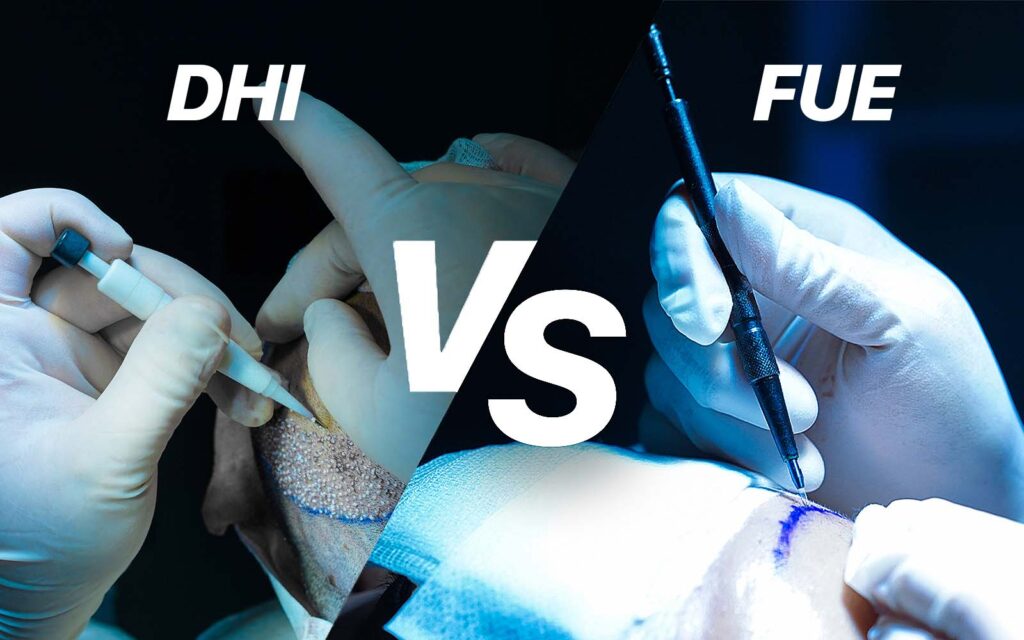
1. The Surgeon’s Hand on the Choi Pen
In many high-volume clinics, DHI is marketed as a luxury add-on, yet the actual pens are handed to junior technicians who lack the anatomical training to manage complex angles. In a surgeon-led boutique environment, the doctor personally utilizes the Choi Pen to dictate three vital factors:
- Depth Calibration: The Choi Pen has a micrometric adjustment that allows the surgeon to set the exact depth of the follicle. This prevents the “pitting” or “cobblestoning” mentioned in Part 1, ensuring the graft sits perfectly flush with the skin surface.
- Rotational Alignment: Hair does not just grow in a direction; it has a subtle twist or rotation as it emerges. A surgeon can rotate the Choi Pen during the moment of insertion to match the natural “whorl” or spiral of your scalp, a level of detail that a technician-led factory simply cannot provide.
- Force Management: Applying too much pressure during implantation can traumatize the delicate bulb of the hair follicle. A surgeon’s tactile sensitivity ensures that the graft is “guided” into place rather than “forced,” leading to nearly 100% survival rates.
2. Maximum Density (High-Definition Results)
DHI allows for a significantly higher density of grafts per square centimeter. Because the Choi Pen creates a circular, microscopic opening rather than a lateral slit, the surrounding tissue remains intact. This allows the surgeon to place grafts closer together without compromising the blood supply (vascularity) of the scalp. For patients seeking a “High-Definition” hairline that looks dense even under harsh bathroom lighting, the surgeon-led DHI approach is the only viable option.
The Science of Graft Survival: The “Cold Chain” and Biological Viability
A hair follicle is a living organ. Once it is extracted from the donor area, it begins a race against time. In a “hair mill” where surgeons are absent, follicles are often left in standard saline solutions at room temperature for hours while technicians struggle through the workload. This leads to “graft desiccation” (drying out) and a significant drop in survival rates.
1. The Bio-Preservation Protocol
At Hair Legends Antalya, we treat every follicle as a precious resource. Our surgeon-led team utilizes advanced storage solutions, often enriched with HypoThermosol or specialized growth factors, maintained at a strict 4°C (39°F). This “Cold Chain” management slows down the metabolic rate of the follicle, ensuring that it remains in a state of “suspended animation” until it is safely implanted back into the scalp.
2. Minimizing “Out-of-Body” Time
By limiting our daily patient count, our surgeons can ensure that grafts are out of the body for the shortest possible duration. In an assembly line clinic, a graft might sit on a tray for 4 to 6 hours. At our boutique clinic, the surgeon-led workflow ensures that grafts are re-implanted in small batches, often within 60 to 90 minutes of extraction. This drastically increases the “take rate” and ensures that your result is thick, uniform, and permanent.
Anesthesia and Patient Safety: The Medical Foundation
One of the most overlooked aspects of the “package service” model is the administration of local anesthesia. In unlicensed clinics, technicians often administer high doses of lidocaine without proper monitoring of the patient’s heart rate or blood pressure. This is a severe medical risk.
1. Surgeon Monitored Pain Management
A surgeon-led clinic prioritizes patient comfort through advanced techniques like Pressure-Guided Needleless Anesthesia. This reduces the initial sting of the injection and ensures that the numbing agent is distributed evenly across the dermal layers. Throughout the procedure, a medical professional monitors the patient’s vital signs, adjusting the dosage to ensure the patient remains comfortable without the risk of “lidocaine toxicity,” which can occur in high-volume settings.
2. Emergency Preparedness
A boutique clinic operating under a surgeon’s license is equipped with full emergency response kits and advanced cardiac monitoring. While complications are rare in hair transplants, a surgeon is trained to handle allergic reactions or vasovagal syncope (fainting) immediately and effectively. A technician-led facility is simply not legally or medically prepared for these rare but serious scenarios.
The Ethics of Donor Management: Protecting the “Genetic Capital”
A “hair mill” will often promise “maximum grafts” to a patient regardless of their donor capacity. This is an ethical violation known as Over-Harvesting. If a clinic takes 5,000 grafts from a donor area that can only safely provide 3,500, the back of the head will look “moth-eaten” or scarred, and the patient will have no hair left for a future procedure as they continue to age.
1. The Surgeon’s Long-Term Roadmap
A surgeon thinks 10 to 20 years into the patient’s future. At Hair Legends Antalya, we perform a “Trichoscopic Analysis” of the donor area to determine its exact density and follicular health. Our surgeon then designs a plan that achieves a “Legendary” result today while preserving a “Safety Reserve” of grafts for the future. We practice Diffuse Extraction, skipping follicles in a calculated matrix to ensure the donor area looks completely untouched once it heals.
Post-Operative Mentorship: The 12-Month Relationship
The surgery is only 50% of the journey. The remaining 50% happens during the 12-month healing process. Industrial clinics often ignore patients once they have paid their fees, leading to anxiety and poor results due to improper aftercare.
1. Clinical Aftercare vs. Hotel Service
We believe that the first 10 days after surgery are a “Medical Window.” Our boutique model includes daily digital check-ins and a specialized first wash performed under medical supervision. We provide a customized recovery kit containing pharmaceutical-grade shampoos, growth factor serums, and specific anti-inflammatory medications tailored to your scalp’s sensitivity.
2. The Role of the Surgeon in Follow-Ups
When a patient has a question at month four (during the “Shedding Phase”), they aren’t talking to a salesperson; they are receiving advice rooted in the surgeon’s original surgical plan. This continuity of care ensures that if a patient needs a PRP (Platelet-Rich Plasma) boost or a change in their topical medication, it is handled with professional medical accuracy.
Why the Boutique Model is the Only Choice for “Legends”
To be considered among the “Best Hair Transplant Clinics in Antalya,” a facility must transcend the “package” mentality. A hair transplant is a permanent change to your physical appearance. It is a surgery, a design project, and a biological integration all in one.
The Hair Legends Commitment:
- No Assembly Lines: We limit our intake to ensure the surgeon’s focus remains 100% on your scalp.
- Artistic Superiority: We reject templates in favor of the Golden Ratio and European Aesthetic standards.
- Medical Accountability: Every incision, every graft calculation, and every safety protocol is owned by a licensed surgeon.
- Transparent Pricing: We don’t hide behind “all-inclusive” buzzwords to mask a lack of quality. Our value lies in our surgical excellence.
Choosing Hair Legends Antalya means choosing a legacy of quality over a factory of quantity. By prioritizing surgeon-led precision and boutique-level care, we ensure that your hair restoration is not just a procedure, but a life-changing masterpiece that remains natural, dense, and “Legendary” for a lifetime.