
Hair Growth Cycle: If you’ve ever noticed more hair than usual on your pillow, in the shower or on your hairbrush, it’s easy to assume that you’re going bald. But shedding and hair loss aren’t always the same thing.
Hair is constantly moving through a natural cycle. Some follicles are producing new hair while others are resting, and some are releasing an old hair so that the next one can eventually grow. At any given moment, thousands of hairs are somewhere in this process.
The difficult part is knowing when what you’re seeing is normal and when it deserves a closer look.
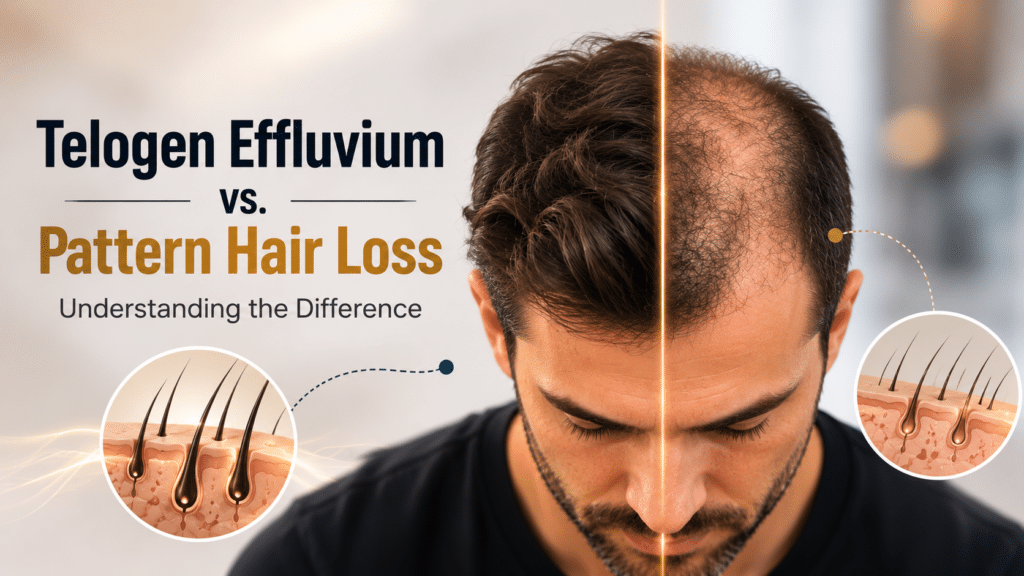
A few extra hairs in the shower may mean very little. On the other hand, a sudden increase in shedding, a widening part, a receding hairline or gradually increasing scalp visibility can point to a different problem.
Understanding the hair growth cycle makes these changes easier to put into context. It also explains why hair loss treatments rarely produce overnight results and why a stressful event that happened months ago can sometimes be responsible for the shedding you’re noticing today.
The Three Phases of the Hair Growth Cycle
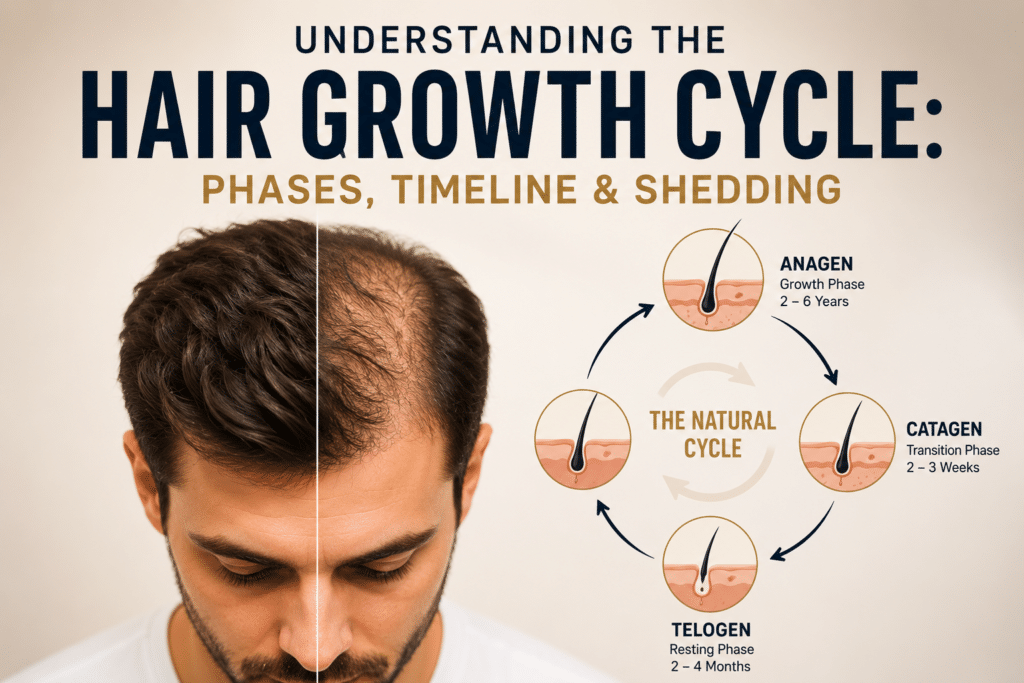
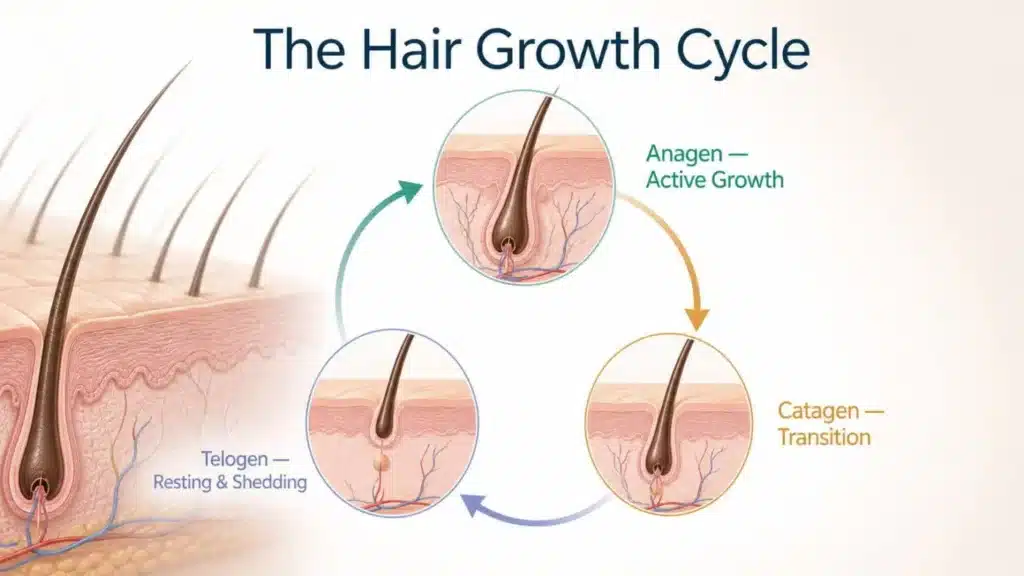
Every scalp hair goes through three main stages: anagen, catagen and telogen. The length of each phase varies between individuals, and the follicles don’t all move through the cycle at the same time. That’s what allows us to keep most of the hair on our heads while individual strands are naturally shed.
Anagen: The Active Growth Phase
Anagen is the part of the cycle when your hair is actively growing.
The cells at the base of the follicle are highly active, producing the hair shaft that eventually emerges from the scalp. Scalp hair can remain in this phase for several years, which is one reason some people can grow their hair very long while others seem to reach a maximum length much sooner.
Most of the hairs on a healthy scalp are normally in the growth phase at any given time. The exact proportion varies, but it is generally the large majority of scalp hairs.
The length of the anagen phase also matters when looking at hair loss. If a follicle remains productive for years, it has plenty of time to produce a long, strong hair shaft. If the growth phase becomes progressively shorter, the resulting hairs may become finer and shorter.
This is one of the changes seen in androgenetic alopecia, commonly known as male or female pattern hair loss.
Catagen: The Transition Phase
Catagen is much shorter than anagen.
During this stage, active hair production slows down and the lower part of the follicle begins to shrink. The hair is no longer growing in the same way, but it hasn’t been shed yet.
The transition generally lasts only a few weeks.
There isn’t much that you can see from the outside during catagen. The important changes are happening inside the follicle as it prepares to enter the resting phase.
Telogen: The Resting and Shedding Phase
Telogen is the resting stage.
The follicle becomes inactive for a period of time and eventually releases the old hair. That hair then sheds, leaving the follicle available to begin another growth cycle.
This is why normal shedding shouldn’t automatically be interpreted as permanent hair loss.
The important distinction is what happens next.
If the follicle remains healthy, a new hair can eventually begin growing. If the follicle is gradually becoming smaller because of a condition such as androgenetic alopecia, the replacement hair may be thinner than the previous one.
That’s why someone can lose a similar number of hairs from day to day but still experience progressive thinning over several years.
How Much Hair Shedding Is Normal?
There is no single number that applies perfectly to everyone, but daily shedding is a normal part of having hair.
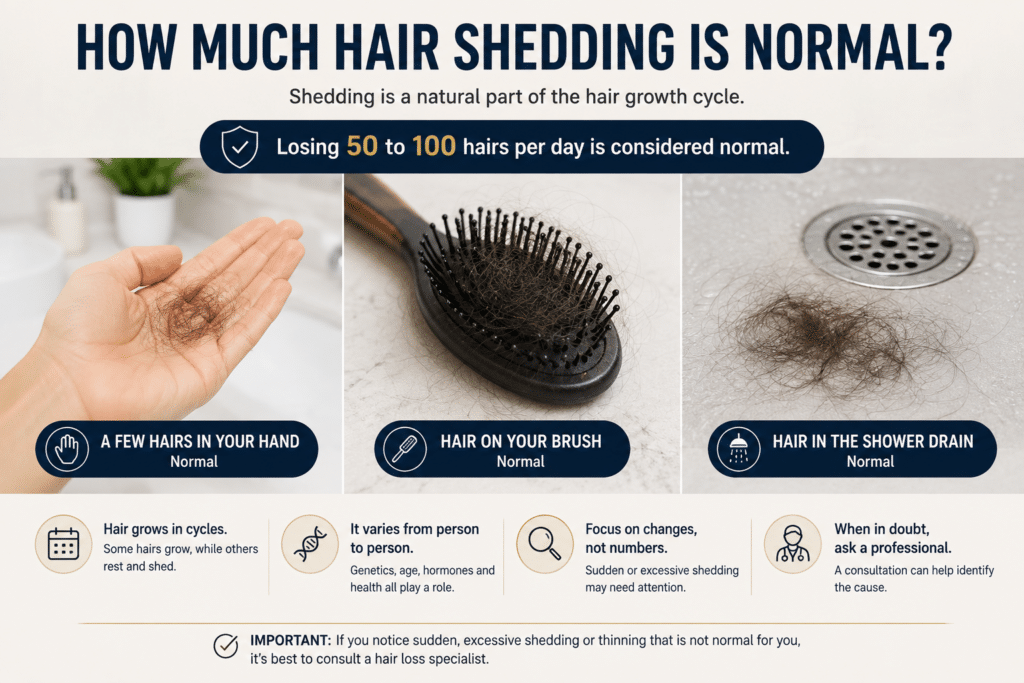
The American Academy of Dermatology notes that losing around 50 to 100 hairs a day can be normal. Cleveland Clinic also describes daily shedding as part of the normal hair cycle. (AAD)
The number can be difficult to judge in real life.
Someone who washes their hair every day may notice a small amount of shedding each time. Someone who washes every three or four days may see considerably more hair in the shower simply because several days of naturally shed hairs are being removed at once.
Hair length can also make shedding look more dramatic. A handful of long hairs can look like much more hair than the same number of short hairs.
Rather than counting every strand, pay attention to changes in your normal pattern.
If your hairbrush suddenly contains considerably more hair than usual, your shower drain is collecting noticeably more strands, or your overall density seems to be changing, that’s more useful information than trying to reach an exact daily number.
Common Causes of Increased Shedding and Typical Recovery Patterns
Hair can respond to changes in the body surprisingly slowly.
A person may go through a major illness, a period of intense stress, significant weight loss or surgery and feel completely fine afterward only to notice increased shedding several weeks later.
That delay can make the cause difficult to recognize.
The hair cycle doesn’t always respond immediately to an event. In conditions such as telogen effluvium, increased shedding often becomes noticeable around two to three months after the triggering event.
There are many possible triggers.
A high fever or serious infection can affect the hair cycle. Major surgery and significant psychological stress may do the same. Rapid weight loss and restrictive diets can also play a role, particularly when nutritional intake becomes inadequate. Hormonal changes, certain medications and other medical conditions can contribute as well.
This is one reason it’s useful to think back over the previous few months when sudden shedding begins.
The event that caused the change may have happened long before you noticed the hair coming out.
Stress and Hair Shedding
Stress is often blamed for hair loss, but the relationship is more complicated than simply saying “stress causes baldness.”
Short periods of ordinary daily stress aren’t necessarily enough to cause noticeable shedding. More significant physical or emotional stress can trigger a shift in the hair cycle in susceptible people.
If the trigger is temporary and the follicles remain healthy, shedding can eventually settle as the cycle returns to normal.
That doesn’t mean recovery happens immediately.
Hair grows slowly, and even after excessive shedding stops, it takes time before new growth becomes long enough and thick enough to make a visible difference.
Weight Loss and Restrictive Diets
Rapid weight loss is another commonly overlooked trigger.
When someone dramatically reduces their calorie intake or follows a restrictive diet, the body has to adjust to the change. If the diet also lacks adequate protein or important nutrients, hair growth can be affected.
This is particularly relevant for people who lose a significant amount of weight in a short period.
The solution isn’t automatically to take a large number of supplements. If nutritional deficiency is suspected, it’s better to identify the actual problem and discuss appropriate testing or dietary changes with a healthcare professional.
Illness, Fever and Surgery
A significant illness can temporarily disrupt the normal hair cycle.
High fever, severe infections and major surgery are recognised triggers of increased shedding.
Again, the timing can be confusing.
You may recover from the illness and feel completely back to normal before the hair shedding begins. That doesn’t necessarily mean the two events are unrelated.
Keeping a simple record of major illnesses, operations, medication changes, weight changes and periods of significant stress can be surprisingly useful when discussing hair loss with a doctor.
Telogen Effluvium: When Shedding Increases Temporarily
Telogen effluvium is one of the most common explanations for sudden, diffuse hair shedding.
Instead of losing hair from one clearly defined area, people usually notice more shedding across the scalp. The hair may seem to come out in the shower, on the pillow or while brushing.
The scalp itself generally looks healthy. There shouldn’t normally be an obvious rash, severe inflammation or painful scalp associated with uncomplicated telogen effluvium.
What has happened is essentially a shift in the hair cycle.
A larger-than-usual number of follicles enter the resting phase, and those hairs are eventually shed. The trigger may have occurred weeks or months earlier.
This can be frightening because the amount of hair coming out may seem completely disproportionate to what someone normally experiences.
The reassuring part is that telogen effluvium is often temporary.
Acute cases generally resolve within months, although the exact recovery period varies. The American Academy of Dermatology notes that normal fullness often returns within six to nine months after the excessive shedding settles, while Cleveland Clinic describes hair regrowth commonly becoming noticeable within several months. (AAD)
That doesn’t mean every case should simply be ignored.
If shedding continues for a long time, becomes severe, or is accompanied by other symptoms, a professional assessment is worthwhile.
Telogen Effluvium vs. Pattern Hair Loss
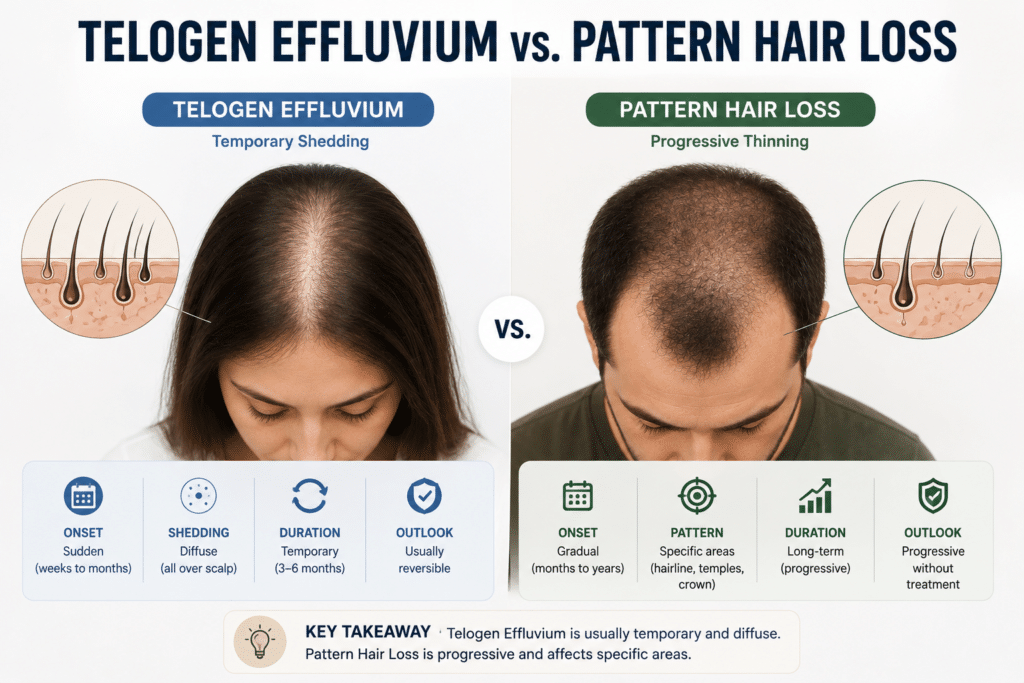
This distinction is particularly important.
Telogen effluvium usually causes a relatively sudden increase in shedding. Pattern hair loss tends to be much slower and more predictable.
With male pattern hair loss, for example, the temples may gradually recede, the crown may become thinner, or the hair across the top of the scalp may slowly lose density.
The two conditions can also occur together.
Someone may already have androgenetic alopecia and then experience a period of telogen effluvium after illness or major stress. The temporary shedding can make the underlying pattern hair loss much more obvious.
That’s one reason self-diagnosing based only on the amount of hair in the shower can be misleading.
The pattern, timing and appearance of the scalp matter.
When Shedding Becomes More Noticeable After a Hair Transplant
Hair shedding can also be confusing for people who have undergone a hair transplant.
Transplanted follicles don’t immediately produce mature hair. The newly transplanted hairs can enter a temporary shedding phase before new growth begins.
This is one reason patients should not judge the success of a transplant during the first few weeks or months.
Hair restoration follows the biology of the follicle. The procedure moves healthy follicles from one area to another, but it cannot force them to skip their natural growth cycle.
The same principle applies to native hair surrounding the transplanted area.
If those follicles are genetically susceptible to pattern hair loss, they may continue to thin even after a successful transplant.
For patients considering a Hair Transplant Antalya procedure, understanding this distinction before surgery can prevent a lot of unnecessary anxiety later. A hair transplant restores selected areas, but long-term hair preservation may require a broader strategy.
How Long Does It Take for Hair to Grow?
Hair growth is slow enough that patients often become impatient.
After an episode of increased shedding, you may notice short new hairs appearing before you see any meaningful change in overall density. That’s because a newly growing hair has to reach a certain length before it contributes much to the appearance of fullness.
The same is true after hair transplantation.
A procedure can be completed in a day, but the final cosmetic result develops over many months.
This is why photographs taken at regular intervals are often more useful than checking the mirror every morning. Small changes are difficult to notice when you see yourself every day.
Comparing photographs from month three, six, nine and twelve can give you a much clearer picture of how the hair is developing.
How a Hair Loss Consultation Can Help
When someone notices increased shedding, the first instinct is often to search for a treatment.
A better first question is:
Why is this happening?
There are many different causes of hair loss, and the appropriate treatment depends on the diagnosis.
During a professional consultation, the doctor can look at the distribution of thinning, the condition of the scalp, the characteristics of the hair and the patient’s medical and family history.
They may also ask about recent illness, stress, weight changes, diet, medications and other events that occurred before the shedding began.
Depending on the situation, additional tests may be appropriate. Cleveland Clinic notes that blood tests or other investigations may be recommended when another underlying condition is suspected.
A consultation is particularly useful when the pattern isn’t obvious.
If the problem is temporary shedding, a hair transplant may be completely unnecessary.
If the follicles are gradually miniaturising because of androgenetic alopecia, early medical treatment may be worth discussing.
If permanent hair loss has already developed and the donor area is suitable, transplantation may eventually become an option.
These are very different situations, even though all three can begin with the simple complaint of “my hair is falling out.”
What Can You Do to Support Healthy Hair Growth?
There is no magic routine that can completely prevent hair loss, especially when genetics play a major role.
Still, basic habits matter.
Eating a balanced diet, getting adequate protein, avoiding extreme dieting and addressing significant stress can support general health and create better conditions for normal hair growth. If you suspect a deficiency, it’s better to discuss it with a healthcare professional rather than taking high-dose supplements without knowing whether you need them.
Hair care also matters, although shampoo alone cannot reverse genetic hair loss.
Avoiding unnecessary traction, excessive heat and harsh chemical treatments can help reduce damage to the hair shaft. Remember, however, that damaged hair and follicle-level hair loss are not the same thing.
One affects the hair you already have.
The other affects how new hair is produced.
When Should You See a Hair Loss Specialist?
You don’t need to panic every time you lose more hair than usual.
But there are situations where getting an assessment makes sense.
Consider speaking with a qualified doctor if shedding is sudden or severe, continues for several months, creates obvious thinning, produces bald patches, or is accompanied by scalp symptoms.
A consultation is also worthwhile if your hairline is steadily changing or the crown is becoming progressively thinner.
Early assessment doesn’t necessarily mean you’ll need a procedure.
In fact, one of the benefits of getting the cause identified early is that you may discover that surgery isn’t necessary at all.
For people who eventually do need surgical restoration, understanding the condition of the hair before significant donor resources are lost can make future planning much easier.
Frequently Asked Questions
Is shedding every day normal?
Yes. Some daily shedding is expected because individual hairs naturally reach the end of their growth cycle. The American Academy of Dermatology estimates that losing around 50 to 100 hairs per day can be normal.
Does washing your hair cause hair loss?
Washing doesn’t normally cause healthy follicles to become permanently damaged. You may simply notice hairs that had already reached the shedding stage coming out during the shower.
Why am I suddenly losing more hair than before?
Temporary increased shedding can follow stress, illness, fever, surgery, significant weight loss, hormonal changes or certain medications. The timing of the trigger is important because the shedding may not appear until weeks or months later.
Is telogen effluvium permanent?
Usually not. Acute telogen effluvium is generally temporary, although recovery takes time. If the shedding continues beyond the expected period, the underlying cause should be reassessed.
Can stress make hair fall out?
Significant physical or emotional stress can contribute to excessive shedding. However, not every case of hair loss is caused by stress, so persistent or progressive thinning should be properly assessed.
Does hair grow back after shedding?
If the follicles remain healthy and the underlying trigger has been resolved, hair can regrow. The visible recovery can take several months because hair growth itself is gradual.
When should I consider a hair transplant?
A hair transplant is generally considered when there is permanent hair loss, an appropriate donor supply and a treatment plan that can produce a natural result. Temporary shedding conditions such as uncomplicated telogen effluvium are not normally reasons to rush into surgery.
Can a Hair Transplant Antalya procedure stop future hair loss?
A transplant can restore hair to selected areas, but it doesn’t stop the underlying genetic process that causes pattern hair loss in native follicles. Long-term planning is therefore important.
Final Thoughts
Hair shedding can look alarming when you see it happening in real time, but the hair growth cycle is much more complicated than the number of strands you find in your shower.
Some shedding is simply part of normal biology. Other episodes may follow stress, illness, surgery, weight loss or hormonal changes and eventually settle. Pattern hair loss is different again, progressing gradually as susceptible follicles become smaller over time.
The most useful thing you can do is look at the bigger picture.
When did the shedding begin? Was anything significant happening a few months beforehand? Is the hair coming out evenly across the scalp, or are the temples and crown gradually becoming thinner? Has your hairline changed? Are the hairs becoming finer?
Those details often tell a much clearer story than counting individual strands.
At Hair Legends, we believe understanding the cause of hair loss should come before deciding how to treat it. For patients considering Hair Transplant Antalya, a proper assessment of the existing hair, donor area and future pattern of hair loss is an important part of creating a sensible treatment plan.
A hair transplant can be an effective solution for suitable candidates, but it should be viewed as one part of a long-term hair restoration strategy rather than a quick answer to every type of shedding.
If your hair has suddenly started falling out, don’t assume the worst. And if you’ve noticed gradual thinning over time, don’t wait until the available options become more limited.
Understanding your hair growth cycle is a good place to start.