
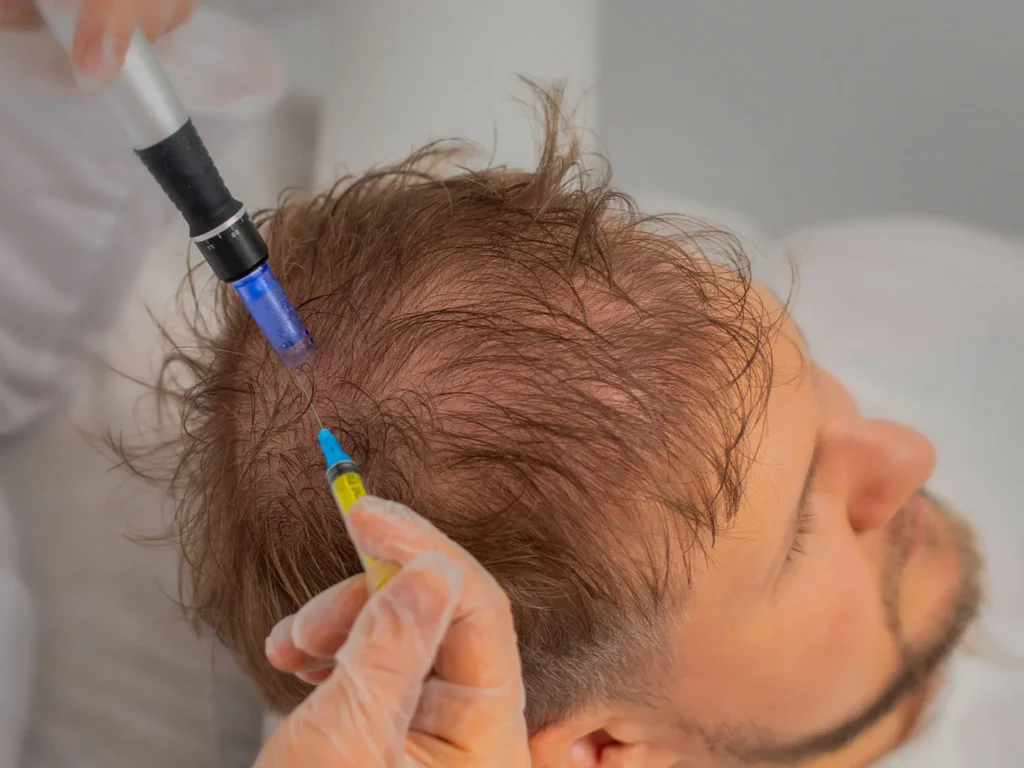
Exosome Hair Loss Treatment: In the 2026 landscape of regenerative medicine in Antalya, Exosome Hair Therapy represents a revolutionary shift from physical transplantation to molecular signaling. It is a non-surgical, cell-free intervention that utilizes nanovesicles (measuring 30–150 nanometers) to restore cellular communication within the scalp. These microscopic “data packets,” naturally secreted by stem cells, carry a potent cargo of microRNAs, proteins, and growth factors designed to instruct dormant follicles to repair and regrow.
In cases of Androgenetic Alopecia, follicles often shrink and become “deaf” to the body’s natural growth cues due to DHT and micro-inflammation. Exosomes act as biological translators, delivering critical signals like VEGF, IGF-1, and Wnt/β-catenin to switch hair-cycle genes back to the “on” position. At Hair Legends Antalya, we focus on patients with thinning, vellus-leaning hairs; the follicle structure still exists, it simply lacks the chemical command to produce. Our surgeon-led approach utilizes precise mapping, recognizing that vascular density across the frontal and donor zones requires different injection strategies for maximum absorption.
What Is Exosome Hair Therapy?
At its core, Exosome therapy is a high-potency, cell-free treatment that utilizes extracellular vesicles microscopic “messenger bubbles” to deliver a concentrated payload of regenerative intelligence directly to dormant or thinning hair follicles. While previous generations of hair restoration, such as PRP (Platelet-Rich Plasma), relied on the limited growth factors found in a patient’s own blood, Exosome therapy utilizes clinical-grade, laboratory-purified vesicles derived from mesenchymal stem cells.
These exosomes are not cells themselves; they are the “communication packets” that cells use to talk to one another. At Hair Legends Antalya, we view Exosomes as the ultimate “Software Update” for the scalp. Each vesicle is packed with a proprietary blend of:
- Progenitor Growth Factors: To trigger the hair growth cycle.
- MicroRNA: To silence the genetic signals that lead to hair thinning.
- Anti-inflammatory Proteins: To clear the “cellular debris” caused by DHT and environmental stress.
In a boutique, surgeon-led environment, this therapy is far more than a simple injection. It is a targeted medical intervention designed to restore the paracrine signaling the internal conversation between the dermal papilla and the hair follicle. By introducing billions of these purified messengers into the thinning areas of the scalp, we effectively jump start the biological machinery required to produce thick, healthy, and Legendary hair once again, without the need for invasive surgery or daily chemical dependence.
How Does Exosome Therapy Work for Hair Loss?
Exosome therapy treats hair loss by addressing the breakdown in cellular communication. In a healthy scalp, dermal papilla cells send constant growth signals to follicles. However, hair loss driven by DHT and chronic micro-inflammation causes these “conversations” to fall silent, pushing follicles into a permanent dormant state (Telogen phase).
Exosomes act as high speed biological messengers that bypass these cellular barriers. When injected at Hair Legends Antalya, billions of these nanovesicles deliver a “software update” of miRNAs and Wnt/β-catenin cues directly into the thinning zones. This molecular signaling clears inflammatory debris and instructs dormant follicles to re-enter the Anagen phase, effectively rebooting the hair’s natural growth cycle.
How Does Exosome Therapy Stimulate Hair Regrowth?
Exosome therapy stimulates regrowth by acting as a molecular catalyst for dormant follicles. At Hair Legends Antalya, we utilize these nanovesicles to trigger Angiogenesis, the formation of new micro capillaries that increase oxygen and nutrient delivery to starving roots.
The primary mechanism involves the delivery of specific MicroRNAs and growth mediators like VEGF and IGF-1. These biochemical signals “force” follicles trapped in the resting phase back into the active Anagen phase. By shortening the dormant period and strengthening the structural proteins within the dermal papilla, exosomes effectively transition fine, vellus hairs into thick, terminal strands, maximizing overall scalp density.
Is Exosome Hair Therapy Effective?
Clinical data and our internal results at Hair Legends Antalya indicate a consistent 20% to 35% increase in hair shaft diameter within a four to six month window following treatment. Unlike traditional stimulants that offer temporary topical irritation, exosomes provide a foundational shift in the scalp’s molecular environment.
The effectiveness of this therapy is strictly dependent on two variables: Vesicle Concentration and Surgical Precision. While high volume clinics often utilize diluted products with low bioactive counts, our surgeon-led protocol at Hair Legends Antalya employs clinical-grade exosomes with a concentration of 10 to 20 billion vesicles per vial. These nanovesicles deliver high-potency signaling molecules like miR-122-5p and VEGF, which are essential for clearing the micro inflammation caused by DHT.
By restoring the “communication bridge” between the dermal papilla and the hair follicle, exosome therapy effectively transitions fine, vellus-leaning hairs back into thick, terminal strands. For the patient who seeks to avoid surgery or for those looking to protect their native hair following a Hybrid Transplant, the clinical efficacy of exosomes offers a scientifically proven, legendary boost in overall scalp density and hair health.
How Many Exosome Sessions Are Needed for Hair Regrowth?
We prioritize biological efficiency over repetitive treatments. The standard protocol for our 2026 Exosome Masterclass typically consists of 1 to 2 primary sessions, strategically spaced 30 to 45 days apart. This interval is medically calculated to ensure “signal saturation,” allowing the first wave of nanovesicles to integrate before the second wave extends the follicle’s Anagen (growth) phase.
While high volume clinics might push for monthly visits, clinical studies (such as those published in BMC regarding MSC-derived vesicles) confirm that a single, high-potency session can show measurable density increases even at the 12-month mark. However, at our boutique center, we find that a second session often acts as a “Legendary Booster,” enhancing the peak response and solidifying the results for 12 to 24 months.
The Result Timeline: What to Expect
- 6–8 Weeks: The first sign of success is a significant reduction in active hair shedding.
- 8–12 Weeks: Visible improvements in hair thickness and scalp coverage begin to emerge as dormant follicles officially re-enter the active growth cycle.
- Maintenance: To sustain these molecular gains, we recommend an optional annual booster session, ensuring your hair follicles continue to “listen” to the growth signals indefinitely.
What Happens in an Exosome Session?
An exosome session is a meticulously orchestrated medical procedure that bridges the gap between biotechnology and clinical artistry. Unlike standard hair treatments, this process is divided into four distinct biological phases, ensuring that every nanovesicle reaches its target with maximum efficiency.
1. The Bioelectric Reset (0–5 minutes)
The procedure begins with a “priming” phase. Using specialized micro-currents or dermabrasion techniques, the scalp’s protective barrier is temporarily made more permeable. This bioelectric reset opens the cellular pores, creating a state of high receptivity. It ensures that once the exosomes are introduced, they aren’t just sitting on the surface but are actively drawn into the deeper dermal layers where the follicles reside.
2. The Vesicle Mapping Phase (5–25 minutes)
This is the core of the treatment. Rather than a series of random injections, a strategic “Vesicle Map” is followed. Using ultra fine delivery systems, billions of purified exosomes are placed at a precise depth of 2mm to 4mm. We prioritize areas showing the highest degree of miniaturization typically the frontal hairline and the crown ensuring the “signal saturation” is highest where the follicles are most at risk.
3. The Integration Window (Day 1–Day 10)
Once the session concludes, the silent biological work begins. During these first ten days, the exosomes fuse with the membranes of the target cells. This is the period of molecular communication; inflammation is being neutralized at a microscopic level, and the “software update” is being installed into the follicle’s genetic machinery.
4. The Recovery Intelligence Layer (Weeks 1–4)
By the end of the first month, the signals have been fully processed. The scalp’s vascular network begins to expand, and follicles transition from a dormant “repair mode” to an active “production mode.” Patients often notice a decrease in scalp irritation and a healthier skin texture during this final phase of the session’s immediate impact.
What Are Exosomes Made Of?
Exosomes are not cells; they are highly sophisticated, membrane bound nanovesicles that act as the “intelligence carriers” of the regenerative world. Think of them as microscopic biological envelopes protected by a stable lipid bilayer. This protective shell allows them to travel through the scalp’s tissue without being degraded by enzymes before they reach the target hair follicles.
Inside these “envelopes” is a potent cargo of over 1,000 distinct proteins and signaling molecules. The most critical components for hair restoration include:
- Messenger RNA (mRNA) and MicroRNA (miRNA): These are the genetic “instruction manuals” that tell a shrinking follicle to stop miniaturizing and start producing thick keratin.
- Growth Factors: Specifically VEGF (for blood vessel growth), IGF-1 (for hair shaft elongation), and HGF (for follicle strength).
- Cytokines: Anti-inflammatory proteins that calm the scalp and clear the path for new growth.
How Are Exosome Ingredients Collected?
In the professional medical landscape of 2026, the collection process is a rigorous exercise in biotechnology. Clinical-grade exosomes are primarily harvested from Mesenchymal Stem Cells (MSCs) derived from ethically sourced umbilical cord tissue or adipose tissue.
The collection is not a simple extraction but a multi-stage purification process:
- Isolation: Stem cells are cultured in a controlled laboratory environment.
- Secretome Harvesting: As these cells “communicate,” they release exosomes into their environment.
- Ultracentrifugation & Filtration: Using high-speed rotation and tangential flow filtration, the exosomes are separated from cells, DNA fragments, and impurities.
- Standardization: Every vial is verified for particle count (ensuring 10–20 billion vesicles) and bio-activity. This ensures that the product used is uniform, sterile, and highly potent.
What Do Exosomes Deliver to Hair Follicles?
Exosomes deliver a “Biological Software Update.” When these vesicles dock with the membrane of a dermal papilla cell, they release their cargo directly into the cell’s cytoplasm.
The primary delivery consists of Wnt/β-catenin signaling cues. These are the specific molecular “switches” that every hair follicle requires to transition from the resting (Telogen) phase to the growth (Anagen) phase. By delivering these cues along with structural proteins, exosomes provide both the command to grow and the raw materials needed to build a stronger hair shaft. This dual-action delivery is why the treatment can turn a thin, peach-fuzz hair (vellus) back into a dark, thick, terminal hair.
How Long Do Exosome Results Last?
Because Exosome therapy alters the cellular behavior of the follicles, the results are significantly more durable than traditional topical treatments. On average, the improved density and hair quality last between 12 to 18 months.
The longevity depends on the individual’s “Genetic Pressure.” If a patient has aggressive androgenetic alopecia, the DHT will eventually try to signal the follicles to shrink again. However, since the exosomes have “re-programmed” the local environment and improved vascularity, the follicles remain resistant for a much longer period. To maintain a “Legendary” level of density, an optional annual maintenance session is typically recommended to refresh the molecular signals.
Exosome Package at Hair Legends
The Exosome Package is our premier restoration program, specifically engineered for the high-end international patient who refuses to compromise on density or recovery speed. This all-inclusive medical-tourism protocol bridges the gap between surgical precision and molecular regeneration, creating a seamless journey from hair loss to a “Legendary” result for a fixed price of €3,890.
This comprehensive package goes beyond a standard procedure by integrating a high-potency Exosome Therapy session immediately following a Sapphire FUE or DHI hair transplant. This strategic combination serves two critical functions: it provides the newly implanted grafts with the “biological fuel” needed for 100% survival, while simultaneously protecting your existing native hair from future thinning.
The “Legendary” All-Inclusive Protocol Includes:
- Advanced Surgery: Your choice of Sapphire FUE for maximum coverage or DHI for ultra-precise hairline artistry.
- Molecular Synergy: A clinical grade Exosome Therapy session to accelerate neovascularization and cut healing time in half.
- The Recovery Suite: A multi-layered healing approach featuring Oxycure Therapy (Oxygenation), PRP (Growth Factor Boost), and Low-Level Laser Therapy (LLLT) to stimulate cellular ATP.
- Smart Aftercare: A complete 12-month digital monitoring program, including all necessary post-op medications and specialized hair care kits.
- VIP Logistics: 5-star hotel accommodation in Antalya and all private VIP transfers between the airport, hotel, and clinic.
By merging the mechanical excellence of a transplant with the signaling power of exosomes, this package ensures that your hair restoration isn’t just a change in appearance it is a total biological upgrade.
What Are the Benefits of Exosome Hair Therapy?
The primary benefit of Exosome therapy is its ability to re-code the scalp’s environment. Unlike traditional treatments, it offers a “cell-free” safety profile with “stem-cell” level potency. The advantages include:
- Rapid Anagen Triggering: Forcing dormant follicles back into the growth phase faster than any topical solution.
- Non-Invasive Density: Increasing hair shaft diameter (thickness) without the need for incisions or downtime.
- Anti-Inflammatory Mastery: Clearing the micro-inflammation caused by DHT that leads to “scalp aging” and thinning.
- Systemic Safety: Since it is a cell-free suspension, there is zero risk of tissue rejection or allergic reaction.
What Are the Side Effects of Exosome Hair Therapy?
Exosome therapy is remarkably safe because it does not involve the transfer of live cells or genetic material that could cause tumors or immune responses. In the 2026 clinical landscape, side effects are minimal and temporary. Some patients may experience:
- Mild Redness: A slight pinkish hue at the injection sites that typically fades within 2 to 4 hours.
- Temporary Sensitivity: A localized “tightness” or minor tenderness in the scalp for the first 24 hours.
- Minimal Swelling: In rare cases, minor edema may occur, which resolves on its own without medication.
Because the vesicles are laboratory purified and standardized, the risk of infection is significantly lower than with autologous blood treatments like PRP.
What Does Exosome Hair Therapy Aftercare Require?
he success of a molecular intervention depends heavily on the stability of the scalp environment during the first 72 hours. Because exosomes are nanovesicles that need to fuse with your cellular membranes, the aftercare protocol is designed to prevent “washout” and ensure maximum absorption.
The First 24 Hours: The “Settling” Phase
During the first full day, it is critical to keep the scalp dry and untouched.
- No Washing: Avoid water or any topical products. The micro channels created during the injection phase need time to close naturally to trap the exosomes within the dermis.
- Physical Rest: Avoid strenuous exercise or activities that cause heavy sweating. Excessive perspiration can flush the vesicles out of the follicular pores before they have a chance to dock with the target cells.
Days 2 to 7: The “Integration” Phase
Once the initial 24-hour window has passed, you can return to a gentle routine.
- Specialized Cleansing: Use a pH-balanced, sulfate-free shampoo provided in your care kit. Avoid aggressive scrubbing; instead, use a gentle patting motion to clean the treated areas.
- Environmental Protection: Avoid direct, prolonged sun exposure and high-heat environments like saunas or steam rooms. Excessive heat can trigger an inflammatory response that may interfere with the “anti-inflammatory” signaling of the exosomes.
- No Chemical Treatments: Refrain from hair dyeing, perming, or using harsh styling products for at least one week.
The Long-Term “Legendary” Maintenance
Exosome therapy doesn’t require a lifestyle change, but it thrives on consistency. We recommend maintaining a diet rich in proteins and omega-3 fatty acids to provide the “raw materials” the follicles will need as they transition into the Anagen phase.
What Are the Alternatives to Exosome Hair Therapy?
While exosomes represent the cutting edge of 2026 biotechnology, they are part of a broader spectrum of hair restoration. Depending on your specific biological needs, other options may be considered:
- Minoxidil and Finasteride: The traditional chemical approach. These require lifelong daily commitment and primarily work by blocking DHT or increasing blood flow. They lack the “regenerative” signaling power of exosomes.
- Low-Level Laser Therapy (LLLT): A non-invasive light treatment that stimulates mitochondrial activity (ATP) in the cells. It is often used as a supportive therapy rather than a standalone replacement for exosomes.
- Nutraceuticals: High-potency hair supplements (like Viviscal or Nutrafol) that provide vitamins and minerals. These address nutritional deficiencies but cannot “reboot” a dormant genetic pathway.
- Scalp Micropigmentation (SMP): A medical tattoo that creates the illusion of density. It does not grow hair but provides a visual solution for those who are not candidates for biological treatments.
What Are the Differences Between Exosome vs PRP vs Stem Cell Therapy?
In the world of regenerative medicine, these three treatments are often confused, yet they operate on very different biological levels.
| Feature | PRP (Platelet-Rich Plasma) | Regenera (Stem Cell) | Exosome Therapy |
| Biological Source | Patient’s own blood. | Patient’s own tissue (biopsy). | Lab-purified nanovesicles. |
| Mechanism | Fertilizer (Growth Factors). | Structural (Progenitor Cells). | Signaling (Molecular Cues). |
| Potency | Low to Moderate. | High (Tissue Repair). | Extreme (Cellular Reboot). |
| Cellular Content | Contains cells/platelets. | Contains living cells. | Cell-Free (Pure Signaling). |
| Consistency | Varies by patient health. | Varies by donor site. | Standardized & Potent. |
Exosomes are considered superior for signaling because they are “cell-free.” This means they are smaller, more concentrated, and can penetrate tissue more effectively than bulky cells or platelets.
Can Exosome Therapy Replace a Hair Transplant?
The final verdict on Exosome therapy is one of strategic application.
When it acts as a replacement:
If you are in the early stages of thinning (Norwood 1–2) and your follicles are “miniaturized” but still alive, Exosome therapy can effectively replace the need for surgery. By thickening the existing hair and forcing dormant roots to grow, it can restore a full look without a single incision.
When it acts as a partner:
If an area is completely bald meaning the follicle is dead and the scalp is shiny Exosomes cannot grow hair there. Only a Hybrid Hair Transplant can restore hair to a dead zone. In this scenario, Exosomes do not replace the transplant; they guarantee its success. They ensure the new grafts survive and that the “native” hair around the transplant stays thick and healthy, preventing the need for a second surgery in the future.
At the end of the day, Exosome therapy is about intelligence. Whether it’s used to avoid the operating table or to perfect a surgical result, it ensures that your hair restoration journey is scientifically optimized for a Legendary outcome.
Why Choose Hair Legends for Hair Therapy?
Choosing a destination for exosome therapy in 2026 requires looking beyond “hair mill” marketing. At Hair Legends Antalya, we treat molecular restoration as a high-precision medical science, not a generic add-on. Choosing our boutique clinic means opting for a Surgeon-Led environment where every nanovesicle is strategically placed to maximize your “Genetic Capital.”
1. The “Legendary” Potency Standard
The success of exosome therapy is mathematically tied to the Vesicle Count. While many clinics use diluted products containing only 1–2 billion exosomes, we exclusively utilize clinical-grade vials with 10 to 20 billion active vesicles. This ensures the “signal saturation” is high enough to actually flip the genetic switch from thinning to growth.
2. Surgeon-Driven Vesicle Mapping
We do not believe in random injections. Our surgeons perform Digital Scalp Mapping to identify specific “Zones of Miniaturization.” By understanding vascular density and follicle depth (2mm–4mm), we deliver the exosomes directly to the dermal papilla. We are one of the few clinics that will tell a patient “No” if their scalp is beyond biological repair, ensuring our Ethical Integrity remains as strong as our results.
3. A Holistic Recovery Ecosystem
We don’t just “inject and send.” Our exosome sessions are integrated into a total biological upgrade, including Oxycure Therapy to hyper oxygenate the tissue and Laser Therapy (LLLT) to boost cellular ATP. This ensures your follicles have the energy to process the “software update” we deliver, leading to a permanent, natural, and Legendary density.