
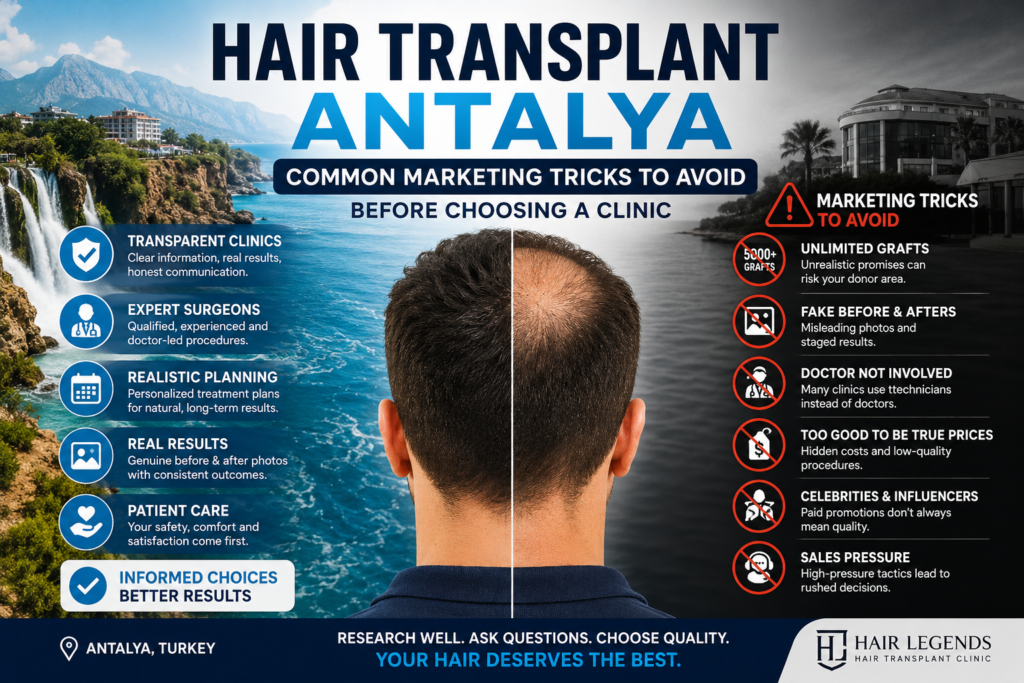
The popularity of Hair Transplant Antalya has exploded over the past decade.
Every year, thousands of patients travel from the United Kingdom, Ireland, Germany, the Netherlands, and other European countries seeking affordable hair restoration treatment in Turkey. Antalya, in particular, has become one of the leading destinations due to its combination of experienced medical professionals, modern facilities, luxury accommodation, and competitive pricing.
This growth has created many positive developments.
Patients now have access to better technology, more treatment options, and highly skilled practitioners than ever before.
Unfortunately, it has also created a different problem.
As competition between clinics increases, marketing often becomes more aggressive.
Many patients spend months researching hair transplant clinics online. They compare websites, watch YouTube videos, scroll through social media accounts, and request dozens of quotations.
The challenge is that not everything they see reflects reality.
Some clinics rely on carefully selected photographs. Others promote unrealistic graft numbers. Some advertise prices that appear incredibly low until hidden costs are added later.
The result is confusion.
Patients who are making an important medical decision often struggle to separate genuine expertise from effective marketing.
At Hair Legends, we believe patients deserve transparency.
This guide explains some of the most common marketing tricks used within the hair transplant industry and how international patients can make informed decisions before booking treatment in Antalya.
Why Marketing Matters More Than Most Patients Think
Choosing a hair transplant clinic is different from booking a hotel or purchasing a new phone.
A successful hair transplant can improve confidence for decades.
A poor hair transplant may require years of corrective treatment.
Yet many patients approach clinic selection in exactly the same way they would compare holiday packages.
They focus on:
- Price
- Hotel quality
- Airport transfers
- Social media followers
- Advertising claims
While these factors may seem important, they rarely determine the quality of the final result.
The reality is that most patients are not hair transplant experts.
They may understand the basics of FUE or DHI procedures, but they often lack the technical knowledge needed to evaluate a clinic properly.
This creates an information imbalance.
Clinics know exactly how patients make decisions.
Patients often do not know how clinics market themselves.
That is why understanding common marketing tactics can be just as valuable as understanding the procedure itself.
Marketing Trick #1: The “Unlimited Grafts” Promise
One of the most common claims seen across the industry is the promise of extremely high graft numbers.
Patients frequently encounter advertisements offering:
- 5,000 grafts
- 6,000 grafts
- 7,000 grafts
- Unlimited graft packages
At first glance, this sounds impressive.
More grafts should mean more hair, right?
Not necessarily.
The Truth About Graft Numbers
Every patient has a limited donor area.
The donor area acts like a bank account.
You can only withdraw what is available.
Removing too many grafts from a donor area may create visible thinning, patchiness, and long-term aesthetic problems.
Experienced surgeons evaluate:
- Donor density
- Hair calibre
- Hair characteristics
- Future hair loss progression
- Scalp laxity
before recommending graft numbers.
This means two patients with similar hair loss patterns may require completely different treatment plans.
Why Some Clinics Push Huge Numbers
Large graft counts are easy to market.
A patient comparing two clinics may see:
Clinic A: 3,000 grafts
Clinic B: 5,500 grafts
Many automatically assume Clinic B offers better value.
However, experienced surgeons understand that harvesting more grafts than necessary can sometimes create worse long-term outcomes.
A responsible clinic focuses on what is appropriate rather than what sounds impressive.
Marketing Trick #2: Before and After Photos That Tell Only Half the Story
Before-and-after photos remain one of the most powerful marketing tools in the hair transplant industry.
They can also be one of the most misleading.
This does not mean photographs are fake.
In many cases, the results shown are genuine.
The issue lies in what patients do not see.
The Questions Most Patients Forget to Ask
When reviewing before-and-after photos, consider:
- How many grafts were used?
- How old is the patient?
- What was the donor quality?
- Was medication used?
- Is the result six months or twelve months post-op?
- How many procedures has the patient undergone?
Without this context, comparisons become difficult.
The Lighting Effect
Professional photography can dramatically influence perception.
A hairline photographed under soft, controlled lighting often appears significantly denser than the same result under bright overhead lighting.
Camera angles also matter.
The difference between an average photograph and a carefully staged photograph can be substantial.
This is why video results often provide more useful information than static images.
Videos reveal density, hairline design, donor area quality, and natural movement in a way that photographs cannot.
Marketing Trick #3: “Doctor-Led” Procedures That Are Not Actually Doctor-Led
This is perhaps one of the most important issues facing international patients.
Many websites prominently feature doctors throughout their marketing materials.
Patients naturally assume the doctor performs most of the procedure.
The reality varies significantly between clinics.
Understanding Who Performs What
A hair transplant involves multiple stages.
These may include:
- Consultation
- Hairline design
- Local anaesthesia
- Extraction
- Channel creation
- Implantation
Different clinics delegate these responsibilities differently.
Some doctors perform key surgical stages personally.
Others supervise while technicians complete most of the procedure.
Neither model is automatically good or bad.
The problem occurs when patients believe they are purchasing one type of service but receive another.
Questions Worth Asking
Before booking, consider asking:
- Who performs the extraction?
- Who designs the hairline?
- Who creates recipient sites?
- Who implants the grafts?
- How many patients are treated per day?
Transparent clinics usually answer these questions clearly.
Vague answers often indicate that additional clarification is needed.
Marketing Trick #4: The Lowest Price Always Wins
Price is understandably one of the biggest factors for international patients.
Hair transplant costs in Antalya are often substantially lower than in the United Kingdom.
This is one reason medical tourism continues to grow.
However, extremely low pricing should always be examined carefully.
What Patients See
A clinic advertises:
“Hair Transplant Antalya From £1,299”
The offer appears incredible.
Many patients stop their research immediately.
What Patients Often Don’t See
Questions worth asking include:
- Are medications included?
- Is aftercare included?
- Are blood tests included?
- Are airport transfers included?
- Are there additional fees for larger sessions?
- Is accommodation included?
- Are follow-up consultations included?
Sometimes the cheapest package remains excellent value.
Sometimes the final cost becomes significantly higher than expected.
The objective is not finding the lowest number.
The objective is understanding exactly what you are paying for.
Marketing Trick #5: Social Media Popularity Equals Quality
A clinic with hundreds of thousands of followers appears trustworthy.
At least on the surface.
Many patients assume social media popularity automatically reflects clinical quality.
Unfortunately, the relationship is not always so straightforward.
Large followings can be influenced by:
- Advertising budgets
- Viral content
- Influencer partnerships
- Giveaways
- Entertainment-focused videos
None of these factors necessarily indicate surgical quality.
What Matters More Than Followers?
When evaluating a clinic, look beyond follower counts.
Instead, focus on:
✓ Consistent patient results
✓ Long-term outcomes
✓ Donor area preservation
✓ Natural hairline design
✓ Genuine patient testimonials
✓ Transparent communication
A clinic’s social media presence can be useful.
It should never be the only factor guiding your decision.
The Hidden Cost of Choosing the Wrong Clinic
Many patients focus entirely on the cost of their first procedure.
Very few consider the cost of repairing a poor one.
Corrective hair transplants are often more complex than primary procedures.
Donor resources may already be depleted.
Scar tissue may be present.
Planning becomes more challenging.
In some cases, a repair procedure costs more than the original surgery.
This is why experienced patients often approach clinic selection differently.
Instead of asking:
“Where can I get the cheapest hair transplant?”
They ask:
“Where can I achieve the best long-term result?”
That single shift in perspective often leads to better decisions.
The hair transplant industry has become increasingly competitive, particularly in destinations such as Antalya.
While many clinics provide excellent treatment, patients should recognise that marketing and medical quality are not always the same thing.
Claims involving massive graft numbers, perfectly staged before-and-after photos, doctor-led branding, ultra-low pricing, and social media popularity should always be evaluated carefully.
The best clinic is rarely the one with the loudest advertising.
It is usually the one that combines transparency, realistic expectations, ethical planning, and consistent long-term results.
In Part 2, we will examine even more advanced marketing tactics, including celebrity endorsements, influencer promotions, manipulated review strategies, hidden patient volume, and the truth behind all-inclusive hair transplant packages.
Marketing Trick #6: Celebrity Endorsements That Reveal Very Little
One of the first things many patients notice when researching a hair transplant clinic in Antalya is the use of celebrity testimonials.
A well-known athlete.
A television personality.
A social media influencer.
A reality TV star.
At first glance, this appears reassuring.
If a celebrity trusted the clinic, surely it must be good.
The reality is more complicated.
The Question Nobody Asks
Most patients focus on who the celebrity is.
Very few focus on what treatment the celebrity actually received.
For example:
- How many grafts were transplanted?
- Was the procedure performed by the same team available today?
- Did the celebrity receive additional treatments?
- Were multiple procedures performed?
- Is the result being shown after six months or several years?
Without these details, the endorsement becomes little more than a marketing asset.
A successful result on one patient does not automatically guarantee a similar outcome for another.
What Matters More Than Celebrity Patients?
Instead of focusing on famous faces, pay attention to consistency.
A clinic that can demonstrate excellent outcomes across hundreds of ordinary patients often provides far more useful evidence than a single celebrity success story.
The best clinics do not rely on one exceptional result.
They produce strong results repeatedly.
Marketing Trick #7: Influencer Reviews That Feel Like Independent Advice
Over the last few years, influencers have become one of the biggest marketing channels in the hair transplant industry.
This trend is particularly common among clinics targeting patients from the United Kingdom and Europe.
A YouTube creator documents their journey.
An Instagram personality shares daily updates.
A TikTok creator posts dramatic before-and-after footage.
The content often feels authentic.
Sometimes it is.
Sometimes it is sponsored marketing presented as personal experience.
Why Influencer Content Can Be Misleading
Most influencers are not hair transplant experts.
Their role is to document an experience, not evaluate surgical quality.
As a result, many reviews focus on:
✓ Airport pickup
✓ Hotel quality
✓ Clinic appearance
✓ Staff friendliness
✓ Recovery experience
While these factors are important, they do not necessarily indicate whether the hair transplant itself was performed well.
A beautiful clinic lobby cannot compensate for poor graft placement.
A luxury hotel cannot improve a poorly designed hairline.
The Better Approach
Use influencer content as supplementary information.
Do not use it as your primary decision-making tool.
The quality of the medical work should always remain the priority.
Marketing Trick #8: The “Limited Time Offer” Pressure Strategy
Many patients receive messages such as:
“Book this week and save £500.”
“Only three slots remaining this month.”
“Special offer ends tomorrow.”
These tactics are designed to create urgency.
Urgency can be useful when booking a holiday.
Medical decisions are different.
A hair transplant should never feel like a rushed purchase.
Why Pressure Selling Is Problematic
A reputable clinic understands that patients need time.
Time to research.
Time to compare.
Time to ask questions.
Time to feel comfortable.
When excessive pressure becomes part of the sales process, patients may end up making decisions before fully understanding their options.
The best treatment plan is rarely the fastest booking.
It is usually the most informed booking.
Marketing Trick #9: Package Deals That Distract From Clinical Quality
Antalya has become famous for all-inclusive hair transplant packages.
Many clinics advertise:
- Hotel accommodation
- VIP airport transfers
- Translation services
- City tours
- Luxury vehicles
These additions can certainly improve convenience.
However, they sometimes become the main focus of the marketing message.
The Important Question
What exactly are you buying?
A medical procedure?
Or a holiday package?
Ideally, both elements should be excellent.
Unfortunately, some patients spend more time comparing hotels than comparing surgical quality.
When evaluating a package, separate the medical service from the tourism service.
Ask yourself:
“If the hotel and transfers were removed entirely, would I still choose this clinic?”
The answer often reveals what truly matters.
Marketing Trick #10: “We Treat Thousands of Patients Every Year”
High patient volume can be interpreted in two very different ways.
Some patients view it as evidence of experience.
Others view it as a warning sign.
The truth depends on how the clinic operates.
When High Volume Can Be Positive
A busy clinic may indicate:
- Strong reputation
- Experienced teams
- Efficient systems
- Consistent demand
These are positive signs.
When High Volume Becomes a Concern
Problems arise when volume begins affecting individual patient care.
Questions worth asking include:
| Question | Why It Matters |
|---|---|
| How many patients are treated daily? | Indicates workload |
| How many surgeries occur simultaneously? | Shows attention levels |
| How much time is allocated per patient? | Reflects personalization |
| Who performs key stages? | Reveals treatment structure |
The goal is not necessarily finding the smallest clinic.
It is finding a clinic that balances experience with personalised care.
Marketing Trick #11: Guaranteed Results Claims
Perhaps no marketing claim deserves more scrutiny than guaranteed results.
Hair transplantation is highly successful when performed correctly.
However, no ethical medical professional can guarantee a specific outcome.
Human biology simply does not work that way.
Why Guarantees Should Raise Questions
Hair growth depends on multiple variables:
- Individual healing response
- Donor quality
- Hair characteristics
- Existing hair loss progression
- Medical history
Even when everything is done correctly, biology still plays a role.
This is why reputable clinics typically discuss probabilities and expectations rather than guarantees.
Be cautious of any marketing message that suggests perfect certainty.
Medicine is not mathematics.
Marketing Trick #12: Focusing Only on the Hairline
The hairline receives enormous attention during consultations.
Understandably so.
It is the most visible part of the result.
However, experienced surgeons know that a successful hair transplant involves much more than the front line.
What Patients Often Overlook
A great result depends on:
✓ Hairline design
✓ Density planning
✓ Donor preservation
✓ Natural angulation
✓ Future hair loss management
✓ Long-term strategy
Some clinics create aggressive hairlines designed to look impressive in photographs.
The problem is that those same hairlines may not age well over the next ten or twenty years.
A natural result should look appropriate not only today but also in the future.
How to Evaluate a Hair Transplant Clinic More Effectively
After reviewing all of these marketing tactics, patients often ask the same question:
“What should I focus on instead?”
The answer is surprisingly simple.
Instead of looking for the most impressive marketing, look for the strongest evidence.
A Practical Checklist
Before choosing a clinic in Antalya, consider the following:
□ Who performs each stage of the procedure?
□ Are long-term results available?
□ Is donor area quality visible in patient examples?
□ Does the clinic provide realistic expectations?
□ Are consultations detailed and transparent?
□ Is the treatment plan personalised?
□ Are questions answered clearly?
□ Do patient results appear consistent?
The clinics that score highly in these areas are often the clinics worth investigating further.
The Most Valuable Question You Can Ask
After years of treating international patients, we believe one question reveals more than any other.
Ask the clinic:
“If I were your family member, would you recommend the same treatment plan?”
A trustworthy clinic should have no difficulty answering.
The response often tells you far more than a brochure, advertisement, or social media post ever could.
Conclusion
Marketing is not inherently bad.
Every reputable clinic needs to communicate its services and educate potential patients.
Problems arise when marketing becomes more important than medicine.
Celebrity endorsements, influencer promotions, package deals, urgency tactics, guaranteed results, and high-volume claims can all influence decision-making. However, none of these factors automatically determine the quality of a hair transplant.
The most successful patients are usually those who look beyond the advertising and focus on the fundamentals:
- Experience
- Transparency
- Planning
- Donor management
- Long-term thinking
- Consistent patient outcomes
In Part 3, we will explore the biggest red flags patients should watch for before booking a Hair Transplant in Antalya, including consultation warning signs, unrealistic promises, poor donor management, and how to identify clinics that prioritise sales over patient outcomes.
The Biggest Red Flags Patients Should Never Ignore
By the time most patients reach the final stages of their research, they have usually narrowed their options down to a handful of clinics.
The websites look professional.
The reviews appear positive.
The prices seem reasonable.
The clinics all promise natural results.
At this stage, the challenge is no longer finding a clinic.
The challenge is identifying potential warning signs before making a decision.
Interestingly, the biggest red flags are rarely found on a clinic’s homepage.
They usually appear during conversations, consultations, and the questions that follow.
The difference between an excellent clinic and a poor one is often revealed in the details.
Red Flag #1: You Receive a Quote Without a Proper Assessment
Imagine sending three photographs to a clinic.
Ten minutes later you receive a message:
“5000 grafts. £1,499. Available next week.”
Many patients are impressed by the speed.
They should be concerned instead.
A proper treatment plan requires much more than a quick glance at a few photographs.
A responsible clinic should evaluate:
- Your age
- Current hair loss pattern
- Family history
- Donor area quality
- Hair characteristics
- Future hair loss progression
- Medical background
Without this information, any recommendation is largely guesswork.
Hair transplantation is not a one-size-fits-all procedure.
The best clinics spend time understanding the patient before discussing numbers.
Red Flag #2: Every Patient Needs the Same Number of Grafts
One of the easiest ways to identify a sales-driven consultation is when every patient seems to require exactly the same treatment.
You may notice something interesting:
Patient A: 5000 grafts
Patient B: 5000 grafts
Patient C: 5000 grafts
Different ages.
Different hair loss patterns.
Different donor areas.
Yet somehow the recommendation never changes.
This should raise questions.
In reality, graft requirements vary enormously.
A patient with early-stage hair loss may need a completely different approach than someone with advanced baldness.
The purpose of a consultation is to create a personalised strategy.
Not to fit every patient into the same package.
Red Flag #3: Nobody Talks About Your Future Hair Loss
One of the most overlooked aspects of hair transplantation is future planning.
Hair loss is often progressive.
The hair you have today may not be the hair you have ten years from now.
Yet many consultations focus entirely on the immediate cosmetic result.
Patients are shown how they might look in twelve months.
Very little discussion takes place about how they may look in ten years.
Experienced surgeons think differently.
They ask questions such as:
- What happens if hair loss continues?
- How much donor area should be preserved?
- Will the hairline remain natural with age?
- Could future procedures be required?
These discussions may not be exciting.
They are often essential.
Red Flag #4: The Consultation Feels Like a Sales Call
There is a significant difference between education and sales.
A good consultation helps the patient understand their options.
A poor consultation focuses exclusively on securing a deposit.
Warning signs may include:
✓ Constant urgency
✓ Discount pressure
✓ Avoiding technical questions
✓ Generic responses
✓ Little discussion about risks
The best consultations are surprisingly balanced.
They discuss advantages.
They discuss limitations.
They discuss realistic expectations.
Patients should leave feeling informed, not pressured.
Red Flag #5: Nobody Discusses Donor Area Preservation
Many patients focus entirely on the recipient area.
That is understandable.
The recipient area is where the new hair will appear.
However, experienced professionals often spend just as much time evaluating the donor area.
Why?
Because donor hair is limited.
Once a graft is extracted, it cannot be replaced.
Poor donor management is one of the most common reasons corrective procedures become difficult.
A clinic that focuses only on creating density today without considering tomorrow may be creating future problems.
A strong result is not just about what grows on top.
It is also about what remains healthy at the back and sides.
The Difference Between Marketing and Medical Planning
At this point, many patients begin to notice an interesting pattern.
Marketing focuses on immediate excitement.
Medical planning focuses on long-term success.
Marketing says:
“Look how dense this result is.”
Medical planning asks:
“Will this still look natural fifteen years from now?”
Marketing promotes maximum graft counts.
Medical planning protects donor resources.
Marketing highlights quick decisions.
Medical planning encourages informed decisions.
This distinction is one of the most important concepts in modern hair restoration.
Why Some Hair Transplants Fail
Patients often assume failed hair transplants happen because of poor surgical technique alone.
Sometimes that is true.
However, failure often begins much earlier.
It starts during the planning stage.
Examples include:
- Unrealistic hairline design
- Excessive graft extraction
- Poor candidate selection
- Inadequate donor assessment
- Lack of long-term planning
These problems are difficult to fix later.
This is why consultation quality matters so much.
The procedure itself may last only a day.
The consequences can last a lifetime.
Questions Every Patient Should Ask Before Booking
Instead of focusing only on price and package details, consider asking these questions.
About the Procedure
- Who performs the extraction?
- Who creates the recipient sites?
- Who implants the grafts?
- How many patients are treated daily?
About Planning
- Why do you recommend this number of grafts?
- How will this design age over time?
- What happens if my hair loss progresses?
About Results
- Can I see long-term outcomes?
- Can I see donor area results?
- Can I see patients with similar hair characteristics?
The quality of the answers often reveals more than the answers themselves.
What Truly Defines a Great Hair Transplant Clinic?
After reviewing dozens of marketing tactics and warning signs, patients often ask a final question:
“What should I actually look for?”
The answer is surprisingly straightforward.
Great clinics tend to share several characteristics.
Transparency
They explain the procedure clearly.
They discuss limitations openly.
They do not rely on unrealistic promises.
Consistency
Results are not limited to one exceptional case.
Good outcomes appear repeatedly across many patients.
Personalisation
Treatment plans are tailored to the individual.
Recommendations are based on medical factors rather than package structures.
Long-Term Thinking
The focus extends beyond the next twelve months.
Future hair loss, donor preservation, and ageing are all considered.
Communication
Patients feel informed throughout the process.
Questions are welcomed rather than avoided.
Why Hair Legends Believes Education Matters
At Hair Legends, we believe informed patients make better decisions.
That is why education remains a core part of our approach.
A patient who understands graft planning, donor management, hairline design, and long-term strategy is far more likely to achieve realistic expectations and a successful outcome.
The objective should never be convincing someone to book as quickly as possible.
The objective should be helping them choose the right solution for their individual circumstances.
Sometimes that means proceeding with treatment.
Sometimes it means waiting.
Sometimes it means exploring alternative options.
Good medicine is not about selling procedures.
It is about providing appropriate recommendations.
Final Thoughts
The hair transplant industry in Antalya offers extraordinary opportunities for international patients.
Many clinics provide excellent treatment and life-changing results.
At the same time, patients must recognise that marketing and medical quality are not always the same thing.
Celebrity endorsements, influencer campaigns, aggressive discounts, unlimited graft claims, and luxury package deals can all influence perception.
None of them guarantee a successful result.
The most reliable indicators remain remarkably simple:
- Transparent communication
- Ethical planning
- Donor preservation
- Realistic expectations
- Consistent outcomes
- Long-term thinking
When choosing a Hair Transplant Antalya clinic, focus on these fundamentals.
A hair transplant is not a purchase you make for next month.
It is a decision that may influence how you look and feel for decades.
The clinics worth trusting are usually the ones that spend less time selling and more time educating.
And in the long run, that difference matters more than any marketing campaign ever could.