
Ben Affleck Hair Transplant: Hollywood has always had a complicated relationship with aging. Actors are expected to look remarkably similar to the way they did twenty years ago, even though cameras have become sharper, audiences more observant, and social media quick to point out every wrinkle, grey hair, or receding hairline. Among the many celebrities whose appearance has sparked years of discussion, Ben Affleck is one of the most frequently mentioned when the conversation turns to hair restoration.

Searches for “Ben Affleck hair transplant” continue to grow every year. Fans compare photographs from different decades, YouTube channels analyze his changing hairline frame by frame, and online forums debate whether his thicker-looking hair is the result of surgery, medication, clever styling, or simply good genetics. Yet despite all the speculation, one important fact remains unchanged: Ben Affleck has never publicly confirmed having a hair transplant.
That distinction matters.
At Hair Legends Antalya, we believe celebrity discussions should always be approached responsibly. Rather than making sensational claims about someone’s private medical history, we prefer to examine publicly available photographs from the perspective of experienced hair restoration professionals. Hair loss follows recognizable patterns, and while photographs can suggest possibilities, they cannot provide certainty.
The purpose of this article isn’t to declare whether Ben Affleck underwent surgery. Instead, we’ll explore why so many people believe he may have, what modern hair transplant specialists notice when comparing images across different years, and how advances in FUE technology have transformed hair restoration for everyday patients not just Hollywood actors.
Why Ben Affleck’s Hair Has Become a Topic of Conversation
Unlike actors who disappear from public view for years at a time, Ben Affleck has spent more than three decades under constant media attention. From Good Will Hunting and Armageddon to Gone Girl, The Accountant, and his appearances as Batman, millions of high-resolution photographs document nearly every stage of his adult life.
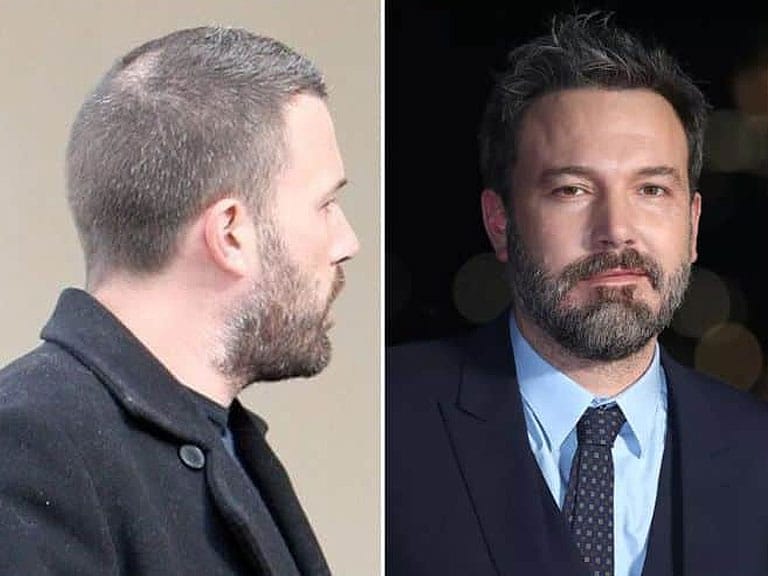
That continuous timeline makes subtle physical changes much easier to notice.
When Affleck first became famous during the late 1990s, he displayed what most people would describe as a naturally youthful hairline. His temples appeared full, the frontal hairline was well defined, and his overall density suited a man in his twenties. There was nothing particularly remarkable about his hair—it simply looked healthy.
As he entered his late thirties and early forties, however, some public appearances seemed to tell a slightly different story.
Certain photographs showed a little more recession around the temples. In others, the frontal hairline appeared less dense than it had years earlier. Under harsh lighting, the scalp occasionally became more visible than fans were accustomed to seeing.
These weren’t dramatic changes. In fact, many men would never have noticed them had Affleck not been photographed from every conceivable angle.
This is precisely how male pattern hair loss often begins.
Unlike sudden shedding caused by illness or medication, androgenetic alopecia typically progresses gradually. The temples slowly move backward, the frontal hairs become finer, and density decreases so subtly that many people don’t recognize the change until they compare photographs taken years apart.
For someone whose face appears on cinema screens across the world, those small changes naturally attract attention.
Looking at the Photographs Through a Hair Restoration Specialist’s Eyes
One of the most common questions patients ask during consultations at Hair Legends Antalya is surprisingly simple.
“When you look at celebrity photos, what do you actually notice?”
The answer isn’t necessarily the hairline itself.
Experienced surgeons pay closer attention to consistency.
Hair density tends to change very slowly through natural aging. While hairstyles, lighting, camera lenses, and hair products can dramatically influence appearance, the underlying pattern of follicle distribution generally remains predictable.
When specialists compare photographs taken years apart, several features often receive attention:
Has the temple recession remained stable?
Does the frontal hairline suddenly appear denser than expected?
Has crown thinning progressed—or unexpectedly improved?
Do individual hairs appear thicker, or is the overall density genuinely higher?
Most importantly, are these observations consistent across dozens of unrelated public appearances rather than a single carefully styled event?
These are the same questions specialists ask when evaluating ordinary patients.
Looking at publicly available photographs of Ben Affleck, many observers believe his frontal region appears stronger in recent years than it did during certain periods of his forties. Others disagree entirely, arguing that hairstyle, length, lighting, facial weight, beard styling, and professional grooming easily explain the differences.
Both viewpoints are reasonable.
Without direct clinical examination, scalp analysis, donor assessment, or medical history, nobody can honestly state whether surgery occurred.
Responsible medical professionals acknowledge uncertainty rather than pretending certainty exists.
Could Medication Alone Explain Fuller Hair?
Hair transplantation isn’t the only explanation people consider.
Today, many men experiencing early hair loss begin treatment with medications long before surgery becomes necessary.
Finasteride works by reducing the production of dihydrotestosterone (DHT), the hormone primarily responsible for male pattern baldness in genetically susceptible individuals. For many patients, it slows progression considerably and, in some cases, even increases hair density.
Minoxidil, available as either a topical solution or oral medication under medical supervision, may stimulate follicles and extend the hair growth cycle.
Combined with healthier nutrition, improved stress management, dermatological treatments, and professional hair styling, these therapies can create surprisingly noticeable improvements.
Because of this, seeing fuller hair in later photographs does not automatically suggest transplantation.
In many cases, medication preserves enough existing hair that surgery becomes unnecessary for years.
This is why every consultation at Hair Legends Antalya begins with diagnosis rather than immediately recommending a procedure. Not every patient sitting in our clinic actually needs a transplant. Sometimes preserving existing hair produces better long-term results than replacing hair that hasn’t yet been lost.
If Surgery Was Performed, What Would Modern Specialists Expect to See?
Let’s consider the question purely from an educational perspective.
If someone with a pattern similar to Ben Affleck’s did decide to undergo modern hair restoration, today’s preferred approach would almost certainly be Follicular Unit Extraction (FUE) rather than the older strip surgery technique.
There are several reasons why.
Public figures rarely want a visible linear scar across the back of the head.
They also require relatively quick recovery because filming schedules, interviews, and promotional appearances leave little room for extended downtime.
Modern Sapphire FUE addresses many of these concerns by allowing surgeons to harvest individual follicular units with exceptional precision while preserving the natural appearance of the donor area.
Equally important is hairline design.
Contrary to popular belief, the most impressive celebrity hair transplants are often the ones nobody notices.
Creating an unnaturally straight, low hairline might initially appear attractive, but it rarely continues to look convincing as the patient ages.
Instead, experienced surgeons design mature, irregular hairlines that respect facial proportions, future hair loss patterns, and ethnic characteristics.
Naturalness not density is usually the defining characteristic of excellent hair restoration.
That philosophy guides every treatment performed at Hair Legends Antalya.
Many patients arrive asking for the hairline they had at eighteen years old.
In reality, recreating an adolescent hairline on a forty five year old face often produces the opposite of a natural result.
The best transplant is the one people never suspect.
Hair Restoration Has Changed Dramatically Over the Last Twenty Years
One reason celebrity discussions generate so much interest is that many people still imagine hair transplantation the way it looked decades ago.
Older procedures frequently produced obvious plugs, harsh hairlines, and unnatural spacing.
Those results deserved the criticism they received.
Modern hair transplantation is fundamentally different.
Advanced magnification, refined graft handling, improved preservation solutions, microscopic sorting, precise angle creation, and sophisticated implantation techniques allow surgeons to recreate growth patterns that closely resemble natural hair.
For this reason, many patients today are comfortable sharing their experience publicly, whereas previous generations often tried to keep surgery secret.
Whether Ben Affleck ever chose this route remains unknown.
What is certain is that modern hair restoration no longer resembles the procedures many people still imagine when they hear the words “hair transplant.”
How Many Grafts Might Someone with Ben Affleck’s Hair Pattern Need?
One of the biggest misconceptions about hair transplantation is that every patient requires the same number of grafts. In reality, the ideal graft count depends on several variables, including the patient’s age, the stability of their hair loss, the quality of the donor area, hair characteristics, and, perhaps most importantly, the final goal.
This is why experienced surgeons avoid giving graft estimates based solely on photographs. While online clinics often advertise fixed packages of “3,000 grafts” or “5,000 grafts,” responsible planning begins with an in-person examination or a detailed consultation using high-quality images.
If a patient presented with a hair loss pattern similar to the one some observers believe Ben Affleck displayed during his forties, the objective would probably not be a complete reconstruction. Instead, the focus would likely be on strengthening the frontal third, refining the temple areas if appropriate, and increasing density where miniaturization had already begun.
In many comparable cases, this could involve somewhere between 1,500 and 2,500 grafts, although every individual is different. Patients with naturally finer hair may require more grafts to achieve the same visual density, while those with thick, coarse hair often create excellent coverage with fewer follicles.
Hair color also plays a surprisingly important role. Dark hair against a light scalp creates greater contrast, making thinning appear more noticeable. Lighter hair usually offers the opposite effect, which is one reason two patients with identical graft counts may appear to have completely different results.
For experienced surgeons, success isn’t measured by the number of grafts transplanted. It’s measured by whether the final result looks as though no procedure ever took place.
Why Celebrity Hair Transplants Often Look Better Than Older Procedures
When people think about hair transplantation, they sometimes remember the obvious, unnatural results seen on television twenty or thirty years ago. Those procedures often created straight hairlines, visible plugs, and inconsistent growth because the technology and surgical techniques of the time were far more limited.
Today’s best clinics approach hair restoration very differently.
Rather than trying to create the lowest possible hairline, modern surgeons focus on harmony. Every face has unique proportions, and an attractive hairline is one that complements those features instead of drawing attention to itself.
This is particularly important for actors. High-definition cameras reveal details that were impossible to see in older films. An overly symmetrical hairline or incorrect hair angle can appear unnatural under studio lighting, even if it looks acceptable in everyday life.
That is why elite hair restoration places so much emphasis on artistry.
A successful transplant combines surgical precision with aesthetic judgment. The direction of each graft, the irregularity of the hairline, the transition from single-hair grafts to naturally occurring follicular groups all of these small details contribute to the illusion that the hair has always been there.
Whether discussing celebrities or everyday patients, the principle remains the same: the best hair transplant is rarely the densest one. It’s the one nobody notices.
Why So Many Patients Choose Antalya Instead of Larger Cities
Turkey has become one of the world’s leading destinations for hair transplantation, attracting hundreds of thousands of international patients every year. While Istanbul has traditionally dominated the industry, Antalya has quietly developed a reputation for offering something different.
For many visitors, the appeal begins with the pace of the city.
Instead of navigating heavy traffic and spending hours travelling between hotels, clinics, and airports, patients arriving in Antalya often find a more relaxed experience. Shorter transfer times, a Mediterranean climate, and the opportunity to recover near the sea make the treatment journey feel less like a medical obligation and more like a comfortable trip abroad.
This environment is especially valuable during the first few days after surgery, when rest is one of the most important parts of recovery.
International patients also appreciate that Antalya offers internationally accredited medical facilities while maintaining competitive pricing compared with many Western countries. For someone travelling from the United Kingdom, Ireland, Germany, Canada, or the United States, the combination of experienced surgical teams and affordable treatment has made the city an increasingly popular alternative.
At Hair Legends Antalya, we believe the destination itself should support the healing process. Hair transplantation is not simply about the day of surgery. It is a journey that begins with careful planning and continues through recovery, follow-up, and long-term hair care.
What We Focus on at Hair Legends Antalya
Every clinic has its own philosophy.
Some advertise the highest number of grafts possible. Others compete primarily on price. While these factors may attract attention, they do not necessarily determine the quality of the final result.
Our philosophy is built around one principle: natural results that still look natural ten years from now.
Achieving that requires much more than technical ability.
It starts with understanding how hair loss is likely to progress in the future. Designing an aggressive hairline without considering future thinning can leave patients requiring additional procedures sooner than expected. A responsible treatment plan balances today’s appearance with tomorrow’s reality.
Donor management is equally important.
The donor area contains a finite number of permanent follicles. Removing too many grafts in a single session may create visible thinning at the back of the head, limiting options for future procedures. For this reason, experienced surgeons view the donor area as a valuable resource that should be preserved whenever possible.
At Hair Legends Antalya, every treatment plan is individualized. We evaluate facial proportions, donor quality, hair characteristics, age, family history, and the patient’s long-term expectations before recommending surgery. In some cases, we even advise patients to postpone transplantation until their hair loss pattern becomes more stable.
Sometimes, the best medical decision is not to operate immediately.
FAQ
Did Ben Affleck confirm having a hair transplant?
No. Ben Affleck has never publicly confirmed undergoing a hair transplant or any other hair restoration procedure. Any discussion is based solely on observations from publicly available photographs.
Can photographs prove someone had a hair transplant?
No. Photographs can suggest possible changes, but they cannot confirm medical treatment. Hairstyling, lighting, medications, camera angles, and image quality can all influence how hair appears.
At what age should someone consider a hair transplant?
There is no universal age. The decision depends on the stability of hair loss, donor quality, and the patient’s long-term goals rather than age alone.
How long do FUE results last?
Hair transplanted from the permanent donor area is generally resistant to the hormone responsible for male pattern baldness. While the transplanted follicles usually remain permanent, natural hair outside the transplanted area may continue to thin over time.
Is Antalya a good place for a hair transplant?
Antalya has become one of Turkey’s leading medical tourism destinations, offering experienced surgeons, modern clinics, and the opportunity to recover in a comfortable Mediterranean setting.
Final Thoughts
Whether Ben Affleck has undergone a hair transplant may never be publicly known—and ultimately, that’s perfectly acceptable. The discussion surrounding his appearance highlights something far more interesting than celebrity speculation: how dramatically modern hair restoration has evolved.
Today’s procedures are no longer about creating dramatic transformations that everyone notices. They are about restoring confidence in a way that feels authentic, balanced, and appropriate for each individual.
At Hair Legends Antalya, we approach every patient with that same philosophy. Rather than chasing unrealistic trends or promising impossible results, we focus on careful planning, natural hairline design, responsible donor management, and techniques that aim to stand the test of time.
If you’ve started noticing changes in your own hairline and are wondering what options are available, the first step isn’t surgery it’s an expert assessment. Understanding the cause of your hair loss allows you to make informed decisions, whether that involves medical treatment, preventive care, or hair transplantation.
Because in the end, the goal isn’t to look like a celebrity.
It’s to look like the best version of yourself.