
A hair transplant after FUT may be an option if you have had strip surgery in the past and now want to discuss further coverage, changes to your hairline or the appearance of your donor scar. The starting point is a careful assessment of your previous procedure and the donor hair that remains.
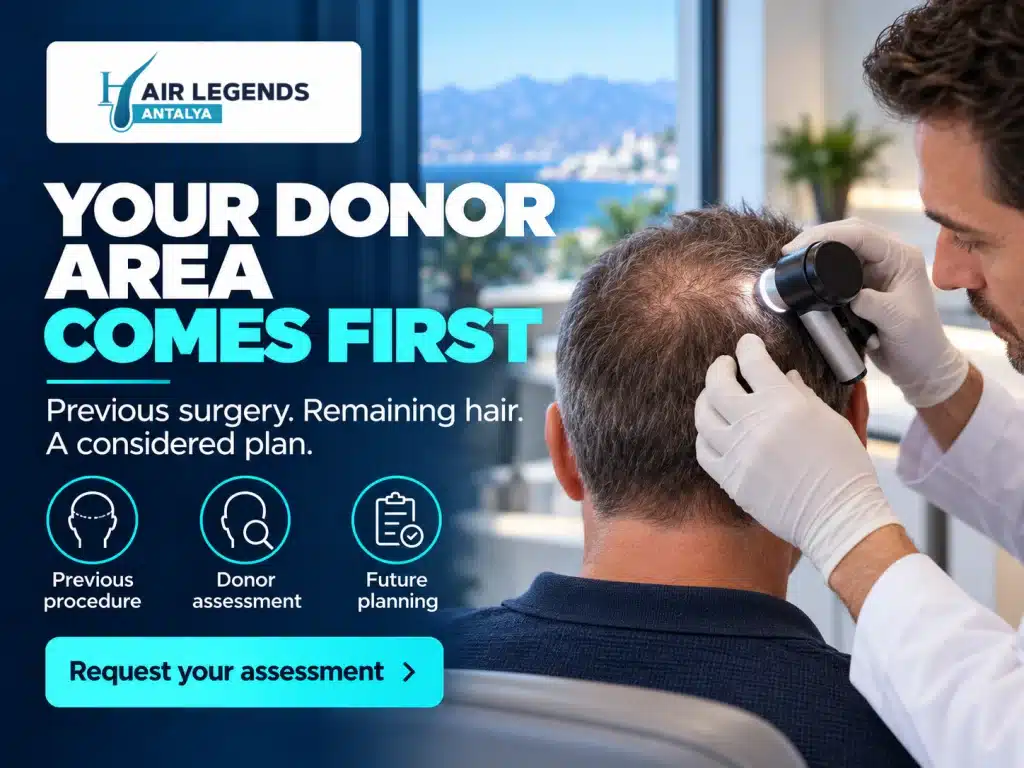
You may be happy with your original transplant but have noticed thinning behind it. Alternatively, you may want advice about uneven coverage or a visible scar at the back of your head. These concerns require different treatment plans.
At Hair Legends Antalya, you can begin by sharing photographs, details of your previous surgery and the areas you would like assessed. We help international patients arrange an initial assessment and understand their proposed treatment and quotation before travelling.
Request Your Hair Transplant After FUT Assessment
Can You Have Another Hair Transplant After FUT?
Having previously undergone FUT does not automatically rule out further hair transplantation. However, it does affect the planning.
FUT, also called strip harvesting, involves removing a strip of hair-bearing scalp from the donor region. The wound is closed, leaving a linear scar. A later procedure needs to account for that scar, the remaining donor supply and the condition of the scalp.
Some patients may be suitable for FUE after FUT. In selected circumstances, another strip procedure may be considered by a surgeon experienced in both approaches. Neither option is automatically appropriate for everyone.
The ISHRS discussion of FUT and FUE explains why the choice of harvesting method should consider the available donor resources over a patient’s lifetime.
For a broader overview of repeat procedures, read our guide to a second hair transplant in Antalya.
What Would You Like to Improve?
Before comparing techniques or graft numbers, identify your main concern.
| Your concern | What to discuss during assessment |
|---|---|
| Thinning behind an earlier hairline | Whether further hair loss has changed the areas needing treatment |
| Limited coverage through the middle or crown | Which areas deserve priority within the available donor supply |
| An unnatural-looking hairline | Whether correction requires more than additional grafts |
| A visible FUT scar | Whether scar camouflage or another approach may be appropriate |
| Several concerns together | Whether treatment should be divided into stages |
Another operation should have a clearly defined purpose. “More grafts” alone does not explain the improvement being proposed.
If your main concern is an unsatisfactory previous result, our hair transplant repair guide explains the broader questions to discuss.
Why Donor Planning Matters After FUT
Your previous surgery has already used part of your donor resources. The new plan must account for what remains rather than assume that a standard graft package will suit you.

A donor examination may consider:
- Remaining hair density across the donor region.
- Hair thickness and the number of hairs within follicular units.
- Signs of thinning within potential harvesting areas.
- The position and width of the existing scar.
- Previous harvesting beyond the original FUT procedure.
- The amount of coverage you hope to achieve.
The ISHRS FUE clinical guidelines identify donor evaluation as fundamental to estimating graft availability, possible coverage and treatment limitations.
Photographs can support an initial discussion, but they cannot reliably establish every detail needed for a surgical plan.
Questions Worth Asking
Ask the assessing clinician:
- Which donor areas appear suitable for further harvesting?
- How does my previous FUT procedure affect the plan?
- Which treatment areas would you prioritise?
- What improvement is realistic with my remaining donor supply?
- What would make you recommend against another procedure?
These answers are more useful than a large graft estimate offered without an explanation.
Can FUE Be Performed After FUT?
FUE may be considered after FUT when suitable donor hair remains. It involves removing individual follicular units rather than taking another strip.
However, FUE does not remove an existing FUT scar, and it is not a scar-free technique. It creates small extraction scars of its own. Planning must consider their cosmetic effect alongside the earlier linear scar.
If the proposed procedure uses an implanter pen, sometimes described as DHI, ask how the grafts will be harvested as well as how they will be implanted. A label describing implantation does not answer the donor-planning question.
The ISHRS guide to surgical hair restoration explains the distinction between harvesting follicles and placing them into the recipient area.
You can also read about FUE hair transplantation in Antalya.
Can Hair Be Transplanted Into an Old FUT Scar?
In selected cases, follicles can be transplanted into a mature FUT scar to help camouflage it. This aims to make the scar less conspicuous; it does not erase the scar tissue or guarantee that the area will look the same as unoperated scalp.
Scar tissue needs its own assessment. Its thickness, stability and blood supply can influence whether implanted follicles are likely to survive. A clinician may consider a small test area before recommending more extensive work.
The ISHRS guide to hair restoration in scarred scalp explains why scar characteristics and blood supply matter.
Mention any persistent pain, redness, raised areas or previous healing problems. Scar treatment should not be planned from appearance alone.
Scar Camouflage and Scalp Coverage Are Separate Goals
If you want both scar camouflage and more coverage on top, ask how donor resources would be divided between those goals.
Your quotation should identify whether it covers:
- Transplantation into the scar.
- Additional hairline, mid-scalp or crown work.
- Both, within one proposed plan.
- A staged approach with separate procedures.
How Many Grafts Are Available After FUT?
There is no universal number.
Someone who had one relatively limited strip procedure may have different options from someone who has had several operations. The earlier graft count is useful background, but it does not replace an examination of the remaining donor area.
Ask for an estimate that distinguishes between:
- Grafts proposed for harvesting.
- Grafts allocated to each recipient area.
- Any grafts intended for scar camouflage.
If there is uncertainty, the plan should explain what can be estimated remotely and what must be confirmed in person. Avoid treating another patient’s graft count as a prediction for your own case.
How Much Does a Hair Transplant After FUT Cost in Antalya?
The cost depends on the work proposed after assessment. A limited scar-camouflage procedure and a larger operation addressing several scalp areas are different treatments.
Request a personalised written quotation that explains:
| Item | What to clarify |
|---|---|
| Treatment scope | Which areas and concerns the plan addresses |
| Proposed approach | How harvesting and implantation are planned |
| Clinical responsibilities | Who performs each stage |
| Scar treatment | Whether it is included, separate or unsuitable |
| Follow-up | Initial checks and support after returning home |
| Travel arrangements | Hotel nights and transfers included, if any |
| Payment | Currency, deposit, balance and applicable charges |
| Additional stages | Whether another procedure may be needed and how it would be priced |
For general pricing context, see our hair transplant cost guide. A general starting price should not be treated as a confirmed quotation for repeat or corrective surgery.
Already have accommodation? Mention this when enquiring and explore our hair transplant in Antalya without a hotel guide.
What Should You Send Hair Legends?
To begin your enquiry, prepare:
- Clear photographs of the front, top, crown, sides and back.
- A close photograph showing the FUT scar, if possible.
- The approximate date of each previous procedure.
- The documented graft count, if available.
- A short explanation of what you would like to improve.
- Your preferred travel month and accommodation needs.
If you do not have old records, tell us. You do not need to guess the number of grafts or the exact technique.
Relevant medical history and medication details should be shared privately with the clinical team. An initial photo assessment is preliminary; final suitability and planning require a clinical examination.
Send Your Previous Procedure Details on WhatsApp
Planning Your Visit to Antalya
Before purchasing flights, confirm that your case has been reviewed and that the proposed dates allow time for assessment, treatment and the required follow-up.
Ask whether your previous surgery or proposed scar treatment changes the expected schedule. Your stay should be based on your individual plan.
Hair Legends can help coordinate the arrangements included in your confirmed package. If you are bringing a companion or staying elsewhere in Antalya, mention this when requesting your quotation.
Our booking guide explains which details to confirm before travelling.
Recovery, Results and Limitations
A repeat transplant is still surgery. Potential risks include bleeding, infection, scarring, poor growth and an outcome that does not meet expectations. Existing hair may continue thinning, so the plan should consider how your appearance could change over time.
Follow the treating clinician’s instructions rather than assuming that the advice from your previous operation will apply unchanged.
Growth takes months. Early appearance does not establish the final result, and scar camouflage may require reassessment before further treatment is considered.
The NHS hair transplant guide provides general information about recovery and possible complications.
Frequently Asked Questions About Hair Transplant After FUT
Does needing another transplant mean my FUT failed?
No. Your reason for seeking another assessment may be further thinning, a different treatment goal or concern about the original result. Explain what has changed and when you noticed it.
Will FUE remove my old FUT scar?
No. FUE harvesting does not remove a linear FUT scar. Transplanting follicles into a suitable scar is a separate camouflage procedure.
Can I treat the crown and FUT scar together?
This may be considered in selected cases. The plan must account for both treatment areas and the available donor resources. Ask whether a combined or staged approach is proposed.
Can you confirm the graft count from photographs?
Photographs help with preliminary assessment, but the final graft plan requires clinical evaluation. Any remote estimate should be presented with that limitation.
Can I enquire if my first operation was at another clinic?
Yes. Share the information you have about your previous treatment and describe your current concerns. Missing records can be discussed during the assessment process.
Discuss Your Hair Transplant After FUT with Hair Legends
If you are considering a hair transplant after FUT, start with a clear understanding of your remaining options.
Send Hair Legends photographs, your previous procedure details and the changes you would like assessed. We can help arrange an initial review and explain the proposed treatment, costs and travel arrangements for Antalya.