
Diffuse thinning can be one of the more difficult types of hair loss to understand. Unlike a clearly defined bald patch or a receding hairline, the hair may still be present across most of the scalp. The problem is that it gradually becomes finer, weaker and less dense.
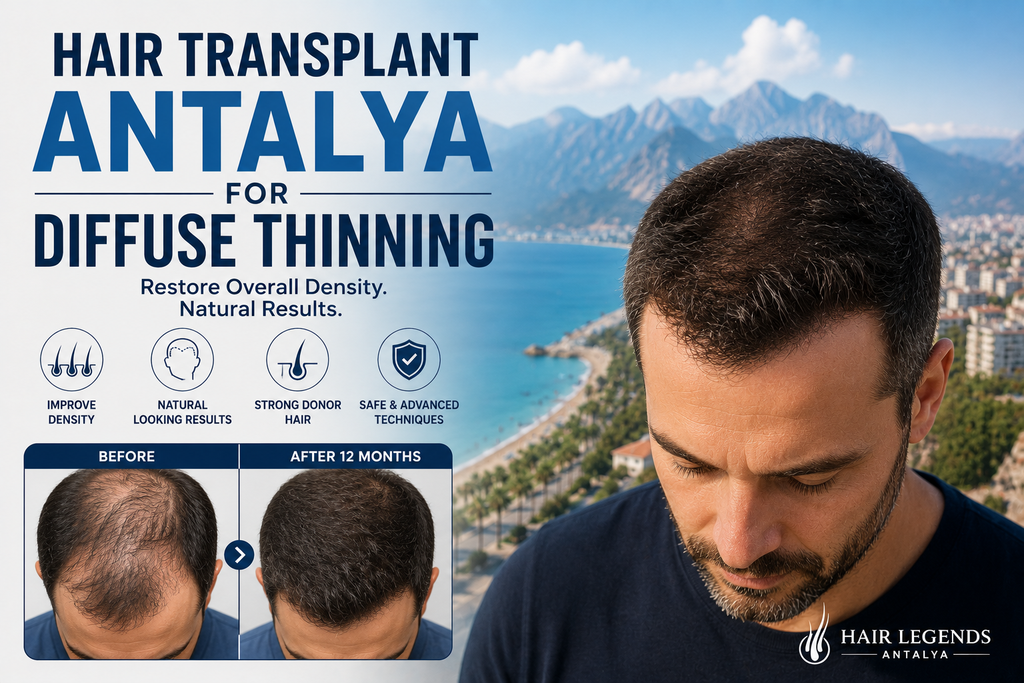
For many people, this creates a frustrating situation. There is still hair on the scalp, but the scalp becomes increasingly visible under bright light, after showering or when the hair is wet. Some patients also notice that styling no longer provides the same coverage it once did.
This often leads to an important question: Can a hair transplant help with diffuse thinning?
In selected patients, it can. However, diffuse thinning requires a more careful assessment than simply counting the number of grafts that could theoretically be transplanted.
For patients considering a hair transplant in Antalya, the first step should be understanding why the hair is thinning, which hairs are still viable and whether there is enough stable donor hair to improve density without creating unnecessary risk.
What Is Diffuse Hair Thinning?
Diffuse thinning means that hair density decreases across a broader area rather than disappearing completely from one clearly defined region.
A person with diffuse thinning may still have hair at the hairline, mid-scalp and crown, but the individual hairs may have become thinner and the spaces between them more visible.
This can make the condition particularly difficult to recognise in its early stages. Someone may not consider themselves “bald” because they still have considerable hair coverage. Yet photographs taken several years apart can reveal a significant reduction in overall density.
Diffuse thinning can occur for different reasons, so identifying the underlying cause is an important part of the consultation.
Is Diffuse Thinning the Same as Male Pattern Hair Loss?
Not necessarily.
Androgenetic alopecia can produce a diffuse pattern, particularly when miniaturisation affects a large area of the scalp. However, other forms of hair loss can also cause diffuse shedding or thinning.
Stress, nutritional problems, certain medications, hormonal changes and some medical conditions can affect hair density.
This distinction matters because a hair transplant is not a treatment for every type of diffuse hair loss.
If the follicles are temporarily shedding because of an underlying condition, transplantation may not be the appropriate first step.
A proper assessment should therefore come before deciding how many grafts are required.
Can a Hair Transplant Treat Diffuse Thinning?
A transplant can improve density in selected patients with diffuse thinning, particularly when the affected area contains miniaturised or weakened hairs but the donor area contains stronger, stable follicles.
The objective is different from treating a completely bald area.
With diffuse thinning, the doctor may need to place grafts among existing hairs. This requires careful planning because the transplanted follicles must complement the native hair rather than simply creating a separate area of dense growth.
The challenge is therefore not only graft placement. It is creating a transition between transplanted and existing hair that looks natural as the entire scalp continues to age.
Why Is Diffuse Thinning More Complicated to Transplant?
A completely bald recipient area gives the surgeon a relatively clear space in which to place grafts.
Diffuse thinning is different.
There may already be hundreds or thousands of existing hairs between the areas where new follicles need to be implanted. These native hairs have to be considered during the design and implantation process.
There is also another issue: some of the existing hairs may be miniaturised but still alive.
If those hairs continue to weaken after surgery, the appearance of the scalp can change even though the transplanted grafts continue to grow normally.
This is why a diffuse-thinning patient needs a long-term plan rather than simply a high graft count.
How Is Diffuse Thinning Diagnosed Before a Hair Transplant?
The first consultation should establish the pattern and likely cause of the thinning.
The doctor will usually examine the donor and recipient areas and assess characteristics such as hair calibre, density and the degree of miniaturisation.
Photographs and a detailed medical history can also be useful, particularly if the patient has noticed a relatively sudden increase in shedding.
In some cases, additional medical evaluation may be appropriate before surgery.
This is an important distinction between a proper consultation and simply receiving an online graft estimate.
A photograph can suggest that someone has diffuse thinning, but it cannot always explain why the thinning is occurring.
What Is Miniaturisation and Why Does It Matter?
Miniaturisation is the process in which a hair follicle gradually produces a finer and weaker hair.
A patient may still see hair emerging from the scalp, but the hair shaft becomes smaller over time. As more follicles become miniaturised, overall density decreases.
This is particularly relevant to diffuse thinning because the scalp can become visibly thinner without developing a completely bald area.
When evaluating a patient for transplantation, it is important to distinguish between healthy native hairs and hairs that are progressively miniaturising.
The latter may require consideration as part of the long-term treatment strategy.
Can You Transplant Between Existing Hairs?
In selected cases, yes.
This is one of the reasons diffuse thinning can require careful surgical planning.
The goal is not to remove all existing hair or replace it. Instead, transplanted follicles can be positioned in areas where additional density would create a meaningful visual improvement.
The placement has to respect the direction, angle and characteristics of the existing hair.
Poor planning can create an obvious difference between native and transplanted hair. Good planning aims to make the additional follicles blend into the existing pattern.
Will a Hair Transplant Damage Existing Hair?
This is a common concern among patients with diffuse thinning.
Whenever grafts are implanted into an area containing existing hair, the surgical process needs to be carefully controlled. The doctor must consider the location of existing follicles and plan implantation accordingly.
Temporary shedding of native hair can also occur after transplantation. This is often referred to as shock loss and can be particularly concerning for patients who already have reduced density.
Not every patient experiences significant shock loss, and the risk varies depending on the individual and the condition of the native hair.
Your doctor should discuss this possibility before surgery rather than allowing you to be surprised by temporary changes afterwards.
How Many Grafts Are Needed for Diffuse Thinning?
There is no standard graft number for diffuse thinning.
Two patients can have apparently similar levels of thinning but require very different treatment plans.
The number of grafts depends on the size of the affected area, donor density, hair calibre, the degree of miniaturisation and the patient’s desired improvement.
A patient with diffuse frontal thinning may require considerably fewer grafts than someone whose thinning extends from the hairline through the crown.
This is why online advertisements promising a fixed number of grafts for everyone should be treated cautiously.
The donor area is a finite resource.
Why Donor Area Quality Is So Important
Every hair transplant depends on the donor area.
The follicles used for transplantation need to come from areas considered sufficiently stable for the patient’s pattern of hair loss. The doctor therefore needs to evaluate not only how many grafts can be extracted, but also how the donor area is likely to behave in the future.
This becomes particularly important in diffuse thinning because the recipient area can be large.
A patient may want dense coverage across the entire scalp, but using too many grafts in one procedure can leave fewer options for future treatment.
The best plan is not necessarily the one with the largest graft number.
Can Diffuse Thinning Be Treated Without a Hair Transplant?
Sometimes it can.
If the underlying cause of thinning is temporary or medically treatable, addressing that cause may be more appropriate than surgery.
Even in patients with androgenetic hair loss, medical treatments may sometimes be discussed as part of a broader hair-loss strategy.
Minoxidil and finasteride are examples of treatments that may be considered for appropriate patients, although they are not suitable for everyone and should be discussed with a qualified healthcare professional.
For a patient considering transplantation, stabilising ongoing hair loss may also help create a more predictable long-term result.
The important thing is not to assume that every reduction in density automatically means that surgery is required.
Hair Transplant Antalya for Diffuse Thinning: Why Individual Planning Matters
Antalya is a popular destination for international hair-transplant patients, but travelling to Antalya does not change the fundamental principles of hair restoration.
The patient still needs an accurate assessment, realistic expectations and a treatment plan based on their own donor and recipient areas.
For diffuse thinning, this is particularly important because there may be no single obvious bald area to target.
At Hair Legends Antalya, the planning process should focus on where additional density would make the greatest visible difference while preserving the donor supply for the future.
This can mean prioritising the frontal area rather than attempting to cover every thinning region at once.
What If the Hairline Is Also Receding?
Diffuse thinning and a receding hairline can occur together.
In that situation, the frontal area often becomes an important part of the treatment plan because restoring the hairline can have a significant effect on the overall appearance of the face.
However, lowering the hairline excessively is not necessarily the best solution.
The doctor needs to consider the patient’s age, existing facial proportions, donor availability and the likelihood of future hair loss.
A mature, natural-looking hairline can often provide a stronger long-term result than an aggressively low hairline that consumes too many grafts.
What If the Crown Is Also Thinning?
The crown can make diffuse thinning more challenging because it covers a relatively large surface area.
It also has a natural whorl and changing hair directions that need to be respected during implantation.
For some patients, prioritising the front and mid-scalp creates a greater visual improvement.
For others, the crown may be a significant concern and deserve attention.
The decision depends on the patient’s pattern of loss and the amount of donor hair available.
A consultation should explain these priorities clearly rather than simply promising complete coverage everywhere.
Can Women With Diffuse Thinning Have a Hair Transplant?
Diffuse thinning is not exclusive to men.
Women can also experience diffuse reduction in hair density, but the underlying causes can be different and need careful evaluation.
A woman with sudden or unexplained diffuse shedding may require medical investigation before transplantation is considered.
In selected women with stable hair loss and an appropriate donor area, transplantation can be an option.
However, patient selection is particularly important because female-pattern hair loss can sometimes affect areas beyond the traditional male-pattern zones.
What Results Can You Expect?
The result of a transplant for diffuse thinning should be judged by improvement in visual density rather than expecting every square centimetre of scalp to have the density of teenage hair.
The aim is to make the hair look fuller, improve coverage and reduce the visibility of the scalp.
Patients often notice that the hair looks different depending on lighting and styling. This is normal because the underlying density has not necessarily returned to its original level.
The transplanted follicles can provide permanent growth, but the native hairs surrounding them may continue to change.
This is why expectations should be discussed honestly before surgery.
How Long Does It Take to See the Result?
Hair transplantation is a gradual process.
The early postoperative appearance does not represent the final result. During the first weeks, transplanted hairs may shed as the follicles enter a new growth cycle.
New growth usually develops gradually rather than appearing all at once.
Over the following months, patients can begin to see changes in density and coverage, while the hair continues to mature.
The final appearance takes much longer than the initial recovery period.
Patients should therefore avoid judging the success of a diffuse-thinning transplant too early.
What Happens If Native Hair Continues to Thin?
This is perhaps the most important long-term consideration.
A transplanted follicle can continue producing hair, but that does not prevent surrounding native follicles from miniaturising.
If native hair becomes significantly thinner, the overall appearance can change even when the transplanted grafts are healthy.
This is why a good transplant plan should consider what the scalp may look like several years later.
In some cases, ongoing medical treatment may be recommended by a healthcare professional. In others, a future procedure may eventually be considered.
Neither possibility should be presented as a guarantee. The important point is to plan with the future in mind.
Is Diffuse Thinning a Good Reason to Wait?
Sometimes waiting is sensible.
If the cause of the thinning is unclear or the hair loss is progressing quickly, rushing into surgery may not be the best approach.
A period of observation or medical management may provide a clearer picture of how the hair is behaving.
On the other hand, a patient with established androgenetic alopecia, a suitable donor area and stable expectations may be a reasonable candidate for transplantation.
The right decision depends on the individual assessment.
Why a High Graft Count Is Not Always Better
Patients with diffuse thinning often worry about density and may naturally assume that more grafts will always produce a better result.
That is not necessarily true.
The donor area has limits, and extracting too aggressively can compromise its appearance or reduce the available supply for future procedures.
A skilled treatment plan therefore considers how many grafts are needed to create a meaningful improvement without unnecessarily using donor resources.
In hair restoration, efficiency matters.
The goal is to achieve the greatest visual improvement from the available grafts.
Hair Transplant Antalya for Diffuse Thinning: Who May Be a Good Candidate?
A suitable candidate will generally need a donor area with sufficient quality and density, a clearly understood pattern of hair loss and realistic expectations about what transplantation can achieve.
The patient’s overall health and the stability of the hair loss are also important.
Someone with extensive diffuse thinning but a weak donor area may not be an ideal candidate for aggressive transplantation.
Another patient with moderate thinning and a strong donor area may achieve a very noticeable improvement with a more conservative procedure.
This is why the consultation is more important than the graft number shown in an advertisement.
Final Thoughts
Diffuse thinning can be frustrating because the hair is still there, yet the overall appearance gradually becomes less dense.
A hair transplant in Antalya can be an effective option for selected patients, but it requires a different approach from treating a clearly defined bald area.
The doctor needs to understand the cause of the thinning, assess the native and donor hair, consider the possibility of future miniaturisation and decide where additional density will make the greatest difference.
For some patients, that may mean concentrating on the hairline and frontal area. For others, the mid-scalp or crown may also need attention.
There is no universal graft number and no single technique that is automatically right for everyone.
At Hair Legends Antalya, the objective should be to create a natural improvement while protecting the donor area and considering the patient’s long-term hair-loss pattern.
Diffuse thinning does not automatically mean that a hair transplant is impossible.
It simply means that the planning needs to be more precise.
Frequently Asked Questions
Can diffuse thinning be treated with a hair transplant?
Yes, selected patients with diffuse thinning can benefit from transplantation. The donor area must contain sufficient stable follicles, and the cause and progression of the hair loss should be assessed first.
Is diffuse thinning harder to transplant than a bald area?
It can be. Grafts may need to be placed between existing hairs, making planning and implantation more demanding.
How many grafts are needed for diffuse thinning?
There is no standard number. Graft requirements depend on the size of the affected area, donor density, hair calibre and the patient’s goals.
Can hair transplants damage existing hair?
Careful implantation is designed to minimise unnecessary trauma to existing follicles. Temporary shedding of native hair can nevertheless occur after surgery.
Can women with diffuse thinning have a hair transplant?
Some women may be suitable candidates, but diffuse thinning in women should be carefully evaluated because it can have several different causes.
Will diffuse thinning continue after a hair transplant?
Native hair can continue to thin even after transplantation. Long-term planning and, where appropriate, medical management can therefore be important.
Is FUE suitable for diffuse thinning?
FUE can be used for selected diffuse-thinning patients. Whether it is appropriate depends on the donor area, recipient area and overall treatment plan.
Is DHI better than FUE for diffuse thinning?
Neither technique is automatically better for every patient. The appropriate method depends on the individual characteristics of the hair and the treatment objectives.
Is Antalya a good option for diffuse thinning?
Antalya is an established destination for international hair-transplant patients, but the most important consideration is the quality of the medical assessment and treatment plan rather than the location alone.
Can diffuse thinning be treated without surgery?
Depending on the cause, some forms of diffuse thinning may respond to medical treatment or correction of an underlying issue. A proper diagnosis should come before deciding on transplantation.