
Travelling to Antalya for a hair transplant usually involves more planning than simply booking a flight, having the procedure and heading straight home. For international patients, one of the most common questions is also one of the most practical: how soon can I fly after a hair transplant?
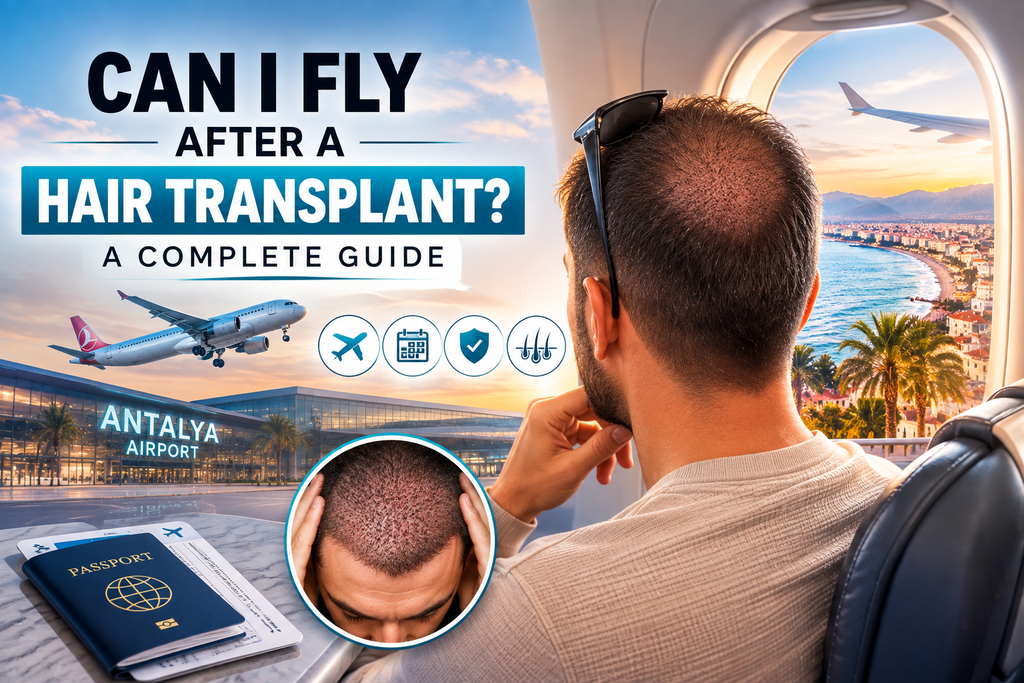
The answer depends on several factors, including the type of procedure, the number of grafts, your recovery and how you feel in the first few days after surgery. While many patients can return home within a few days, the exact timing should always be confirmed by the medical team treating you.
For patients travelling specifically for a hair transplant in Antalya, planning the return journey before the procedure can make the experience much more comfortable. Your hotel stay, postoperative check, first wash and flight should all fit together rather than being treated as separate parts of the trip.
At Hair Legends Antalya, we believe the patient’s journey should continue beyond the operating room. A well-planned return home is part of the overall treatment experience, particularly when the patient is travelling internationally.
How Soon Can You Fly After a Hair Transplant?
There is no single number of hours that applies to every patient. In many uncomplicated cases, international patients can travel home a few days after their hair transplant once the medical team has checked their recovery and provided the necessary aftercare instructions.
The first few days are useful because they allow the scalp to begin settling before the patient has to deal with an airport, luggage and a flight. Some patients experience mild redness or swelling during this period, while others have very little discomfort.
Your travel date should therefore be based on your individual recovery rather than simply choosing the earliest possible flight.
For someone travelling from Europe, this may be relatively straightforward because the journey is often short and direct. Patients travelling from the United States, Canada or Australia may need to think more carefully about flight duration and connections.
Why Do Hair Transplant Patients Stay in Antalya for Several Days?
Staying in Antalya for a few days after surgery is not simply about having extra time in the city. The early postoperative period is when the transplanted grafts need the most careful handling.
Depending on the clinic’s treatment protocol, patients may return for a first wash and postoperative assessment before leaving. This gives the medical team an opportunity to examine the donor and recipient areas and make sure the patient understands how to continue caring for the scalp at home.
It also means that the patient is not immediately travelling through a busy airport after surgery.
For someone coming from another country for a hair transplant Antalya procedure, this short period can provide some reassurance. If a question comes up during the first few days, the clinic is still nearby and available to provide guidance.
Can You Fly After an FUE Hair Transplant?
FUE is one of the most widely used techniques in modern hair restoration. Individual follicular units are carefully extracted from the donor area and then implanted into the areas affected by hair loss.
Although the extraction points are small, the procedure still leaves the scalp in an early healing stage. The transplanted grafts also need to be protected from unnecessary pressure, friction and contact.
The flight itself is generally not the main concern. What matters more is how the patient behaves while travelling.
Moving luggage, reaching into overhead compartments, rubbing the scalp or accidentally allowing another object to press against the recipient area can all be avoided with a little preparation.
Patients should follow the specific instructions provided by their clinic and avoid assuming that another patient’s travel schedule will automatically be suitable for them.
Can You Fly After a DHI Hair Transplant?
DHI, or Direct Hair Implantation, is another hair-transplant technique used for selected patients. The implantation process differs from conventional FUE, but the newly transplanted follicles still need protection during the early recovery period.
Choosing DHI does not automatically mean that a patient can travel immediately after surgery. The decision should be based on the individual’s recovery and the medical team’s assessment.
Whether the patient has undergone FUE, Sapphire FUE, DHI or another follicular-unit transplantation procedure, the same basic principle applies: the grafts should be protected and the scalp should be allowed to recover before the patient begins a long journey.
What Happens Before You Fly Home From Antalya?
Before an international patient leaves Antalya, the clinic should provide clear information about postoperative care.
This normally includes instructions about washing the scalp, protecting the grafts, medication and activities that should be avoided during the early recovery period. Depending on the clinic’s protocol, the patient may also have a first wash or postoperative examination before departure.
This final stage is particularly useful for international patients. Once you return home, you may be thousands of kilometres away from the clinic, so it is reassuring to know that the early recovery has been checked before travelling.
At Hair Legends Antalya, we consider this part of the patient’s journey just as important as explaining the procedure itself. Patients should leave with a clear understanding of what to do during the first days at home and how to contact the clinic if they have questions.
Can Swelling Get Worse After a Hair Transplant?
Swelling is one of the things that can surprise patients after a hair transplant. The scalp may look relatively normal immediately after the procedure, only for swelling to become more noticeable during the following days.
In some patients, swelling can extend towards the forehead or around the eyes. This can look concerning, but mild postoperative swelling can occur during normal recovery.
The important point is to understand what your clinic considers normal for your procedure.
If swelling becomes severe, develops rapidly or is accompanied by other worrying symptoms, contact your medical team rather than assuming it is simply part of the recovery.
Patients should also avoid planning their trip so tightly that there is no flexibility if their recovery takes longer than expected.
Can You Wear a Hat on the Plane?
This is one of the most common questions from patients travelling home after a hair transplant.
Many people understandably want to cover their scalp at the airport. The redness, small crusts and freshly transplanted grafts can make patients feel self-conscious, especially when they are surrounded by other travellers.
However, protecting the grafts should be more important than hiding them.
Whether you can wear a hat and what type of hat is appropriate depends on your clinic’s instructions and the stage of your recovery. A tight hat that presses against the recipient area is not appropriate during the early healing period.
If your medical team allows headwear, it should be used carefully and should not create unnecessary pressure or friction when being put on or removed.
What Should You Take on Your Flight Home?
A little preparation can make the journey considerably easier.
Keep your medication and important postoperative instructions in your hand luggage rather than placing essential items in checked baggage. If your clinic has provided products that you need during the journey, make sure they are packed appropriately and accessible.
Comfortable clothing is also useful. A shirt or top that does not need to be pulled tightly over the head can make changing clothes much easier during the early recovery period.
If you have a long flight ahead, think about comfort before leaving the hotel. You do not want to discover at the airport that your journey involves more walking, luggage handling or waiting than you expected.
How Should You Sleep During the Flight?
Sleeping can be one of the more uncomfortable parts of travelling after a hair transplant.
During the early recovery period, patients are often advised to keep the head elevated and avoid putting direct pressure on the transplanted area. Your clinic should explain the sleeping position that is appropriate for your procedure.
A travel pillow may help with comfort, but it should not press directly against the newly transplanted grafts.
On a long flight, you may naturally move around while sleeping. The goal is not to become afraid of every movement, but to minimise unnecessary pressure and follow the postoperative advice given by your medical team.
What Should You Avoid at the Airport?
An airport can be surprisingly demanding after surgery. There may be long queues, security checks, luggage and a lot of walking.
Try not to rush.
If you have checked luggage, arrange transportation and assistance where appropriate so that you do not have to lift heavy bags unnecessarily.
You should also be careful with overhead luggage. Reaching above your head and lifting a heavy suitcase can be uncomfortable during the early recovery period.
The same applies to crowded areas. There is no reason to allow strangers to touch your scalp, and you should avoid situations where the recipient area could be accidentally bumped.
The simpler and calmer you can make the journey, the better.
What Is It Like Flying From Antalya Airport After a Hair Transplant?
Antalya Airport is an important international airport for patients travelling to the city for medical treatment. Because Antalya is also a major tourist destination, international patients generally have access to a wide range of hotels, airport transfers and transportation options.
For a recent hair-transplant patient, arranging transportation in advance can be particularly helpful.
A private transfer from the hotel to Antalya Airport means you do not need to worry about finding a taxi or navigating public transport while recovering.
It is also worth allowing plenty of time at the airport. After surgery, there is little benefit in creating additional stress by arriving at the last possible moment.
Your return journey should be organised around comfort rather than speed.
What About Long-Haul Flights After a Hair Transplant?
A short flight from Antalya to London or another European destination is very different from a long journey to New York, Los Angeles, Toronto or Australia.
Long-haul patients should consider the total journey time, layovers and the amount of time they will spend sitting.
A longer journey does not necessarily mean that you cannot travel. It simply requires more planning.
Before surgery, tell your clinic how far you will be travelling and whether your return journey involves connections. This allows the medical team to consider the entire situation rather than giving you generic advice.
Some patients may also prefer to stay an additional night in Antalya before beginning a particularly long journey.
There is no prize for getting home as quickly as possible.
When Should You Delay Your Flight?
Most patients recover without major problems, but surgery always carries some degree of risk and individual recovery can vary.
If you develop significant bleeding, severe or increasing pain, unusual discharge, fever, rapidly increasing swelling or another symptom that concerns you, contact your clinic before travelling.
Do not assume that a flight must go ahead simply because it has already been booked.
Your medical team can assess the situation and advise you on the safest course of action.
This is another reason why booking your procedure with a clinic that provides ongoing communication after surgery is important for international patients.
How Long Should You Stay in Antalya After a Hair Transplant?
Many international patients plan around three days in Antalya for their treatment journey, although the ideal stay can vary.
The exact length depends on the procedure, the patient’s recovery and the clinic’s postoperative protocol. Some patients also choose to stay longer because they prefer to have additional time to recover before travelling.
When planning your trip, think about the entire process rather than focusing only on the surgery date.
You need time for the consultation, procedure, early recovery, postoperative care and return journey.
Trying to save one hotel night may not be worthwhile if it leaves you rushing to the airport immediately after surgery.
What Happens After You Arrive Home?
Returning home is only the beginning of the longer hair-growth process.
During the first weeks, the scalp will continue to change. Redness and crusting gradually settle, and transplanted hairs may eventually shed before new growth begins.
This can be confusing for patients who expect the transplanted hairs to simply continue growing from the day of surgery.
Hair transplantation is a gradual process. The early appearance is not an indication of the final result.
Once home, continue following the aftercare instructions provided by your clinic. If you have questions or notice something unusual, contact the medical team rather than relying solely on photographs or advice from social media.
Can You Return to Work After Flying Home?
This depends largely on your type of work.
Someone working from home may feel comfortable returning to their normal routine relatively quickly. Someone working outdoors, performing physical labour or working in a dusty environment may need more time.
People who wear helmets for work should discuss this with their clinic before surgery because direct pressure on the scalp may not be appropriate during the early recovery period.
Your appearance is another consideration. Although the grafts themselves are small, redness and crusting can remain visible for a while.
If you work in a public-facing role and would prefer to have more time for the scalp to settle, staying an extra few days in Antalya or arranging additional time away from work may be worthwhile.
Can You Travel Alone After a Hair Transplant?
Many patients travel to Antalya alone and are perfectly comfortable doing so. Others prefer to have a partner or friend with them.
The decision depends on the length of your journey and how comfortable you are travelling after a medical procedure.
A direct two- or three-hour flight is very different from a long-haul journey involving several airports.
If you are travelling alone, arrange your airport transfer in advance and make sure you have easy access to your medication, travel documents and postoperative instructions.
There is no reason for the journey to be complicated.
Good planning usually makes it much easier.
Why Your Return Flight Should Be Part of Your Hair Transplant Plan
International patients sometimes focus so heavily on finding the right graft number or technique that they forget about the practical side of travelling home.
But the return journey is part of the experience.
When you book a hair transplant in Antalya, you are not simply booking a surgical procedure. You are travelling to another country, staying in a hotel, undergoing treatment and then returning home while your scalp is still healing.
That is why the clinic should discuss more than the surgery itself.
Your accommodation, transfers, postoperative appointment and return flight should fit together logically.
At Hair Legends Antalya, we believe that international patients should understand this process before they arrive. Knowing what happens after surgery can make the experience much less stressful.
What Should You Ask Your Hair Transplant Clinic Before Booking?
Before travelling to Antalya, ask the clinic how long they recommend staying after your procedure and when they normally perform the first postoperative check.
Ask what happens if you develop swelling before your scheduled flight. Find out who you can contact once you return home and whether postoperative follow-up continues remotely.
It is also worth asking who will be responsible for your medical care during the procedure and what the clinic’s protocol is for postoperative complications.
These questions are much more useful than simply asking how quickly you can get back on the plane.
Frequently Asked Questions
Can I fly 24 hours after a hair transplant?
Some patients may feel well enough to travel relatively soon after surgery, but this does not mean that 24 hours is appropriate for everyone. Your treating medical team should assess your recovery and confirm when you are fit to travel.
Can I fly 48 hours after FUE?
Many international patients travel around this period, but the appropriate timing depends on individual recovery. A postoperative check before travelling can provide additional reassurance.
Can I fly three days after a hair transplant?
For many international patients, three days provides a practical timeframe for the procedure, early recovery and postoperative care. However, your own medical team’s recommendation should take priority.
Can I wear a hat at the airport after a hair transplant?
Only when your clinic says it is appropriate. During the early recovery period, a hat should not place pressure or friction on freshly implanted grafts.
Can I fly long-haul after a hair transplant?
Many patients can travel long distances after an appropriate recovery period, but long-haul travel requires more planning. Discuss the exact flight itinerary with your clinic before surgery.
How long should I stay in Antalya after my hair transplant?
Many patients plan approximately three days around their procedure, although some may benefit from staying longer depending on their recovery and travel plans.
What if I develop swelling before my flight?
Contact your clinic. Mild swelling can occur after hair transplantation, but significant or unexpected symptoms should be assessed before you travel.
Can I return to work immediately after flying home?
It depends on your job. Office-based work may be possible relatively soon, while physically demanding work, outdoor environments and jobs requiring helmets may require a longer recovery period.
Final Thoughts
For many international patients, flying home is one of the simplest parts of a hair transplant Antalya journey when it has been planned properly.
The important thing is not to focus only on the earliest possible departure date. Give your scalp time to settle, attend the recommended postoperative check and make sure you understand how to care for the grafts before leaving Turkey.
A short stay in Antalya can provide the opportunity to complete the procedure, have the early recovery monitored and return home with clear instructions.
The exact timing will always depend on the individual patient. Someone travelling a short distance within Europe may have very different requirements from someone facing a long-haul journey across the Atlantic.
If you are considering a hair transplant in Antalya, discuss your flight plans with the clinic before booking your surgery. A good treatment plan should consider not only how the grafts will be transplanted, but also how you will look after them once you leave the clinic.
The goal is simple: complete your treatment, protect your newly transplanted grafts and make the journey home as comfortable and straightforward as possible.