
Hair Transplant Keloid Scar: A hair transplant is a surgical procedure, and like any procedure that creates an injury to the skin, it can leave a scar. In most patients, the small openings created during FUE heal well and become difficult to notice. However, a small number of patients have a tendency to produce excessive scar tissue, and this can result in a keloid scar after a hair transplant.
Keloids are uncommon complications of hair transplantation, but they are important because they can be more persistent than ordinary postoperative marks. There are published cases of keloids developing after FUE, including extensive donor-area keloids, while larger studies have reported keloid formation as an uncommon complication of hair transplantation.
At Hair Legends Antalya, we believe that a proper hair transplant consultation should cover more than the number of grafts, the technique and the expected result. The way a patient’s skin heals is also relevant, particularly when there is a history of abnormal scarring.
This is especially important for people considering a hair transplant Antalya procedure from abroad. Patients should understand what normal healing looks like, what a keloid is, who may be more susceptible and what should be discussed with the doctor before surgery.
A keloid does not mean that every patient with a history of raised scars must automatically avoid hair transplantation. It does mean that the decision should be made carefully and individually.
What Is a Hair Transplant Keloid Scar?
A keloid is a raised scar that develops when the body’s wound-healing response produces excessive scar tissue.
When the skin is injured, the body produces collagen and other substances to repair the damaged tissue. Normally, this process gradually settles as the wound matures. With a keloid, the healing response remains overactive and scar tissue continues to develop.
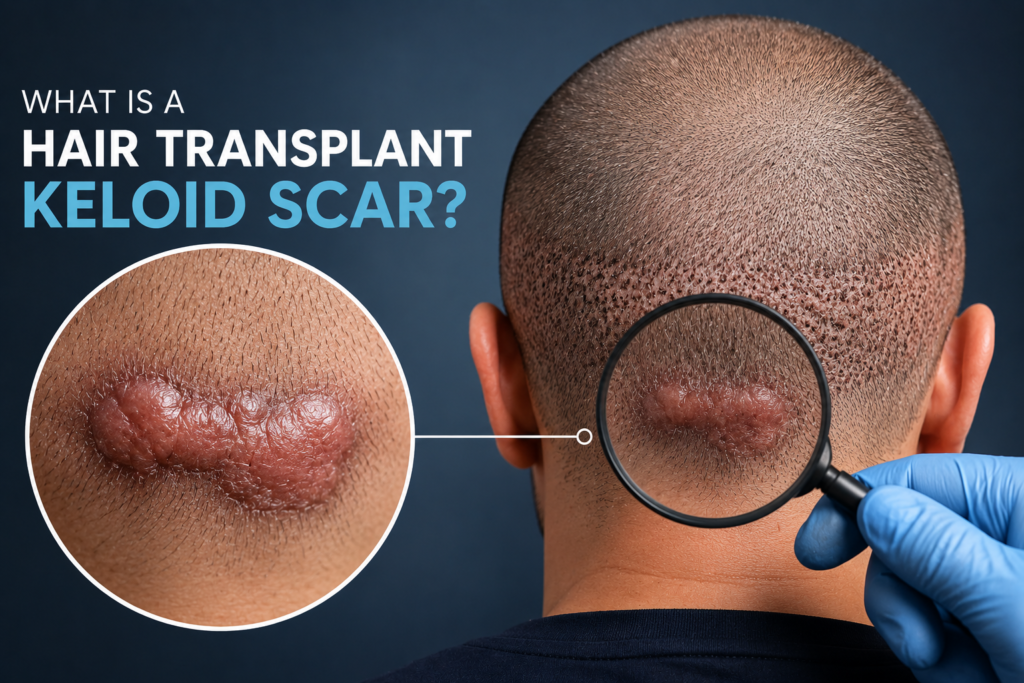
One of the defining features of a keloid is that it can grow beyond the original boundaries of the injury.
This is different from an ordinary FUE extraction mark. After a hair transplant, the donor area may initially have redness, tiny crusts or small visible marks. These generally become less noticeable as the scalp heals.
A keloid behaves differently. It can become firm, raised and sometimes darker than the surrounding skin. Some patients experience itching, tenderness or discomfort. Keloids can also continue growing for months or, in some cases, years.
A hair transplant keloid may develop in either the donor or recipient area, although donor-area scarring is particularly relevant because FUE creates multiple extraction sites.
It is important not to diagnose a keloid simply by looking at the scalp during the first few weeks after surgery. Early healing changes are common and do not necessarily indicate abnormal scarring.
What Is the Difference Between a Keloid and a Hypertrophic Scar?
Keloids and hypertrophic scars are often confused because both can appear raised and firm. However, they behave differently.
A hypertrophic scar generally remains within the boundaries of the original wound. It can become thick, red or raised, but it does not normally extend into the surrounding healthy skin.
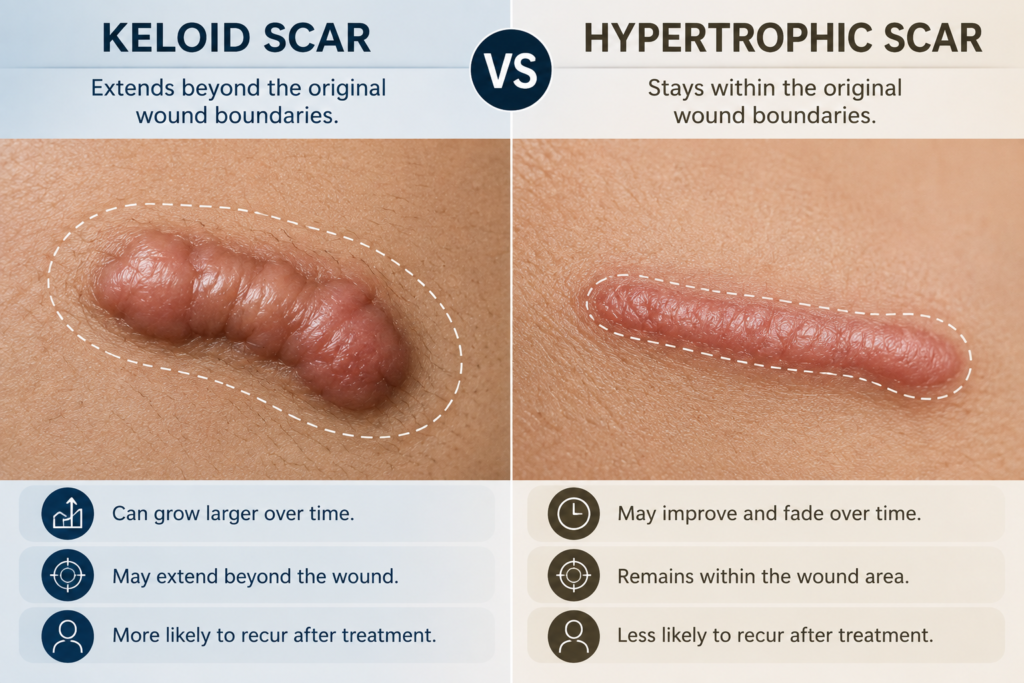
A keloid, on the other hand, can grow beyond the original wound.
The timing can also be different. According to the American Academy of Dermatology, hypertrophic scars often become apparent relatively soon after an injury and may gradually become less noticeable with time. Keloids can develop more slowly and may continue growing after the original injury has healed.
This distinction matters after a hair transplant because the scalp can look quite different during the early recovery period. Redness, crusting and small irregularities are not enough to conclude that a keloid has formed.
If an area becomes progressively thicker, harder or larger rather than gradually settling, it should be assessed by a medical professional.
Does a Hypertrophic Scar Fade on Its Own?
Hypertrophic scars often improve as they mature.
They may become flatter, softer and less noticeable over a period of months. This is one of the main differences between a hypertrophic scar and a keloid, which generally does not disappear simply because time has passed.
This is also why we advise patients not to judge the final appearance of their donor area too early after a hair transplant.
Immediately following FUE, the scalp has undergone thousands of tiny skin injuries. The appearance during the first days and weeks is not representative of the final result.
As healing progresses, the extraction sites normally become less visible.
If a patient notices a particular area becoming increasingly raised or uncomfortable, however, it is better to contact the clinic rather than simply waiting and hoping that it will disappear.
A doctor can determine whether the change represents normal healing, a hypertrophic scar, inflammation or a possible keloid.
Can a Hair Transplant Cause a Keloid?
Yes, although it is uncommon.
FUE is often associated with very small donor-area scars because individual follicular units are removed through small openings rather than through a long strip incision. However, FUE still involves penetrating the skin and removing tissue.
A published case report documented extensive donor-site keloids following FUE hair transplantation and emphasised that practitioners should be aware of the possibility, particularly when treating patients who may have an increased tendency toward keloid formation.
Older research involving 533 hair-transplant procedures reported keloids in 0.4% of procedures. The same study reported other complications, including enlarged scars, folliculitis, infection and donor-area necrosis.
More recent reviews continue to describe scarring and keloid formation as recognised complications of hair restoration surgery, while also emphasising that serious complications are uncommon when procedures are performed by experienced providers.
These figures should not be interpreted as a precise prediction of an individual patient’s risk. The available studies differ in age, surgical techniques and patient populations.
The useful conclusion is simpler:
A keloid after hair transplantation is possible, but it is not a normal or expected result for most patients.
Why Do Some People Develop Keloids?
Keloid formation is not caused by one factor.
Genetic susceptibility appears to play a significant role. Researchers have found strong evidence of familial clustering and differences in susceptibility between populations, although there is no single gene that determines whether an individual will develop a keloid.
The body essentially responds differently to the same type of skin injury.
Two people can have an identical procedure and heal very differently.
One may develop a barely visible mark.
Another may develop a thickened scar.
Someone who has previously developed a true keloid is particularly important to identify before elective surgery because their history provides evidence that their wound-healing response may be more aggressive.
This is why questions about previous scars should be part of a proper hair transplant consultation.
Who Is at Higher Risk of a Hair Transplant Keloid?
A personal history of keloid formation is one of the most useful warning signs.
If you have previously developed a keloid following surgery, an injury, piercing, acne or another skin injury, tell your doctor before considering a hair transplant.
Family history is also relevant. The American Academy of Dermatology reports that a substantial proportion of people who develop keloids have a close blood relative with the same tendency.
Ancestry is another factor associated with keloid susceptibility. Keloids are more common among people with African and Asian ancestry, with increased prevalence also reported in some Latin American and Mediterranean populations.
However, this does not mean that skin colour or ancestry alone can predict whether a particular patient will develop a keloid.
Personal history remains extremely important.
A patient with darker skin who has never developed an abnormal scar may have a different individual risk profile from someone with a strong family history and several previous keloids.
This is why we prefer to assess the patient rather than make assumptions based on appearance.
Why Does Skin Tension Change Where Keloids Appear?
The location of a wound can influence scar formation.
Keloids are particularly common in areas such as the chest, shoulders, upper back, neck and earlobes. Researchers have suggested that mechanical tension and stretching of the skin can contribute to the development and progression of abnormal scars.
The scalp is not among the most classic locations for severe keloid formation. Nevertheless, hair transplantation creates numerous small wounds, so a patient with a strong tendency toward keloids cannot be considered completely risk-free.
Previous scar location can also provide useful information.
For example, a patient who developed a large keloid after chest surgery has demonstrated a tendency toward abnormal scar formation. A patient whose previous injuries consistently healed as flat scars presents a different history.
This is one reason why we ask patients about old surgical scars, piercings, acne scars and injuries rather than simply asking whether they have ever had a problem with their scalp.
Why Is Ancestry a Stronger Predictor Than Skin Tone?
Keloids are often discussed in terms of skin colour, but the biology is more complicated.
Research suggests that genetic and ancestral background contributes to susceptibility. Recent multi-ancestry genetic research has identified multiple genetic regions associated with keloid susceptibility and found substantial differences in estimated genetic contribution between ancestry groups.
This does not mean that ancestry determines an individual’s outcome.
There is no simple test that says a person with a particular ancestry will develop a keloid.
Instead, ancestry can be considered one part of a broader risk assessment that includes personal history, family history, previous surgeries and the location and behaviour of existing scars.
For clinical decision-making, this is much more useful than categorising patients solely according to skin tone.
Which Hair Transplant Technique Carries the Higher Scarring Risk?
Patients often ask whether FUE or FUT is more likely to leave a noticeable scar.
The answer depends on the type of scarring being discussed.
FUE involves extracting individual follicular units through small openings distributed across the donor area. When performed appropriately, these extraction sites generally heal as small marks that become difficult to notice as the scalp recovers and surrounding hair grows.
FUT, also known as strip harvesting, involves removing a strip of donor scalp and closing the resulting wound. This creates a linear scar.
For someone who wants to keep the hair very short, the difference can be important.
A linear FUT scar can become visible with short hairstyles, while FUE generally produces multiple small marks rather than one continuous line.
However, FUE does not mean “no scarring.”
It is still a surgical procedure, and keloid formation has been reported following FUE. A published case specifically described keloids developing in the donor area after FUE.
At the same time, recent reviews of hair transplantation have found that hypertrophic scarring and keloid formation can be particularly relevant to FUT donor wounds, reflecting the larger linear incision involved in strip harvesting.
The correct technique therefore cannot be selected simply by asking which one has the lowest theoretical scar risk.
The doctor should consider the patient’s hair loss, donor characteristics, hairstyle, previous surgery and individual healing history.
How Is Keloid Risk Assessed Before Surgery?
A proper risk assessment starts with a conversation.
Before recommending a hair transplant, the doctor should ask whether the patient has ever developed an unusually raised scar.
This includes scars resulting from:
- Previous surgery
- Cuts or injuries
- Acne
- Piercings
- Tattoos
- Injections or vaccinations
- Previous cosmetic procedures
- Previous hair transplantation
Family history should also be discussed.
Existing scars can then be examined. Their size, thickness, colour, location and behaviour may provide useful information.
A patient with several large, established keloids presents a very different situation from someone who has never experienced abnormal scarring.
Previous hair transplantation is another important consideration.
If a patient is coming to Antalya for a second procedure, the donor area should be examined carefully. Previous extraction may have changed the density of the donor region, and any abnormal scars should be identified before another surgical procedure is planned.
For patients with a significant keloid history, consultation with a dermatologist or scar specialist may be appropriate.
There are cases where the safest decision is not to proceed with an elective hair transplant.
That decision should be made based on the patient’s individual risk rather than pressure to proceed with treatment.
Is FUE Safe for Patients With a History of Keloids?
This needs to be answered individually.
FUE generally produces small donor wounds, but a patient with a strong keloid tendency may respond abnormally even to small injuries.
A previous case report of extensive keloid formation after FUE demonstrates why the possibility should not be completely dismissed.
If someone has previously developed multiple keloids, the doctor may recommend further assessment before elective surgery.
The important thing is not to promise that FUE eliminates the risk.
It doesn’t.
Instead, the doctor should explain the patient’s individual situation and whether the potential benefits justify the surgical risk.
For patients with a mild history of hypertrophic scarring rather than true keloids, the discussion may be different.
This is precisely why an accurate diagnosis of previous scars matters.
Does the Number of Grafts Affect Scarring?
There is no simple rule that says more grafts equal more keloids.
However, larger procedures involve more extraction sites and therefore more areas of skin that need to heal.
Older research found that the frequency of enlarged scars increased with the number of surgical procedures performed.
The number of grafts should therefore be determined according to the patient’s actual needs rather than simply selecting the largest available package.
For example, a patient may request 5,000 grafts because they want maximum density. If the donor area cannot safely support that number, extracting more follicles could create unnecessary problems.
A good treatment plan considers both the recipient area and the donor area’s long-term condition.
Can Poor Hair Transplant Technique Increase Scarring?
A patient’s genetic tendency is a major factor in keloid formation, but surgical technique and aftercare still matter for overall wound healing.
The size and handling of the extraction instruments, the distribution of extraction sites, the management of the scalp and the overall surgical technique can influence complications.
Research into hair-transplant complications emphasises the importance of appropriate patient assessment, trained personnel, accurate surgical technique and postoperative care.
This is particularly relevant when comparing clinics offering a hair transplant in Antalya.
A procedure should not be treated as a race to extract the largest possible number of grafts in the shortest possible time.
The donor area needs to be respected.
The recipient area needs to be planned.
The skin needs to be handled appropriately.
And patients with unusual healing histories need to be identified before surgery.
What Does a Keloid Look Like After a Hair Transplant?
Immediately after FUE, the scalp can look quite different from normal.
Small red dots, crusting and temporary swelling are common parts of recovery. The donor area may also feel sensitive for a short period.
These changes should not automatically be interpreted as scarring.
A keloid usually becomes more clearly defined as time passes. It may appear raised and firm and can gradually extend beyond the original wound.
Some patients experience itching, tenderness or discomfort.
However, it is difficult to distinguish a true keloid from other postoperative changes without an examination.
If an area continues becoming thicker or larger instead of settling, contact the clinic.
Early assessment is preferable to self-diagnosis.
When Should You Contact Your Hair Transplant Clinic?
You should contact your medical team if your recovery appears significantly different from what you were told to expect.
This includes a scar that becomes increasingly raised, hard or enlarged.
You should also seek medical assessment if you experience increasing pain, spreading redness, discharge, fever or other symptoms that could indicate infection.
Not every raised area is a keloid.
It could be a hypertrophic scar, folliculitis, inflammation or another postoperative issue.
The American Academy of Dermatology recommends medical assessment when a scar becomes thicker or when a patient suspects that a keloid may be developing.
Can a Hair Transplant Keloid Be Treated?
Yes, but treatment needs to be individualised.
Keloids can be difficult to manage because they have a tendency to recur.
Depending on the scar, dermatologists may use corticosteroid injections, silicone-based treatments, pressure therapy, cryotherapy or surgical approaches. Sometimes more than one treatment is combined.
The appropriate treatment depends on the size, location, symptoms and maturity of the keloid.
A patient should not assume that removing a keloid surgically will permanently solve the problem. The scar-forming tendency remains, which means recurrence is possible.
This is why scar treatment should ideally be managed by a dermatologist or another appropriately trained medical professional with experience in keloid management.
Are Silicone Sheets or Silicone Gel Useful?
Silicone is commonly used in scar management.
The American Academy of Dermatology notes that silicone gel sheets and silicone gel may help prevent raised scars and can improve characteristics such as redness, hardness and size in some existing raised scars.
Timing matters.
Silicone products should generally be used only after the wound has closed sufficiently and according to medical advice.
A patient should not place silicone sheets or other products directly over fresh hair-transplant wounds simply because they are worried about scarring.
Newly transplanted grafts need their own postoperative care.
The clinic’s instructions should take priority during the early recovery period.
Can Steroid Injections Treat a Hair Transplant Keloid?
Corticosteroid injections are an established treatment for keloids and hypertrophic scars.
They can reduce the thickness and inflammation of the scar and may help relieve itching or discomfort.
However, they need to be administered by a trained medical professional.
The dose, concentration and injection depth matter, particularly on the scalp.
Treatment may also require several sessions rather than one injection.
The American Academy of Dermatology lists corticosteroid injections among the treatments used for keloids and raised scars.
If a patient develops a suspected keloid after a hair transplant, the appropriate approach is to have the scar assessed before starting treatment.
Can a Keloid Be Removed Surgically?
Sometimes, but surgery alone is not always sufficient.
A keloid can return after surgical removal because the patient’s underlying tendency toward excessive scar formation remains.
For this reason, dermatologists may combine surgical excision with other treatments designed to reduce recurrence.
The American Academy of Dermatology notes that keloids can recur after surgical removal and that additional therapy may be necessary.
In a hair-transplant patient, there is an additional consideration: the surrounding follicles and donor-area appearance need to be protected.
Treatment should therefore be planned carefully rather than approaching the scar as an isolated cosmetic problem.
Can Keloids Be Prevented Before Hair Transplant Surgery?
There is no guaranteed method of preventing a keloid in someone who is genetically predisposed.
The most useful preventive step is identifying the risk before surgery.
If you have a history of keloids, tell the doctor.
If a close family member has a history of significant keloid formation, mention that too.
The American Academy of Dermatology recommends avoiding unnecessary skin injury in people who are prone to keloids and emphasises appropriate care of wounds.
In an elective procedure such as hair transplantation, the doctor can then weigh the potential cosmetic benefit against the patient’s individual risk.
Sometimes the best decision is to proceed with additional precautions.
Sometimes further specialist assessment is appropriate.
And sometimes avoiding surgery is the safest option.
Does Sun Exposure Affect a Healing Hair Transplant Scar?
Sun protection is an important part of scar care.
Ultraviolet exposure can contribute to pigmentation changes in healing skin and make scars more noticeable. The American Academy of Dermatology recommends protecting healing scars from sunlight and using broad-spectrum sunscreen with SPF 30 or higher once the wound has healed sufficiently.
This deserves particular attention for patients travelling to Antalya.
The region has a sunny climate, and international patients may spend time outdoors during their stay.
However, sun protection needs to be introduced at the appropriate stage.
Fresh grafts should not be covered with sunscreen immediately after surgery unless specifically instructed by the medical team.
During the early recovery period, physical protection and avoidance of direct sun exposure are generally more appropriate.
Once the scalp has healed, suitable sun protection can become part of normal postoperative skin care.
Hair Transplant Keloid Risk in Afro-Textured Hair
Patients with Afro-textured hair deserve particular consideration because the shape and curvature of the follicular units can make FUE technically more demanding.
The follicle can curve beneath the skin, increasing the importance of understanding its direction during extraction.
Scarring history also matters.
Keloid susceptibility is higher in populations with African ancestry, although ancestry alone cannot predict an individual outcome.
This does not mean Afro-textured hair cannot be transplanted.
It means the procedure should be planned by a team familiar with the characteristics of the patient’s hair and scalp.
The combination of follicular curvature and a possible tendency toward abnormal scarring makes careful assessment particularly valuable.
Can Hair Be Transplanted Into a Keloid or Scarred Scalp?
In selected cases, hair can be transplanted into stable scar tissue.
However, scar tissue is not identical to normal scalp.
It may have different vascularity, tissue characteristics and healing behaviour. These factors can influence graft survival.
Research into hair transplantation in stable scalp scars has shown that transplantation can provide cosmetic improvement in selected patients, but scarred tissue requires additional planning.
A scar should therefore be assessed before graft placement.
If the scar is active, expanding or still changing, treating the underlying scar problem may need to come first.
Once the scar has stabilised, the doctor can determine whether transplantation is technically and medically appropriate.
Is a Keloid the Same as a Failed Hair Transplant?
No.
These are two separate issues.
A patient can have good graft growth and still develop an abnormal scar.
Likewise, a patient can have normal donor-area healing but experience lower-than-expected graft growth for another reason.
Keloid formation relates primarily to the wound-healing response.
Graft survival depends on other factors, including the quality and handling of the grafts, implantation technique, recipient-site conditions and postoperative care.
This distinction is important because patients sometimes assume that every unusual postoperative change means the transplant itself has failed.
It doesn’t.
A proper assessment should identify exactly what is happening.
What Should You Tell Your Doctor Before a Hair Transplant?
Patients often arrive for consultation focused entirely on their hair loss.
But your medical history is equally important.
Tell your doctor if you have ever developed a raised scar after:
- Surgery
- Injury
- Acne
- Piercing
- Tattooing
- Vaccination or injection
- A previous hair transplant
Also mention if a close family member has significant keloid scars.
If you’ve already had a hair transplant, explain how the scalp healed and whether you experienced unusual scarring.
This information does not automatically mean that you cannot have another procedure.
It gives the doctor the information needed to make a more informed decision.
How We Assess Scarring Risk at Hair Legends Antalya
At Hair Legends Antalya, we believe that a successful hair transplant starts with the patient assessment rather than with a graft package.
Before surgery, the doctor needs to understand the patient’s pattern of hair loss, donor capacity, previous procedures and relevant medical history.
Scarring history is part of that discussion.
If a patient tells us that they have developed significant keloids after previous surgery, we don’t treat that information as a minor detail. It may change the risk assessment and, depending on the individual circumstances, may warrant further dermatological evaluation.
The donor area is also assessed before extraction.
This is important for every patient, but especially for people who may eventually require more than one procedure. Donor hair is limited, and unnecessary extraction can create problems later.
The same principle applies to graft numbers.
We don’t believe that the largest possible graft number automatically produces the best result. The appropriate number depends on the patient’s donor supply, hair-loss pattern, recipient area and long-term plan.
Our objective is to create a natural result while respecting the patient’s scalp and available donor resources.
Why Choosing the Right Hair Transplant Clinic in Antalya Matters
Antalya has become one of the most recognised destinations for international hair transplantation, and patients can find a wide range of clinics and treatment packages.
That choice can be useful, but it also means patients need to look beyond price.
When comparing a hair transplant Antalya clinic, ask who will perform the procedure, who is responsible for the medical assessment and how the donor area is evaluated.
Ask how the clinic handles patients with previous surgery or abnormal scars.
Ask what happens if you develop a postoperative concern after returning home.
A professional consultation should not be limited to:
“How many grafts do you want?”
It should also cover:
“Is a hair transplant appropriate for you?”
That distinction is important.
Frequently Asked Questions About Hair Transplant Keloids
Are keloids common after hair transplantation?
No. Keloids are considered an uncommon complication of hair transplantation. An older series of 533 procedures reported keloids in 0.4% of procedures, while later literature has continued to describe them as rare.
Can FUE cause a keloid?
Yes, although it is rare. Published case reports have documented keloid formation in the donor area after FUE.
Is FUT more likely to leave a visible scar than FUE?
FUT creates a linear donor scar, while FUE creates multiple small extraction marks. The visibility of each depends on the patient, surgical technique, healing and hairstyle. Recent literature identifies hypertrophic scarring and keloid formation as recognised complications of FUT donor wounds, while keloids can also occur after FUE.
Does having a keloid mean I cannot have a hair transplant?
Not automatically. A significant keloid history does mean that the risks need to be assessed carefully. Some patients may require dermatological evaluation before elective surgery.
Does a hypertrophic scar disappear?
It can become flatter and less noticeable over time. This is one of the main differences from a keloid, which generally does not simply disappear without treatment.
Why are some people more prone to keloids?
Genetics, family history and ancestry all appear to influence susceptibility. Research has identified multiple genetic factors associated with keloid formation, although there is no single gene that determines whether someone will develop one.
Can a keloid be treated?
Yes. Depending on the scar, treatments can include silicone products, corticosteroid injections, pressure therapy, cryotherapy and surgical treatment. Keloids can recur, so treatment often requires careful follow-up.
Can hair be transplanted into scar tissue?
Sometimes. Stable scalp scars can be treated with hair transplantation in selected patients, although scar tissue can affect graft survival and requires individual assessment.
Should I tell my doctor if a family member has keloids?
Yes. Family history is relevant because keloid susceptibility has a significant genetic component.
When should I contact my clinic after a hair transplant?
Contact your clinic if a scar becomes progressively raised, hard or enlarged, or if you develop significant pain, spreading redness, discharge, fever or another unexpected symptom. A medical professional can determine whether the change is part of normal healing or requires treatment.
Final Thoughts: Understanding Keloid Risk Before a Hair Transplant
A keloid scar after a hair transplant is uncommon, but it is a real potential complication that deserves to be discussed with patients who have a history of abnormal scarring.
The most important point is that not every visible mark after FUE is a keloid. Early redness, crusting and small extraction marks are expected during recovery. Hypertrophic scars and keloids are also different conditions, and their behaviour over time is not the same.
For patients with a personal or family history of keloids, the conversation should happen before surgery.
At Hair Legends Antalya, we believe that good hair restoration is based on appropriate patient selection, careful donor-area management, realistic expectations and a clear understanding of potential risks. A transplant should not be planned simply around the number of grafts a patient wants.
The scalp needs to be assessed.
The donor area needs to be protected.
Previous scars need to be discussed.
And if there is a significant history of keloid formation, the potential benefits of an elective procedure need to be weighed against the individual risks.
For international patients searching for hair transplant Antalya, choosing a clinic should therefore involve more than comparing package prices. The medical team’s experience, consultation process, surgical planning and postoperative support are all relevant.
A hair transplant can produce a very natural improvement for the right patient. But a responsible clinic should never promise that complications are impossible.
Our approach at Hair Legends Antalya is to identify risks before treatment, explain them clearly and build the procedure around the individual patient.
If you have previously developed keloids or unusually raised scars and are considering a hair transplant, mention this during your consultation. It may be one of the most important pieces of information your doctor needs before deciding whether transplantation is appropriate for you.