
When people start researching a hair transplant in Turkey, they usually compare three things first: price, graft number and before and after photographs.
Those are obviously important.
But there is another question that deserves just as much attention:
Who will actually perform the procedure?
This can be surprisingly difficult to answer from a clinic’s website.
You may spend several weeks communicating with a patient coordinator. You may receive a treatment plan and a price quotation. You may even have a video consultation with a doctor.
Then you arrive in Antalya and meet the wider medical team for the first time.
For many international patients, this is when the question becomes much more relevant.
Will the doctor perform the extraction? Who opens the channels? Who implants the grafts? Will the doctor be present throughout the procedure? What exactly does “doctor-led” mean?
These are reasonable questions. In fact, they are questions you should ask before paying a deposit.
A hair transplant is not simply about moving a certain number of grafts from the back of the head to the top. The planning, donor management, hairline design and surgical technique all contribute to the final result.
For patients searching for a hair transplant Antalya doctor, understanding the structure of the medical team can therefore be just as important as comparing prices.
Why Should You Ask Who Performs Your Hair Transplant?
A hair transplant involves several different stages, and not every member of the medical team necessarily performs the same task.
That isn’t unusual.
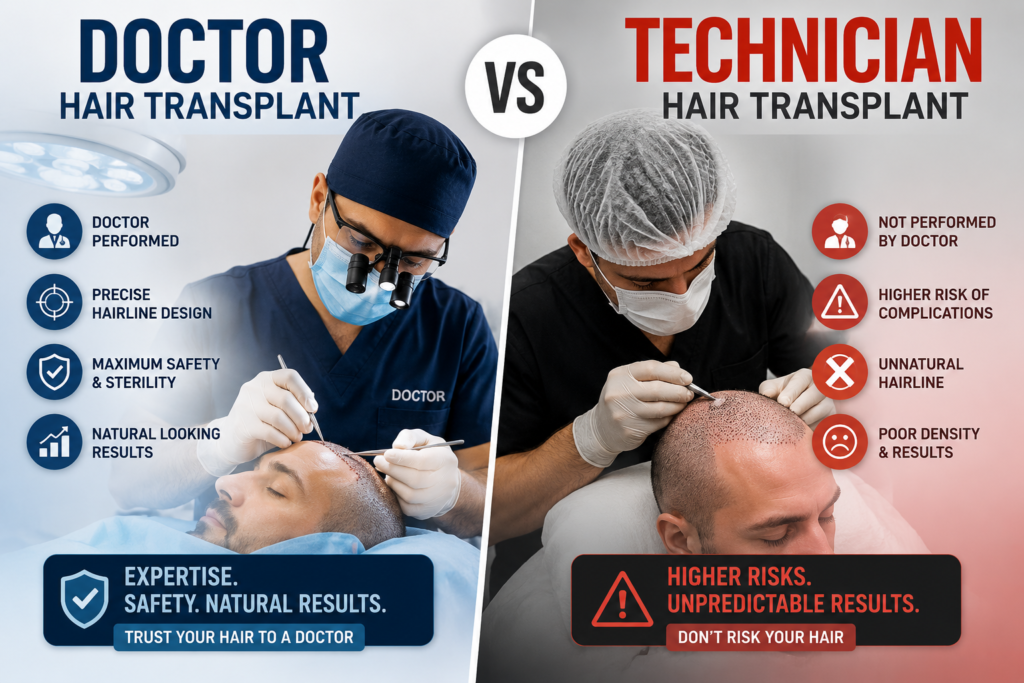
A properly organised procedure can involve a doctor and other qualified healthcare professionals working together. The important part is understanding who is responsible for each stage and making sure the clinic explains this clearly.
This distinction is particularly important because the phrase “doctor-led hair transplant” can mean different things to different clinics.
Some patients interpret it as:
“The doctor personally performs every single step.”
That isn’t necessarily what a doctor-led procedure means.
A more useful definition is that the doctor is responsible for the medical assessment and treatment plan, performs the stages that require physician involvement, and supervises the medical team throughout the procedure.
Under Turkey’s current hair-transplant regulations, appropriately certified healthcare professionals can assist with implantation under the supervision and responsibility of the relevant physician. Physician certification and assistant-practitioner certification are separately defined by the Ministry of Health.
So the question shouldn’t simply be:
“Are technicians involved?”
Instead, ask:
“Who does what?”
That answer tells you much more about the clinic.
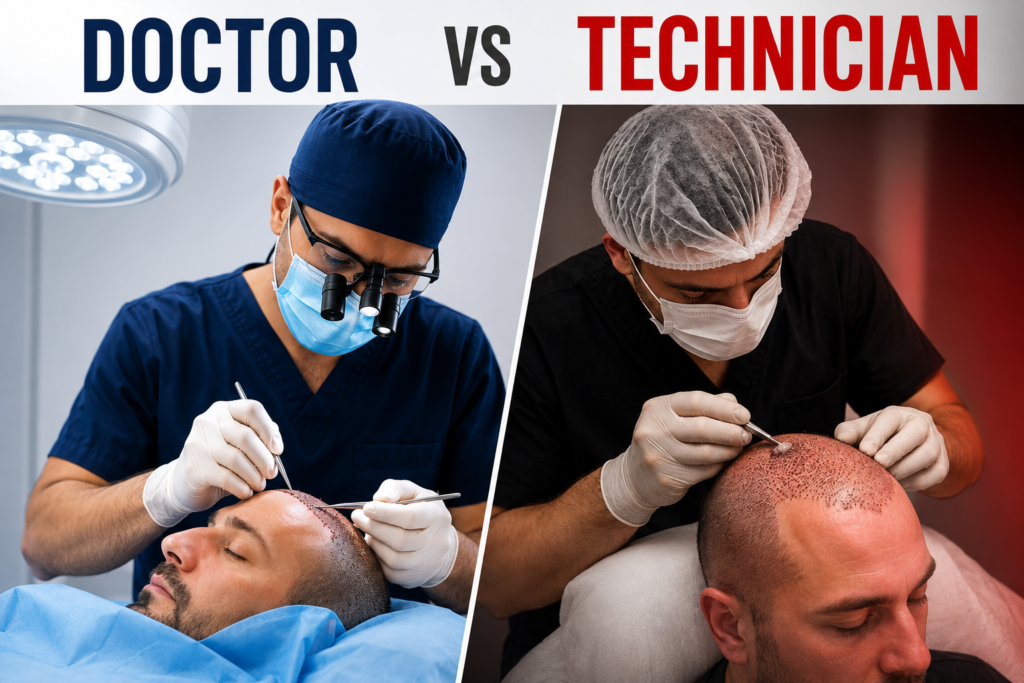
Doctor vs Technician: What Is the Difference?
The word “technician” is often used very loosely in online discussions.
A patient may call every non-doctor member of a hair transplant team a technician. However, that doesn’t necessarily tell you anything about their qualifications.
Turkey has a regulatory framework for hair-transplant units and defines the roles of certified physicians and healthcare professionals who assist with hair transplantation. The Ministry of Health lists separate certification processes for hair-transplant practitioner physicians and assistant practitioners from specified healthcare professions.
This is an important distinction.
There is a big difference between a properly qualified healthcare professional working as part of a supervised medical team and an unqualified person performing medical procedures.
Therefore, don’t make your decision based solely on the word “technician.”
Instead, find out:
- Who is the responsible doctor?
- Who assesses you before surgery?
- Who designs your hairline?
- Who performs extraction?
- Who opens the recipient channels?
- Who implants the grafts?
- Who supervises the procedure?
- Who provides postoperative medical follow-up?
A transparent clinic should be able to answer these questions without hesitation.
What Does the Doctor Do Before the Hair Transplant?
The doctor’s involvement should begin before surgery.
This is particularly important for patients with advanced hair loss.
A patient may contact a clinic and say:
“I want 4,000 grafts.”
Another patient may ask for 5,000.
But the correct number cannot be decided simply by looking at a package list.
The doctor needs to assess the donor area, the pattern of hair loss, existing hair density, hair calibre and the areas that need the most attention.
There is also a question that isn’t always discussed enough:
What happens to your hair five or ten years from now?
A younger patient may still have significant native hair that is vulnerable to future thinning. Designing an extremely low hairline and using a large proportion of the donor supply immediately may create problems later.
This is why good hair restoration planning looks beyond the day of surgery.
A doctor may sometimes recommend fewer grafts than the patient originally requested.
That isn’t necessarily a disadvantage.
It may actually be a sign that the donor area is being treated as a long-term resource rather than an unlimited supply of grafts.
Hairline Design Is More Than Drawing a Line
One of the first things patients often want to know is where their new hairline will be.
It is understandable. The hairline is one of the most visible parts of the result.
But a natural hairline isn’t simply a straight line placed at a preferred height.
The design needs to take into account:
- Facial proportions
- Age
- Existing hair
- Donor capacity
- Hair calibre
- Future hair loss
- The density that can realistically be achieved
A younger hairline may look attractive on a computer screen, but it isn’t necessarily the right choice for a 40- or 50-year-old patient.
Likewise, creating a very dense hairline may not be sensible if the patient has limited donor resources.
The doctor should therefore discuss the design with the patient before surgery and explain why a particular shape and position has been chosen.
For someone travelling to Antalya for a hair transplant, this consultation is one of the most important parts of the entire process.
Who Performs the Graft Extraction?
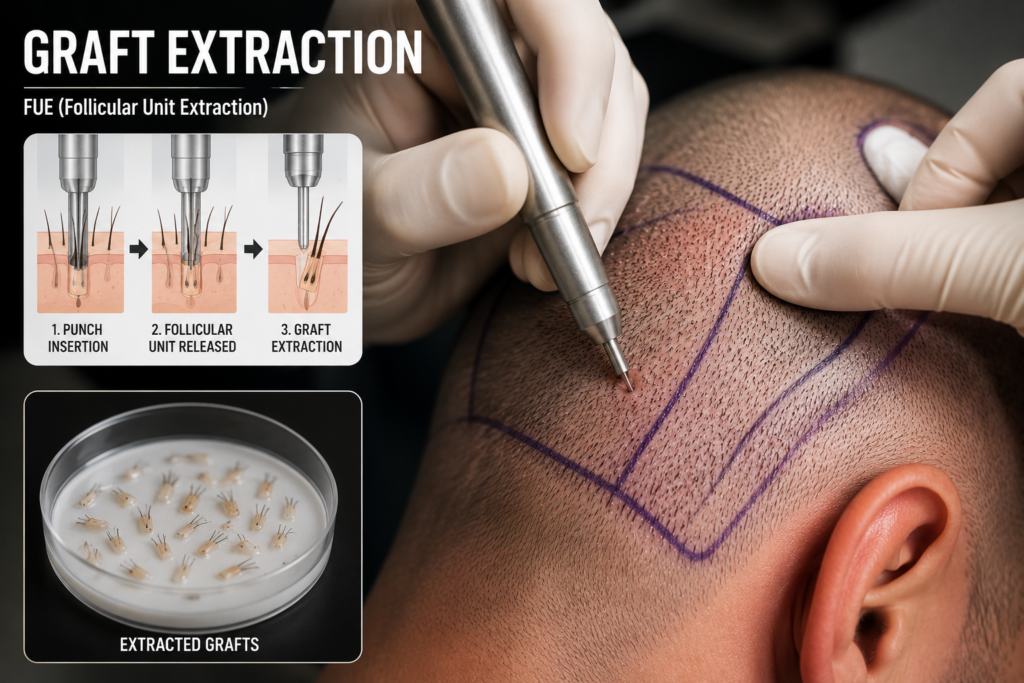
Extraction is one of the key stages of FUE hair transplantation.
Individual follicular units are removed from the donor area, usually at the back and sides of the scalp.
It might sound straightforward, but there is more to it than simply removing 4,000 grafts.
The extraction pattern matters.
If too many grafts are taken from one small section, the donor area can appear visibly thinner. If extraction is poorly distributed, the patient may notice uneven density after the procedure.
The quality and characteristics of the grafts matter too.
Some follicular units contain a single hair, while others contain two, three or more hairs. Their distribution can influence how the grafts are later used.
Under Turkey’s current regulatory framework, the collection of hair follicles is among the stages assigned to appropriately certified physicians.
This is therefore a perfectly reasonable question to ask your clinic:
“Who will personally perform the extraction?”
You should receive a clear answer.
Who Opens the Recipient Channels?
The recipient channels determine where the grafts will ultimately sit.
They also influence the direction and angle of the transplanted hair.
This is especially important around the frontal hairline. Hair grows in a particular direction naturally, and simply placing grafts into the scalp without respecting that pattern can result in an artificial appearance.
Turkey’s current regulation specifically addresses channel opening and assigns this stage to appropriately qualified physicians.
For this reason, if you are comparing clinics, ask directly:
“Who will open the channels during my procedure?”
Don’t assume that the person answering your WhatsApp messages is necessarily the person performing the medical stage of the operation.
Get the answer before you travel.
Who Implants the Grafts?
Implantation is the stage where the prepared grafts are placed into the recipient sites.
This can be a long and meticulous part of the procedure, particularly when thousands of grafts are involved.
The grafts aren’t interchangeable.
Single-hair grafts may be used toward the front to create a softer transition, while multi-hair grafts can be useful behind the hairline where greater density is required.
The direction of the hair also needs to be respected.
This is one reason why a properly trained medical team is important.
Under Turkey’s current regulations, implantation may be performed by an appropriately qualified physician or by healthcare professionals holding the required assistant-practitioner certification, under the supervision and responsibility of the physician.
So again, the presence of a healthcare professional who isn’t the doctor does not automatically indicate a poor-quality procedure.
What matters is qualification, supervision and transparency.
What Does “Doctor-Led” Actually Mean?
This is probably the most misunderstood phrase in the hair transplant industry.
A doctor-led procedure does not necessarily mean that the doctor holds every instrument for every graft.
Large procedures involve many hours of detailed work. A medical team can have several qualified people involved.
What matters is that the doctor is genuinely involved in the medical side of the procedure.
That includes assessment, planning, hairline design, appropriate physician-only stages and supervision of the team.
There is a major difference between:
“A doctor is responsible for this procedure and actively supervises the team.”
and:
“A doctor is available somewhere in the clinic, but the patient has little idea when or how the doctor is involved.”
Patients should know which model they are paying for.
What Happens From Booking to Surgery Day?
For an international patient, the experience begins well before arriving in Antalya.
1. Initial Contact
Usually, the first person you speak to is a patient coordinator.
They may ask for photographs, medical history and information about your hair loss.
That’s normal.
The coordinator’s role is largely administrative and communicative.
2. Medical Assessment
Your photographs and information should be reviewed by the medical team.
An initial graft estimate may be provided, but this shouldn’t necessarily be treated as the final number.
A physical examination can reveal things that aren’t obvious in photographs.
3. Treatment Plan
The clinic should explain which areas are likely to be treated.
Is the priority the hairline?
The mid-scalp?
The crown?
All three?
This should be discussed before surgery.
4. Arrival in Antalya
Once you arrive, your scalp can be examined directly.
The doctor can assess the donor area, hair density and recipient area more accurately.
If the recommended graft number changes slightly after examination, that isn’t automatically a problem.
In fact, it can be a sign that the clinic is making decisions based on the actual condition of your scalp.
5. Hairline Design
The proposed hairline is discussed and marked.
This is an important opportunity to ask questions and make sure you understand the plan.
6. Surgery
The procedure then proceeds according to the treatment plan, with the medical team carrying out their respective roles.
7. Aftercare
Once the procedure is complete, you should receive instructions regarding washing, medication, sleeping position, physical activity and scalp protection.
For an international patient, postoperative communication becomes especially important because you’ll soon be travelling home.
How Can You Tell If a Clinic Is Actually Doctor-Led?
Don’t rely on photographs.
Ask questions.
That’s the simplest way.
A clinic that operates transparently should be able to tell you the doctor’s name and explain the team’s responsibilities.
Before booking, ask:
Who is the doctor responsible for my procedure?
Will I meet the doctor before surgery?
Who designs my hairline?
Who performs the extraction?
Who opens the channels?
Who implants the grafts?
Will the doctor be present during the procedure?
How is postoperative follow-up handled?
These questions don’t require medical knowledge.
You’re simply asking what will happen to you.
What Are the Warning Signs?
There isn’t one sentence that automatically tells you a clinic is unsuitable.
Usually, it’s the overall lack of clarity.
You Can’t Identify the Doctor
If you’ve been talking to a coordinator for weeks but still don’t know the full name of the responsible doctor, ask.
Nobody Can Explain Who Does What
“Don’t worry, our team is very experienced” isn’t a complete answer.
You can politely ask for more detail.
The Graft Number Is Treated Like a Package Size
If every patient appears to receive exactly 4,000 or 5,000 grafts regardless of their donor area, that’s worth questioning.
Graft requirements are individual.
The Hairline Is Promised Without Discussion
A responsible treatment plan should consider your age, existing hair and future loss.
The Conversation Is Only About Price
Price matters, particularly when you’re comparing international treatment options.
But the medical team should be part of the conversation too.
Does Having Technicians Involved Mean a Clinic Is Bad?
No.
This is worth making very clear.
A hair transplant is not necessarily performed by one person working alone.
Turkey’s current regulatory framework recognises the involvement of qualified healthcare professionals in hair transplantation under the supervision and responsibility of the physician.
A properly trained team can therefore be part of a legitimate and well-organised procedure.
The concern is different when patients are promised a particular doctor-led treatment but aren’t told that the doctor has limited involvement.
That’s why terminology matters less than the actual workflow.
Instead of asking:
“Are technicians involved?”
ask:
“Which stages will they perform, what qualifications do they have, and who supervises them?”
That question gives you a much clearer answer.
Why the Donor Area Makes Doctor Involvement Important
Patients often focus almost entirely on the recipient area.
They want to know how dense the new hair will be.
But the donor area is just as important.
You only have a limited number of suitable follicles.
Once a graft has been extracted, it can’t simply be put back.
Poor extraction planning can therefore create a visible problem at the back and sides of the head, even if the transplanted area eventually grows well.
A doctor needs to think about today’s result and tomorrow’s options.
This becomes especially important for younger patients and those with advanced hair loss.
For example, someone with Norwood V or VI hair loss may have a large area that needs coverage but a donor area that cannot support unlimited extraction.
A good plan may involve prioritising the frontal region and preserving some donor capacity for the future.
That kind of decision is difficult to make responsibly if the procedure is treated purely as a fixed number of grafts.
Why “More Grafts” Doesn’t Always Mean a Better Transplant
This is another common misconception.
If 3,500 grafts are appropriate, using 5,000 doesn’t automatically produce a better result.
In some cases, it may create unnecessary donor depletion.
The aim is not to transplant as many follicles as physically possible.
The aim is to achieve the best balance between:
- Coverage
- Density
- Natural appearance
- Donor preservation
- Future hair loss
This is especially relevant when comparing hair transplant cost Antalya.
A package offering 5,000 grafts for a very low price may sound attractive.
But the real question is whether you actually need 5,000 grafts and whether the donor area can safely support them.
A smaller, carefully planned procedure may sometimes be the better option.
Why This Matters for International Patients
A patient travelling from London, Manchester, New York or Berlin may have only a few days in Antalya.
That makes planning particularly important.
You need to know who is responsible for the procedure before you arrive.
You should know what happens on surgery day.
You should know when your first postoperative check or wash takes place.
And you should know who to contact once you’re back home.
A good international hair transplant experience isn’t simply about the operation.
It’s about the entire journey.
This is one reason Antalya has become such a popular destination for hair restoration. International patients can combine a medical procedure with a relatively straightforward travel experience.
But the convenience of travelling to Antalya shouldn’t mean that patients lower their standards when choosing the medical provider.
What Should You Ask a Hair Transplant Clinic Before Paying?
If you’re currently comparing Antalya clinics, save these questions.
About the doctor
- Who is the doctor responsible for my procedure?
- What are the doctor’s qualifications?
- Will I meet the doctor before surgery?
- Will the doctor be present during my procedure?
About the surgery
- Who performs extraction?
- Who opens the channels?
- Who implants the grafts?
- Which stages are performed by the doctor?
- Which stages are performed by other qualified healthcare professionals?
About the grafts
- Why do I need this number of grafts?
- How was the graft number calculated?
- How much donor capacity do I have?
- What happens if I continue losing native hair?
About the result
- Who designs my hairline?
- Which areas will be prioritised?
- What density should I realistically expect?
- Is a second procedure likely to be necessary?
About aftercare
- Who follows my progress after I return home?
- What happens if I have a concern several months after surgery?
- How long is postoperative support provided?
You don’t need to ask all of these in one message.
But you should have clear answers before booking.
Why Hair Legends Uses a Doctor-Led Approach
At Hair Legends, we believe patients should know who is responsible for their treatment before they travel to Antalya.
The process starts with assessment rather than a fixed graft package.
The donor area is evaluated.
The patient’s hair loss pattern is considered.
The hairline is planned according to the patient’s facial characteristics and long-term situation.
The graft requirement is then determined according to the areas being treated and the available donor supply.
During the procedure, the medical team works according to clearly defined responsibilities within the applicable Turkish regulations.
For an international patient searching for a hair transplant Antalya doctor, this transparency matters.
You shouldn’t arrive at the clinic wondering who is going to perform your surgery.
You should already understand the medical team and their roles.
Frequently Asked Questions
Does a doctor perform the entire hair transplant?
Not necessarily. Hair transplantation can involve a qualified medical team. Under Turkey’s current regulations, certain certified healthcare professionals may perform implantation under the supervision and responsibility of the appropriately qualified physician.
Who should design the hairline?
The hairline should be part of the doctor’s treatment plan. Facial proportions, age, donor availability and future hair loss should all be considered.
Who performs extraction in Turkey?
Under the current regulatory framework, follicle collection is among the stages assigned to appropriately certified physicians.
Can qualified healthcare professionals implant grafts?
Yes. The current Turkish framework allows appropriately certified healthcare professionals to perform implantation under physician supervision and responsibility.
Is a technician-led hair transplant automatically unsafe?
No. The important factors are the qualifications of the people involved, their defined responsibilities, physician supervision and compliance with the applicable regulations.
Should I pay more for a doctor-led hair transplant?
Price alone shouldn’t determine the decision. Compare the doctor’s involvement, qualifications, treatment plan, graft number, aftercare and the services included in the package.
How do I know who will perform my hair transplant in Antalya?
Ask the clinic directly before booking. Get the doctor’s name and ask who will perform extraction, channel opening and implantation. A transparent clinic should explain the process clearly.
Final Thoughts
When you’re comparing hair transplant clinics in Antalya, it’s easy to get distracted by the things that are easiest to compare.
4,000 grafts.
€2,000.
Three nights in a hotel.
FUE or DHI.
But none of these numbers tells you who will actually be responsible for your treatment.
That’s why one of the simplest questions you can ask a clinic is also one of the most useful:
Who will actually perform my hair transplant?
Then take the question one step further.
Who designs the hairline?
Who extracts the grafts?
Who opens the channels?
Who implants them?
Who supervises the procedure?
Who looks after you afterwards?
A properly organised hair transplant can involve several qualified members of a medical team. That isn’t necessarily a problem. In fact, Turkey’s regulations recognise a team-based model in which appropriately certified healthcare professionals can participate in implantation under physician supervision and responsibility.
The important thing is that the roles are clear.
For anyone researching a Hair Transplant Antalya procedure, transparency should come before the deposit, before the flight and certainly before the surgery.
At Hair Legends, we believe patients deserve to understand the treatment they’re paying for.
Because ultimately, you’re not travelling to Antalya to buy a number of grafts.
You’re travelling to have a medical procedure performed on you.
And you deserve to know who’s performing it.