
If you’ve been researching hair restoration, you’ve probably noticed one country appears again and again: Turkey.
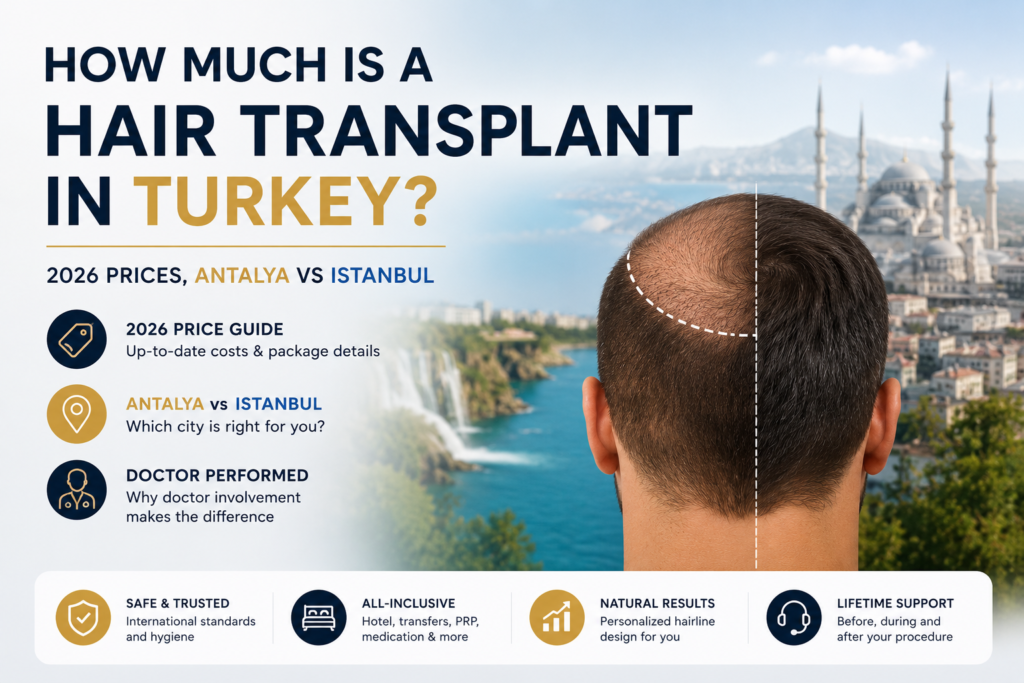
How Much Is a Hair Transplant in Turkey? 2026 Prices, Antalya vs Istanbul For more than a decade, Turkey has become the world’s leading destination for hair transplantation, welcoming hundreds of thousands of international patients every year. People travel from the United Kingdom, Ireland, Germany, France, the Netherlands, Canada, Australia and even the United States, not simply because prices are lower than back home, but because Turkey has built an international reputation for experienced surgeons, advanced techniques and comprehensive all-inclusive treatment packages.
How much is a hair transplant in Turkey?
It sounds like a simple question, but the answer is more complex than many websites suggest.
Some clinics advertise procedures for less than £1,000, while others charge more than £5,000 for what appears to be the same treatment. At first glance, this can be confusing. Are expensive clinics simply charging more for their brand name, or are ultra cheap packages leaving out something important?
The truth lies somewhere in the middle.
The cost of a hair transplant depends on far more than the number of grafts advertised on a website. The surgeon’s experience, the technique used, the quality of the donor area, the number of patients treated each day, medical standards, aftercare, accommodation and perhaps most importantly who actually performs your surgery all influence the final price.
Unfortunately, this last point is often overlooked.
Many patients spend weeks comparing graft numbers and package prices without asking one of the most important questions of all:
Who will actually perform my hair transplant?
As specialists providing hair transplant services in both Antalya and Istanbul, we’ve seen first-hand how this single question can make the difference between a natural, long-lasting result and one that requires corrective surgery years later.
This guide explains exactly what a hair transplant costs in Turkey in 2026, why prices vary so dramatically, how Antalya compares with Istanbul, what should be included in an all-inclusive package, and why choosing an experienced doctor not simply the cheapest clinic may be the most important investment you make.
Why Is Turkey So Popular for Hair Transplants?
Turkey didn’t become the global capital of hair transplantation overnight.
Its reputation has developed through years of investment in medical tourism, internationally accredited hospitals, experienced surgeons and competitive pricing. Today, patients from across Europe and beyond travel to Turkey because they can often receive high-quality treatment for significantly less than they would pay in the UK, Ireland or North America.
Another reason is convenience.
Most international clinics offer complete packages that include airport transfers, accommodation, medical tests, medications and post-operative support. Instead of organising each part of the trip separately, patients arrive knowing that everything has already been arranged.
For many people, this removes much of the stress associated with travelling abroad for medical treatment.
However, it’s important to understand that not all clinics offer the same standard of care. Two packages may appear similar online while providing completely different surgical experiences.
That is why comparing prices alone rarely tells the full story.
Hair Transplant Prices in Turkey (2026)
So, how much should you realistically expect to pay?
Although prices vary depending on the clinic, surgeon and technique, reputable clinics generally fall within a predictable range.
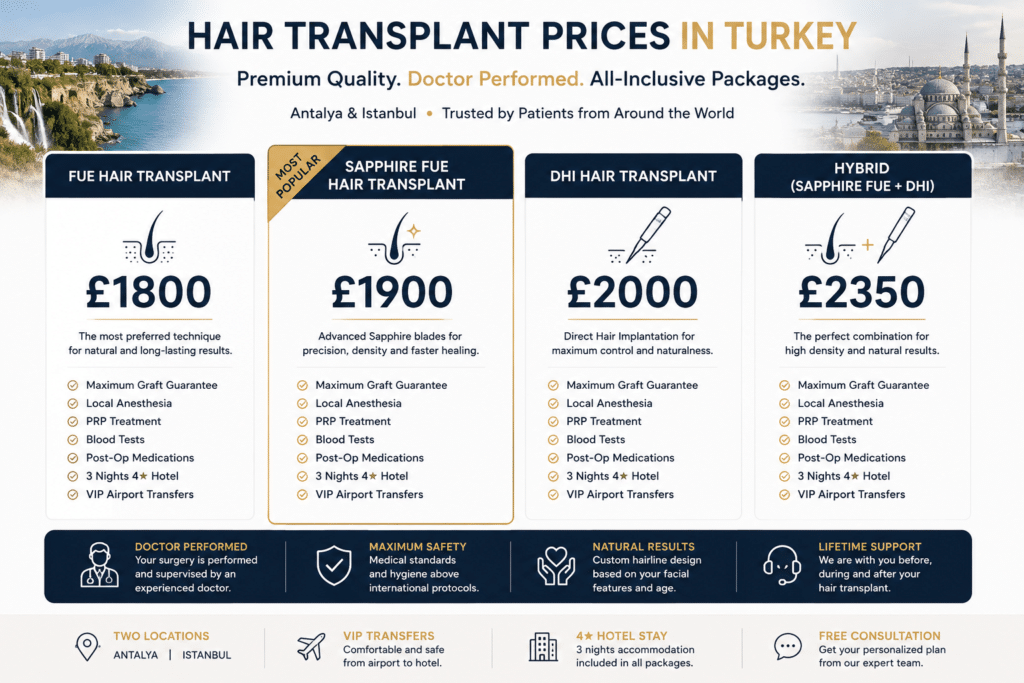
At Hair Legends Antalya & Istanbul, our transparent pricing reflects comprehensive, doctor-led treatment rather than hidden extras.
| Procedure | Price |
|---|---|
| FUE Hair Transplant | £1,800 |
| Sapphire FUE Hair Transplant | £1,900 |
| DHI Hair Transplant | £2,000 |
| Hybrid (Sapphire FUE + DHI) | £2,350 |
Unlike clinics that advertise a low headline price before adding additional charges, every package includes:
- Maximum graft guarantee
- Comprehensive consultation
- Doctor-led surgical planning
- Local anaesthesia
- PRP treatment
- Blood tests
- Post-operative medications
- Three nights in a 4-star hotel
- VIP airport transfers
- Aftercare support
This allows patients to budget with confidence before travelling to Turkey.
One of the most common misconceptions is that a lower price automatically represents better value. In reality, value comes from the quality of the treatment, the experience of the medical team and the long-term outcome not simply the amount paid on the day of surgery.
Why Are Hair Transplants Cheaper in Turkey?
One of the first questions international patients ask is whether lower prices mean lower quality.
The answer is generally no.
Hair transplantation costs less in Turkey primarily because operating expenses are significantly lower than in countries such as the United Kingdom, Germany or the United States. Staff salaries, commercial property costs and overall business expenses allow clinics to provide advanced procedures at prices that would be difficult to match elsewhere.
However, there is another factor that patients should understand.
The Turkish market is extremely competitive.
Some clinics compete by investing in experienced surgeons, advanced equipment and personalised care.
Others compete almost entirely on price.
This is where patients need to be careful.
A package costing several hundred pounds less may achieve those savings by treating a very high number of patients each day, reducing consultation times or limiting direct doctor involvement during surgery.
For this reason, asking why a clinic is cheaper is often more important than asking how much it costs.
Antalya or Istanbul: Which City Is Better for a Hair Transplant?
Many international patients automatically assume Istanbul is the only place to undergo hair restoration because it has become synonymous with medical tourism.
The reality is rather different.
While Istanbul remains an excellent option, Antalya has rapidly established itself as one of Turkey’s most attractive destinations for patients seeking high-quality hair transplantation in a more relaxed environment.
Unlike Istanbul’s busy metropolitan atmosphere, Antalya combines advanced medical facilities with the calm surroundings of the Mediterranean coast.
For many patients, recovery is simply more comfortable.
Rather than spending hours in heavy traffic travelling between airports, hotels and clinics, visitors to Antalya often enjoy shorter transfer times, quieter surroundings and the opportunity to recover in one of Turkey’s most beautiful coastal cities.
At Hair Legends, patients can choose treatment in either Antalya or Istanbul, receiving the same commitment to personalised care, natural hairline design and doctor-led treatment philosophy.
The decision often comes down to personal preference.
Some patients enjoy the energy of Istanbul, while others prefer combining their treatment with a relaxing stay by the Mediterranean.
Both locations follow the same medical standards, ensuring patients never have to compromise on quality.
Who Will Actually Perform Your Hair Transplant? The Question Most Patients Forget to Ask
If there is one section of this guide that deserves your full attention, it is this one.
Most patients spend weeks comparing prices, graft numbers, hotel ratings and online reviews. They ask whether one clinic offers Sapphire FUE instead of standard FUE, or whether PRP is included in the package. These are all reasonable questions—but they often overlook the single factor that can have the greatest impact on their result.
Who will actually perform the procedure?
The answer is not always as straightforward as you might expect.
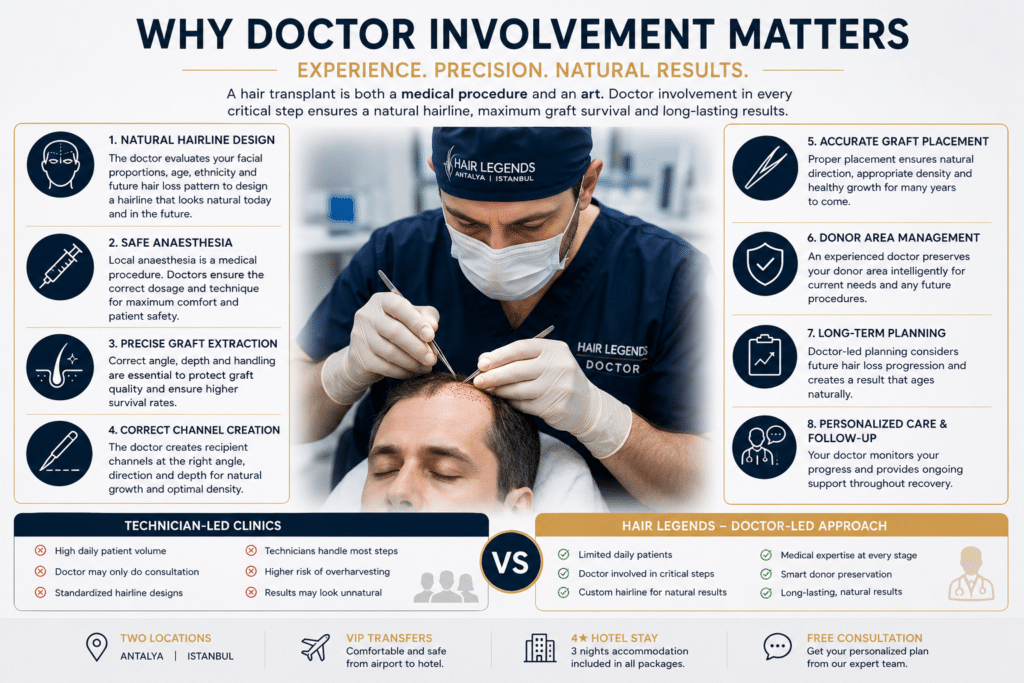
Hair transplantation is a medical procedure. It involves assessing the patient’s pattern of hair loss, evaluating the donor area, planning the future hairline, administering local anaesthesia, creating recipient sites at precise angles, and ensuring the donor area is managed responsibly. Every one of these steps influences not only how the result looks after twelve months, but also how much donor hair remains available for the future.
Yet the level of physician involvement varies considerably from one clinic to another.
Some clinics operate on a boutique model, treating only a limited number of patients each day so that the doctor can remain closely involved throughout the critical stages of the procedure. Others work on a much higher-volume system, where several surgeries may take place simultaneously. In these settings, responsibilities are often shared among different members of the clinical team.
There is no universal model across Turkey, which is exactly why patients should ask detailed questions before making a decision.
Instead of asking, “Is a doctor available?”, ask questions such as:
- Who designs my hairline?
- Who administers the local anaesthesia?
- Who creates the recipient channels?
- Who extracts the grafts?
- Who implants the grafts?
- How many patients does the doctor oversee in one day?
The answers to these questions reveal far more than any advertisement ever will.
Why Doctor Involvement Matters
Modern FUE hair transplantation is often described as both a science and an art.
The science lies in preserving healthy follicles, protecting the donor area and ensuring graft survival. The artistic aspect lies in creating a hairline that looks completely natural not only today, but also ten or twenty years from now.
That is where experience becomes invaluable.
An experienced hair transplant doctor doesn’t simply replace lost hair. They analyse facial proportions, age, ethnicity, donor availability and the likely progression of future hair loss before making a single incision.
For example, many younger patients request the low, perfectly straight hairline they had at eighteen.
An experienced surgeon may advise against that request.
Why?
Because hair loss usually continues with age. Creating an overly aggressive juvenile hairline may consume an unnecessary number of grafts, leaving fewer follicles available if further treatment becomes necessary later in life. A well-planned, mature hairline often produces a more natural appearance while preserving valuable donor resources.
These are medical decisions not simply technical ones.
The Hidden Cost of Choosing the Cheapest Clinic
It is understandable that many patients compare prices first.
After all, travelling abroad for treatment represents a significant investment.
However, there is an important distinction between low cost and good value.
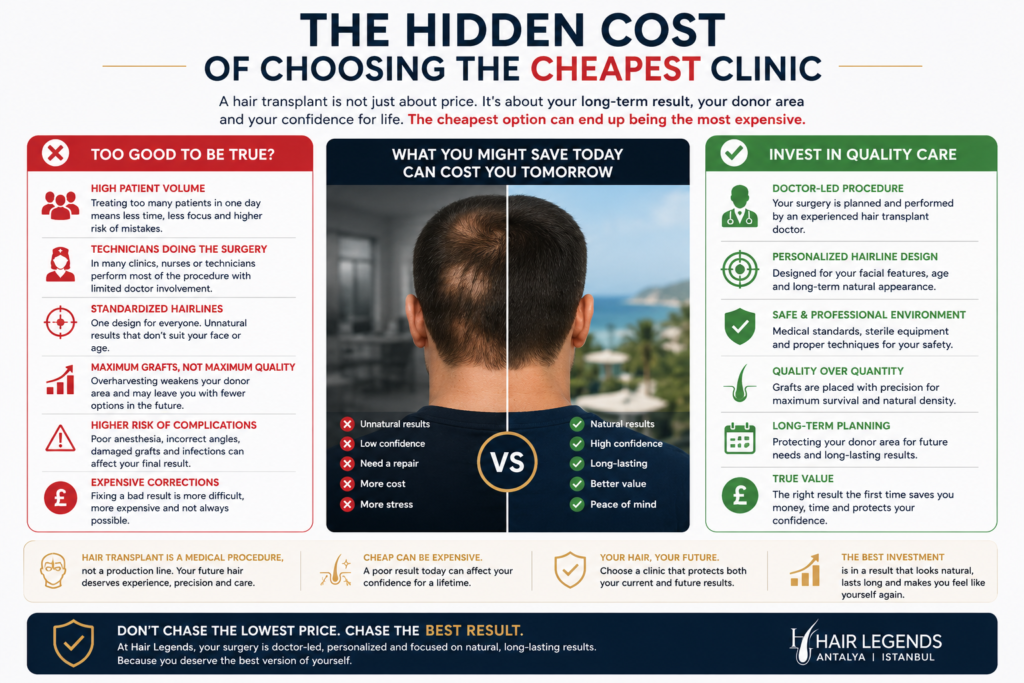
A clinic offering prices hundreds of pounds below the market average has to reduce costs somewhere. Sometimes that reduction comes from lower operating expenses. In other cases, it may involve treating a much higher number of patients each day, limiting consultation times or adopting a production-line approach.
Hair transplantation should never feel like an assembly line.
Every patient has a different donor capacity, different expectations and a different pattern of hair loss. Two patients of the same age may require completely different surgical plans.
Unfortunately, corrective hair transplantation has become increasingly common among patients who initially chose clinics based almost entirely on price.
Repairing an unnatural hairline, an overharvested donor area or poorly planned graft placement is almost always more difficult than performing the first procedure correctly.
For this reason, experienced surgeons often say that the most expensive hair transplant is the one that has to be done twice.
The Hair Legends Difference
At Hair Legends, we believe that every patient deserves a treatment plan designed around their individual needs rather than a standard package.
Whether you visit our clinic in Antalya or Istanbul, our philosophy remains the same:
A hair transplant is a medical procedure not a production line.
Your journey begins with a detailed assessment of your hair loss pattern, donor capacity and long-term goals. Rather than focusing solely on the maximum number of grafts that can be extracted in a single session, we focus on achieving a result that will continue to look natural for years to come.
During the critical stages of treatment, an experienced hair transplant doctor is actively involved in planning and supervising the procedure. This includes the design of the hairline, evaluation of the donor area, surgical planning and overall medical management.
Our objective is not simply to increase hair density.
It is to create a result that complements your face, respects your donor area and ages naturally over time.
That philosophy has helped patients from across the UK, Ireland, Europe and beyond choose Hair Legends for their hair restoration journey.
FUE, Sapphire FUE, DHI or Hybrid: Which Technique Offers the Best Value?
One of the reasons hair transplant prices vary in Turkey is that different surgical techniques require different instruments, planning and implantation methods.
At Hair Legends, we offer four treatment options, each designed for different hair loss patterns and patient expectations.
FUE Hair Transplant – £1,800
Follicular Unit Extraction (FUE) remains the gold standard for many patients. Individual follicular units are carefully harvested from the donor area and transplanted into thinning regions. FUE offers excellent versatility, minimal visible scarring and natural-looking results when performed correctly.
Sapphire FUE – £1,900
Sapphire FUE follows the same principles as traditional FUE but uses ultra-fine sapphire blades to create recipient sites. These blades allow for highly precise channel creation, helping to optimise graft placement and support a natural hairline. For only a small difference in price, Sapphire FUE has become one of our most popular options.
DHI Hair Transplant – £2,000
Direct Hair Implantation (DHI) uses specialised implantation pens that allow follicles to be placed directly into the scalp. This technique can be particularly beneficial for patients who wish to maximise density in specific areas or avoid shaving the entire recipient zone in suitable cases.
Hybrid (Sapphire FUE + DHI) – £2,350
Our Hybrid procedure combines the strengths of both techniques. Sapphire FUE is typically used to create a natural frontal hairline, while DHI can be used to increase density in selected regions. For many patients, this provides the greatest flexibility and the most refined aesthetic outcome.
Importantly, the “best” technique is not always the most expensive one. The ideal choice depends on your hair characteristics, donor quality, degree of hair loss and long-term goals. During your consultation, we recommend the approach that best suits your individual case rather than automatically suggesting the highest-priced option.
Does a Higher Price Mean Better Results?
Not necessarily.
Some premium clinics charge more because they offer highly personalised care, experienced surgeons and advanced facilities. Others may simply have higher operating costs or stronger brand recognition.
Likewise, a lower price does not automatically mean poor quality.
The key is understanding what your package actually includes and how your surgery will be performed.
When comparing clinics, ask yourself:
- Is the treatment plan personalised?
- Will I know who performs each stage of the procedure?
- Does the package include accommodation and transfers?
- Is PRP included?
- What aftercare is provided once I return home?
- Will I receive realistic advice, or simply be promised the maximum number of grafts?
These questions often reveal more than the advertised price alone.
Why Antalya Has Become One of Europe’s Fastest Growing Hair Transplant Destinations
For years, Istanbul was almost synonymous with hair transplantation in Turkey. It remains one of the world’s busiest medical tourism hubs, attracting thousands of patients every month. However, over the last decade, another city has steadily earned an outstanding reputation among international patients: Antalya.
Known for its Mediterranean coastline, luxury resorts and excellent international flight connections, Antalya now offers much more than a holiday destination. It has become one of Turkey’s leading centres for advanced hair restoration, combining experienced medical professionals with a more relaxed treatment experience.
Many of our patients tell us they chose Antalya for one simple reason—they wanted to recover somewhere peaceful.
Unlike large metropolitan cities, Antalya offers shorter transfer times, less traffic and a calmer atmosphere. After surgery, most patients prefer resting comfortably rather than spending hours travelling across a busy city.
Recovery is an important part of every successful hair transplant. Sleeping well, reducing stress and following aftercare instructions all contribute to the healing process. A quieter environment can make those first few days significantly more comfortable.
At Hair Legends Antalya, patients receive the same high medical standards they would expect from an international clinic while enjoying the benefits of recovering in one of Europe’s most beautiful coastal destinations.
Of course, we understand that some patients prefer the convenience and accessibility of Istanbul. That’s why Hair Legends also offers treatment in Istanbul, allowing patients to choose the location that best suits their travel plans while receiving the same commitment to quality, natural results and personalised care.
How to Choose the Best Hair Transplant Clinic in Turkey
With hundreds of clinics advertising online, choosing the right one can feel overwhelming.
Every website promises natural results.
Every clinic claims to be the best.
Most advertise thousands of successful procedures.
So how can patients separate marketing from genuine quality?
The answer begins with asking better questions.
Instead of comparing clinics solely by price, evaluate them using the following criteria.
1. Ask Who Performs Each Stage of the Procedure
This should always be your first question.
Do not assume that the doctor performs every important part of the surgery simply because their photograph appears on the website.
Ask directly:
- Who designs my hairline?
- Who creates the recipient channels?
- Who harvests the grafts?
- Who implants the follicles?
- How involved is the doctor throughout the procedure?
A reputable clinic should answer these questions clearly and transparently.
2. Don’t Chase the Highest Graft Number
Many patients believe more grafts automatically mean better results.
This simply isn’t true.
Removing unnecessary grafts may weaken the donor area and reduce future treatment options.
A responsible clinic focuses on achieving natural density while preserving donor hair for the future.
At Hair Legends, our goal is not to maximise graft numbers.
Our goal is to maximise long-term results.
3. Review Real Patient Results
High-quality before-and-after photographs tell an important story.
Look beyond the frontal hairline.
Pay attention to:
- Natural density
- Hairline irregularity
- Temple design
- Donor area preservation
- Results after 12 months rather than immediately after surgery
Natural results should never look “transplanted.”
4. Look for Honest Advice
A trustworthy clinic will sometimes advise against surgery.
That may sound surprising, but it demonstrates professionalism.
Patients with unstable hair loss, unrealistic expectations or insufficient donor supply may benefit more from medical treatment before considering transplantation.
If every consultation ends with an immediate recommendation for surgery, patients should ask why.
What Happens After a Hair Transplant?
One of the biggest misconceptions is that the procedure itself determines the final outcome.
In reality, recovery plays an equally important role.
Although individual healing varies, a typical timeline looks like this:
Day 1–3
Mild swelling, redness and tiny scabs are completely normal. Patients return to their hotel with detailed aftercare instructions and medication.
Week 1
Scabs gradually disappear as washing continues according to the clinic’s guidance.
Weeks 2–8
Many transplanted hairs shed during this period. This temporary shedding is expected and forms part of the normal growth cycle.
Months 3–4
New hairs begin to emerge.
Growth is initially fine before gradually thickening.
Months 6–8
Patients usually notice significant improvement in density.
Friends and family often begin commenting on the transformation.
Months 12–18
Final results become visible, although individual growth rates vary.
Hair continues to mature naturally over time.
At Hair Legends, our support doesn’t end when patients leave Turkey.
We provide detailed aftercare guidance and remain available to answer questions throughout the recovery journey.
Frequently Asked Questions
How much does a hair transplant cost in Turkey?
Prices vary depending on the clinic, technique and level of doctor involvement. At Hair Legends, procedures start from £1,800 for FUE, £1,900 for Sapphire FUE, £2,000 for DHI and £2,350 for our Hybrid technique.
Is Antalya cheaper than Istanbul for a hair transplant?
Prices are generally comparable when treatment quality is similar. The decision often depends more on travel preferences than cost. Many patients choose Antalya because of its relaxed atmosphere and shorter transfer times, while others prefer Istanbul’s international connections.
Why are hair transplants less expensive in Turkey?
Lower operating costs, a highly competitive medical tourism sector and the large number of specialised clinics allow Turkish providers to offer internationally competitive prices without necessarily compromising quality.
How many grafts will I need?
There is no standard answer.
The required graft count depends on your degree of hair loss, donor quality, hair characteristics and long-term treatment plan.
A personalised consultation provides the most accurate estimate.
Is Sapphire FUE better than standard FUE?
Not necessarily.
Both techniques produce excellent results when performed by experienced professionals.
The best option depends on your individual case rather than simply choosing the latest technology.
Is DHI worth the additional cost?
For suitable patients, DHI can offer advantages in selected areas where higher density or minimal shaving is preferred.
Your surgeon will recommend the technique that best matches your goals.
How long do transplanted hairs last?
Hair transplanted from genetically resistant donor areas is generally permanent. However, non-transplanted hair may continue thinning naturally with age, which is why long-term planning is so important.
Can I return to work after one week?
Many patients with office-based jobs return within seven to ten days, depending on their comfort level and the visibility of healing.
Final Thoughts
Choosing where to have a hair transplant isn’t simply about finding the lowest price.
It’s about finding the right balance between medical expertise, safety, transparency and natural results.
Turkey has earned its reputation as one of the world’s leading destinations for hair restoration because it offers exceptional value. However, patients should remember that value isn’t measured only in pounds or euros it is measured in the quality of the result they will live with for decades.
At Hair Legends, whether you choose treatment in Antalya or Istanbul, our philosophy remains the same.
We believe every patient deserves honest advice, realistic expectations and a treatment plan designed specifically for them not a one size fits all package or a production-line experience.
From your first consultation to your final follow up, our focus is on creating results that look natural, preserve your donor area and complement your facial features for years to come.
If you’re considering a hair transplant in Turkey, we’d be happy to review your photographs, assess your hair loss and recommend the most appropriate treatment plan whether that involves FUE, Sapphire FUE, DHI or simply expert advice on the next step.
Because the best hair transplant isn’t the cheapest one.
It’s the one that still looks natural long after you’ve forgotten you ever had it.