
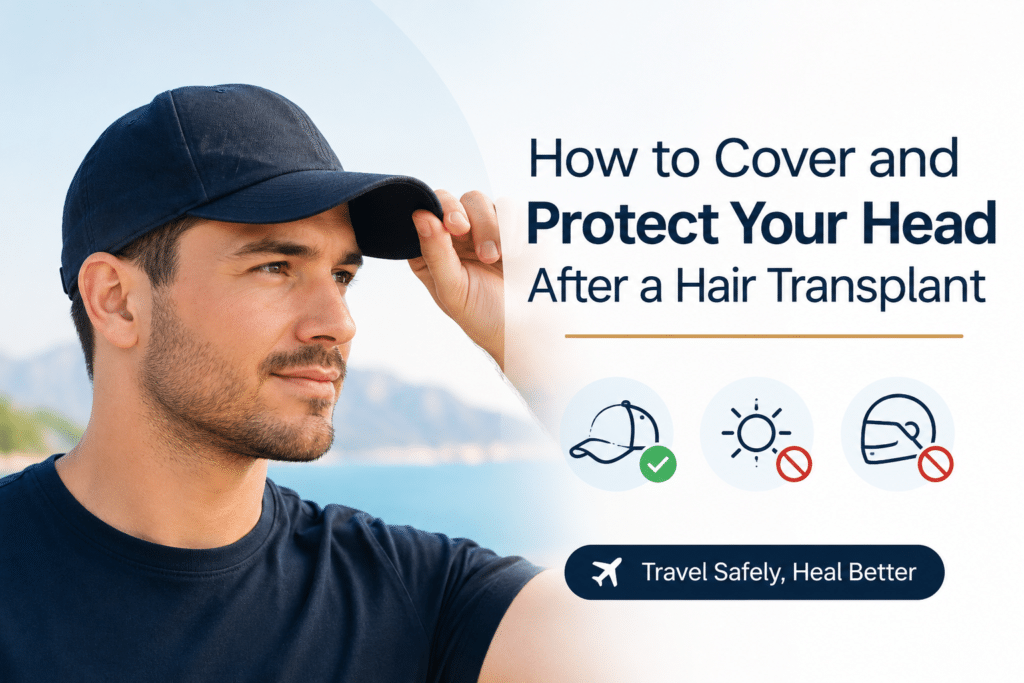
How to Cover and Protect Your Head After a Hair Transplant: You leave the clinic, catch a glimpse of yourself in the mirror, and suddenly a very ordinary question becomes surprisingly important:
“Can I wear a hat?”
For most people, it’s not about fashion. Some want to hide the redness before flying home. Others are worried about the sun during a summer holiday in Antalya. Many simply don’t feel comfortable walking through an airport with visible signs of surgery.
The answer isn’t a simple yes or no.
Whether you can cover your head depends on how many days have passed since your hair transplant, what you want to wear, and how your scalp is healing. A loose surgical cap is very different from a tight baseball cap. A few days can also make a significant difference because transplanted grafts become more secure as the healing process progresses.
One of the biggest misconceptions is that hair grafts remain extremely fragile for weeks. In reality, the most delicate period is much shorter than many patients expect. That doesn’t mean you can immediately return to wearing any hat you like, but it does mean the rules gradually become less restrictive as your scalp recovers.
At Hair Legends Clinic, this is one of the topics we discuss with every international patient before they travel home after a Hair Transplant Antalya procedure. Knowing how to protect your scalp without interfering with healing makes recovery much less stressful, especially if you’re flying home, returning to work, or spending time outdoors.
In this guide, we’ll explain when it’s safe to cover your head, which types of hats are most suitable, what should be avoided during the first weeks, and how to protect your new grafts while they establish themselves.
The Most Important Rule Is Simple
If you only remember one piece of advice after your hair transplant, let it be this:
Don’t let anything rub against the transplanted area before it’s ready.
Notice that the concern isn’t simply wearing a hat. It’s friction.
Every transplanted follicle is placed into a tiny incision made in the scalp. During the first few days, those grafts begin forming microscopic connections with the surrounding tissue. They’re not sitting loosely on the surface, but they also haven’t fully stabilized yet.
That’s why unnecessary pressure should be avoided.
Imagine planting young seedlings in a garden. You wouldn’t keep digging around them to check whether they’ve taken root. Instead, you leave them undisturbed and allow nature to do its work.
Hair grafts aren’t very different.
Patients often assume the greatest risk comes from accidentally knocking their head against something. Surprisingly, repeated rubbing from clothing, hats, or even pulling a shirt over your head can sometimes be more problematic during the earliest stage of recovery.
Fortunately, this period doesn’t last very long.
With each passing day, the grafts become increasingly secure. As the tiny scabs begin falling away naturally and the skin heals, everyday activities gradually become easier.
The key is resisting the temptation to rush the process.
How Long Should You Protect Your Head After a Hair Transplant?
This is where many online articles become confusing.
Some claim you can wear a hat after three days.
Others say two weeks.
Some recommend waiting an entire month.
The reality is that recovery isn’t controlled by the calendar alone. Two people who have the same procedure on the same day may heal at slightly different speeds.
Instead of focusing on one specific date, it’s more useful to think about recovery in stages.
During the first several days, your only job is to protect the newly implanted follicles. At this point, your scalp is still healing from thousands of tiny incisions, so unnecessary contact should be avoided whenever possible.
By the end of the first week, most patients notice a significant difference. The scalp feels less tender, swelling has usually settled, and the grafts are becoming much more stable. That doesn’t mean they’re ready for tight hats or helmets, but gentle protection becomes easier.
Over the following weeks, redness continues to improve, the donor area recovers, and daily routines slowly return to normal.
One thing that doesn’t change, however, is the need to protect your scalp from excessive sunlight during the early months. Even after the grafts are secure, the skin itself remains more sensitive than usual.
Healing isn’t a race.
Patients who give their scalp the time it needs rarely regret being cautious.
Hair Transplant Head-Cover Timeline
Rather than memorizing exact dates, it’s easier to understand recovery by looking at what normally happens during each stage.
Days 1 to 3
During the first few days, it’s best to leave the transplanted area completely undisturbed unless your surgeon advises otherwise.
Your focus should be simple:
Sleep carefully.
Follow your washing instructions.
Avoid bumping your head.
Let the grafts settle naturally.
If you’re travelling during this period, most clinics recommend taking extra care when entering cars, storing luggage, or walking through busy airports where accidental contact is more likely.
Around the First Week
By this stage, many patients already feel much more confident.
Swelling has usually disappeared, discomfort is minimal, and everyday movement becomes easier.
Depending on your surgeon’s instructions, this may be the point where certain loose-fitting hats become an option for short periods.
The important word is loose.
If a hat presses firmly against the transplanted area or needs to be pulled tightly over your scalp, it probably isn’t the right choice yet.
Two to Four Weeks
This is the stage where recovery begins feeling much more normal.
Most of the visible scabbing has disappeared, and many patients return to work, social events, and regular outdoor activities.
Lightweight hats are generally much more comfortable at this point, although you’ll still want to avoid anything that creates excessive heat or pressure.
After the First Month
By now, most patients spend far less time thinking about protecting their grafts.
Daily life feels familiar again.
Even so, sun protection continues to matter. Newly healed skin is still more sensitive than the surrounding scalp, particularly during the summer months.
What Is the Best Head Cover After a Hair Transplant?
Not all hats protect your scalp in the same way.
Some simply cover your head.
Others actively reduce comfort by trapping heat or pressing directly against healing skin.
If your surgeon has confirmed that it’s safe to wear a head covering, the ideal option is usually one that’s light, breathable, and loose enough to sit comfortably without compressing the transplanted area.
Soft cotton fabrics are often preferred because they allow airflow while feeling gentle against the skin.
Some clinics also provide specially designed postoperative caps for patients travelling home. These caps are shaped to minimise direct pressure over the recipient area while still offering privacy during flights or transfers.
Whatever you choose, remember that the purpose isn’t to hide your hair transplant at any cost.
The priority is protecting the scalp while allowing it to heal naturally.
A comfortable hat that sits lightly on your head is almost always a better choice than one that looks fashionable but feels restrictive.
Head Covers to Avoid During Early Recovery
Patients sometimes focus so much on finding the “best” hat that they forget another important question:
Which ones should be avoided?
During the early stages of healing, anything tight enough to grip the scalp firmly should stay in the wardrobe.
That includes snug baseball caps, compression sports caps, thick wool beanies, tight cycling helmets, and any headwear that has to be stretched over the recipient area.
It’s not because these items are inherently dangerous.
It’s because they increase friction every time you put them on or take them off.
The same applies to heavy winter hats that trap heat for long periods.
A warm scalp isn’t necessarily a healthier scalp.
Allowing fresh air to circulate during recovery generally creates a more comfortable environment while reducing excessive sweating.
When patients ask us whether a particular hat is suitable, we often encourage them to think less about the style and more about how it behaves.
Does it slide on easily?
Can it be removed without dragging across the grafts?
Does it leave pressure marks on your forehead?
If the answer to the last question is yes, it’s probably too tight for early recovery.
How to Put On a Hat After a Hair Transplant
Believe it or not, the way you wear a hat can be just as important as the hat itself.
Many people instinctively grab the front of a cap, pull it down over the forehead, and adjust it several times until it feels comfortable.
That’s exactly the sort of movement you want to avoid during the first stage of healing.
Instead, hold the hat open with both hands and gently lower it onto your head without scraping the transplanted area.
When removing it, lift it straight upward rather than dragging it forwards across the hairline.
It may feel overly cautious at first, but these small habits become second nature surprisingly quickly.
The first week after surgery is temporary.
Your results are long-term.
Taking an extra ten seconds each time you put on a hat is a very small price to pay for protecting thousands of carefully placed grafts.
In the second part of this guide, we’ll look at another equally important aspect of recovery: protecting your scalp from the sun, rain, dust, wind, and everyday environmental exposure. We’ll also answer common questions about baseball caps, hijabs, turbans, motorcycle helmets, hard hats, and when it’s safe to return to normal activities after a Hair Transplant Antalya procedure.
Protecting Your Scalp From the Sun
If there’s one thing many patients underestimate after a hair transplant, it’s the effect of the sun.
People tend to focus on hats, sleeping positions, or washing routines, but direct sunlight can be just as important during recovery—especially if you’ve had your procedure in a warm destination like Antalya.
The newly transplanted area is more sensitive than normal skin. During the first weeks, it’s still healing beneath the surface, and prolonged exposure to UV rays may increase irritation, delay recovery, or contribute to longer-lasting redness in some patients.
Fortunately, protecting your scalp doesn’t mean staying indoors for months.
It simply means being sensible.
If you’re walking outside for a few minutes, moving between the hotel and the clinic, or travelling to the airport, there’s usually little cause for concern. Spending hours in direct midday sun is a different story.
The goal during recovery isn’t to avoid daylight altogether. It’s to avoid unnecessary exposure while your scalp is still healing.
During the First Month
The first month is when you should be most careful.
At this stage, the grafts are becoming established, but the skin itself is still recovering from thousands of tiny incisions. Even after the scabs have disappeared, your scalp may remain pink or slightly sensitive.
Whenever possible, avoid standing in direct sunlight for extended periods, particularly between late morning and mid-afternoon when UV levels are strongest.
If you need to be outdoors, look for shade instead of relying solely on a hat.
A loose-fitting cap approved by your clinic can provide additional protection, but it shouldn’t replace common sense. Sitting under an umbrella at the beach or choosing the shaded side of the street is often just as helpful.
Patients sometimes ask whether sunscreen can be applied directly to the transplanted area.
During the early healing period, the answer is usually no unless your surgeon specifically recommends it. The scalp should be allowed to recover naturally before cosmetic products or sun protection creams are introduced.
After the First Month
By this point, life usually feels much more normal.
Most patients have returned to work, resumed light exercise, and stopped thinking about their transplant every hour of the day.
Even so, the scalp may still be more sensitive than surrounding skin.
If you’re planning a beach holiday, hiking trip, or long day outdoors, protecting your scalp is still a good idea.
A lightweight hat remains one of the easiest ways to reduce direct UV exposure, particularly during the summer.
You don’t need to become overly protective, but you also shouldn’t assume your scalp has fully returned to normal just because the visible signs of surgery have faded.
Healing continues beneath the surface for much longer than many people realize.
During the Second and Third Months
By the second and third months, transplanted follicles are firmly established.
In fact, many patients become more concerned about the temporary shedding phase than protecting their scalp.
This is completely normal.
At this stage, you’re gradually returning to your usual routine.
Outdoor activities become easier, travel restrictions are largely gone, and wearing different types of hats is no longer a major concern.
That said, prolonged sun exposure is never particularly good for healing skin.
If you’re planning to spend an entire afternoon outdoors, whether you’re golfing, sightseeing, or relaxing by the sea, it’s still sensible to protect your scalp from excessive UV exposure.
These simple habits aren’t just beneficial after a hair transplant—they’re good practice for long-term scalp health in general.
Protection From Rain, Wind, Dust, and Pollution
Sunlight isn’t the only environmental factor worth thinking about.
Patients often ask whether rain, wind, or city pollution can damage newly transplanted grafts.
The good news is that ordinary weather is rarely a problem.
Walking through light rain for a few minutes isn’t likely to affect your transplant. Wind itself doesn’t harm grafts either.
The bigger concern is what those conditions sometimes bring with them.
Strong winds can blow dust, sand, or other particles onto a healing scalp. Likewise, working in particularly dusty environments may increase irritation during the first days after surgery.
If your occupation involves construction sites, heavy industry, or environments with airborne debris, discuss your return-to-work schedule with your clinic before travelling home.
Most office workers can return relatively quickly, while people working in physically demanding or dusty conditions may benefit from taking a little extra time to recover.
Common sense usually provides the best guide.
If an environment would irritate a fresh cut on your hand, it probably isn’t ideal for a healing scalp either.
Can You Wear a Baseball Cap After a Hair Transplant?
Probably—but not immediately.
The baseball cap is easily the most common head covering patients ask about.
It’s comfortable, familiar, and practical.
The problem isn’t the cap itself.
It’s how tightly many baseball caps fit.
A structured cap that presses against the transplanted area or requires force to put on isn’t suitable during the earliest stage of recovery.
Once your surgeon confirms that it’s safe, a loose-fitting baseball cap can become a perfectly reasonable option.
Many patients travelling home after a Hair Transplant Antalya procedure wear one during their journey, provided it’s comfortable and doesn’t create unnecessary pressure.
If you find yourself constantly adjusting it, pulling it down, or removing it every few minutes, it may still be too early.
Can You Wear a Headscarf or Hijab?
This is an important question for many female patients.
The answer depends largely on timing and how the headscarf is worn.
Immediately after surgery, anything that fits tightly around the transplanted area should generally be avoided.
As healing progresses, many women are able to return to wearing a loosely wrapped headscarf once their surgeon confirms the grafts are sufficiently secure.
The fabric also matters.
Soft, lightweight materials are generally more comfortable than thicker fabrics that create additional pressure or heat.
Every patient’s recovery is different, so personalized advice from your clinic is always preferable to relying on general timelines found online.
Can You Wear a Turban After a Hair Transplant?
Patients who regularly wear a turban for cultural or religious reasons often worry about how soon they can return to their normal routine.
The same basic principle applies.
During the earliest stage of healing, minimizing pressure on the transplanted area is the priority.
Once the grafts have stabilized and your surgeon confirms that healing is progressing well, most patients gradually return to wearing a turban as they normally would.
If tying the fabric requires firm compression around the scalp, waiting a little longer may be advisable.
Your clinic can recommend an appropriate timeframe based on your individual recovery.
Can You Wear a Kippah or Yarmulke?
For patients who wear a kippah or yarmulke daily, planning ahead before surgery can be helpful.
Depending on where the recipient area is located, temporary adjustments may be recommended during the first stage of healing.
Many patients are able to resume wearing one relatively soon once their surgeon is satisfied that the grafts are secure.
If there is any uncertainty, it’s always worth discussing this during your consultation so that postoperative recommendations can be tailored to your daily routine.
When Can You Wear a Motorcycle Helmet or Hard Hat?
Helmets deserve special attention because they’re very different from ordinary hats.
Unlike a loose cap, a motorcycle helmet or industrial hard hat usually creates firm contact around the entire scalp.
For that reason, they generally shouldn’t be worn until your surgeon confirms it’s safe.
This is particularly important for patients whose work requires protective equipment every day.
If your occupation involves construction, manufacturing, engineering, or motorcycling, mention this before your procedure.
Your medical team can help you plan adequate recovery time before returning to activities that require rigid protective headgear.
Trying to speed up this process rarely offers any advantage.
Waiting a little longer is usually the safer choice.
When Should You Contact Your Clinic?
Most patients recover without significant problems.
Some redness, mild swelling, itching, and temporary shedding are all normal parts of the healing process.
However, you should contact your clinic if you notice:
- Persistent bleeding that doesn’t stop.
- Increasing pain rather than gradual improvement.
- Significant swelling that worsens instead of settling.
- Pus or unusual discharge.
- Fever or signs of infection.
- Accidental trauma to the transplanted area.
Even if your concern turns out to be completely normal, asking your medical team is always preferable to relying on advice from strangers online.
A quick message and a photograph are often enough for your clinic to provide reassurance or recommend the next step.
Final Recommendations
Recovering from a hair transplant isn’t about wrapping your head in cotton wool for months. It’s about understanding which precautions genuinely matter and which common fears are largely unnecessary.
During the first few days, protecting the grafts from friction is the priority. As healing progresses, you’ll gradually return to wearing hats, spending time outdoors, and enjoying your normal routine.
There’s rarely a single day when everything suddenly becomes “safe.” Recovery happens step by step, and the best results usually come from patients who allow their scalp to heal naturally instead of rushing back into old habits.
If you’re ever unsure, don’t guess.
Your clinic knows exactly how your procedure was performed and can provide advice based on your individual recovery rather than generic internet timelines.
Frequently Asked Questions
Can I wear a hat immediately after a hair transplant?
Not usually. Newly transplanted grafts need time to stabilize, so it’s important to follow your surgeon’s instructions before covering your head.
Is sunlight harmful after a hair transplant?
Direct sun exposure should be limited during the early stages of recovery because the scalp is more sensitive while healing.
Can rain damage transplanted grafts?
Light rain isn’t generally harmful. The greater concern is exposing a healing scalp to dirt, pollution, or unnecessary irritation.
When can I wear a motorcycle helmet again?
Because helmets fit tightly around the scalp, you should wait until your surgeon confirms it’s safe to wear one.
What should I do if my hat accidentally touches the grafts?
Don’t panic. Gentle contact isn’t always harmful, but if you’re worried or you’ve knocked the transplanted area, contact your clinic for advice.
Is it safe to wear a baseball cap after a Hair Transplant Antalya procedure?
In many cases, yes—but only after your medical team confirms it’s appropriate. A loose, breathable cap is generally a better choice than anything tight or restrictive during the early weeks of recovery.
Recovering from a hair transplant is a temporary process, but the results are designed to last for years. Taking a little extra care with something as simple as a hat, a helmet, or a day in the sun can help create the best possible environment for healthy graft growth. If you have any questions before or after your Hair Transplant Antalya procedure, the team at Hair Legends Clinic is always available to guide you through every stage of your recovery.