
Can You Swim After Hair Transplant in Antalya? A hair transplant in Antalya is often about more than just restoring your hair.
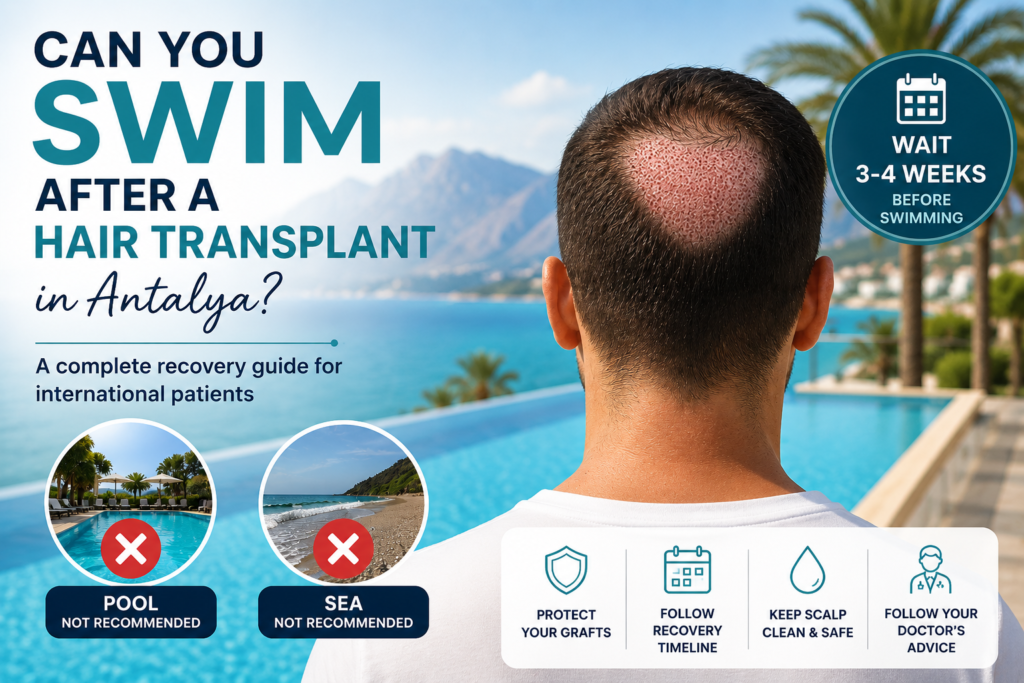
For many international patients, it is also an opportunity to enjoy a few days in one of the Mediterranean’s most popular destinations. With luxury resorts, beautiful beaches, year-round sunshine, and a reputation as a leading medical tourism hub, Antalya offers a unique combination of treatment and relaxation.
That combination naturally leads to one of the most frequently asked questions after surgery:
Can you swim after hair transplant?
It is easy to understand why patients ask.
You have just completed your procedure. Your hotel pool is only a few steps away. The Mediterranean Sea is sparkling under the sun. You feel surprisingly well after surgery and want to make the most of your time in Turkey.
Unfortunately, recovery does not always align with holiday plans.
Although modern hair transplant techniques such as FUE and DHI allow for relatively quick recovery, the newly implanted grafts still need time to settle into their new environment. During this period, activities that seem harmless, including swimming, can potentially interfere with the healing process.
The good news is that you will not need to avoid swimming forever.
The key is understanding when your scalp is ready and why timing matters.
In this guide, the team at Hair Legends explains everything international patients should know about swimming after a hair transplant in Antalya, including recovery timelines, common mistakes, pool versus sea water, and practical advice for protecting your results.
Quick Answer: When Can You Swim After a Hair Transplant?
If you are looking for a simple answer before diving into the details, the following timeline provides a useful guideline.
| Activity | Typical Waiting Period |
|---|---|
| Gentle Washing | Day 2-3 |
| Hotel Swimming Pool | 3-4 Weeks |
| Mediterranean Sea | 3-4 Weeks |
| Jacuzzi or Hot Tub | 4 Weeks or Longer |
| Water Sports | Around 1 Month |
| Scuba Diving | 4-6 Weeks |
While every patient heals differently, most experienced surgeons recommend avoiding swimming for at least three to four weeks after a hair transplant.
This recommendation applies whether you are considering a luxury hotel pool in Lara Beach, an infinity pool overlooking the coast, or a swim in the Mediterranean Sea near Konyaaltı.
The reason is simple.
Your hair transplant may be finished, but your recovery is still underway.
Why Swimming Restrictions Exist After Hair Transplant Surgery
One of the biggest misconceptions about hair transplant recovery is the belief that grafts become permanent as soon as they are implanted.
In reality, the first few weeks are among the most important stages of the entire process.
Think of a transplanted graft as a young tree that has just been planted in new soil.
From the outside, everything may look stable.
Beneath the surface, however, an enormous amount of work is taking place.
The follicle must establish a blood supply.
Healing tissue must strengthen.
The scalp must adapt to thousands of tiny recipient sites.
Only then can long-term growth begin.
Swimming itself does not automatically destroy grafts.
The concern comes from the environment surrounding swimming.
For example, a typical swim often includes:
- Prolonged moisture exposure
- Chlorinated water
- Salt water
- Sun exposure
- Sweating
- Physical activity
- Friction against the scalp
Individually, these factors may seem insignificant.
Combined together during the most delicate phase of recovery, they create unnecessary stress on healing tissue.
At Hair Legends, we always remind patients that successful results are not achieved solely in the operating room.
The weeks following surgery play an equally important role.
Understanding the First Month of Recovery
The first month after a hair transplant is often misunderstood.
Many patients judge recovery based on appearance alone.
If redness improves and scabs disappear, they assume healing is complete.
The reality is more complex.
Days 1 to 7
During the first week, the scalp is focused almost entirely on healing.
Small scabs form around each graft.
Mild redness is common.
Some patients experience temporary swelling around the forehead.
This period is all about protection.
Patients should avoid:
✓ Swimming
✓ Heavy exercise
✓ Direct sunlight
✓ Saunas
✓ Steam rooms
✓ Excessive sweating
The objective is simple: allow the grafts to remain undisturbed while the scalp begins repairing itself.
Days 8 to 14
By the second week, many patients start feeling significantly better.
Most of the visible signs of surgery begin fading.
Scabs gradually disappear.
Normal daily activities become easier.
This stage can be deceptive.
Because the scalp looks healthier, some patients assume restrictions are no longer necessary.
However, healing continues beneath the surface.
The grafts are becoming more secure, but they are still adapting to their new location.
Weeks 3 to 4
This is where confidence starts returning.
Most patients feel completely normal.
The scalp looks dramatically improved.
Redness has often reduced substantially.
Even so, experienced clinics remain cautious.
The fact that recovery appears complete does not always mean biological healing is fully finished.
This is why many surgeons recommend waiting until approximately one month before returning to swimming activities.
The additional patience helps minimise unnecessary risk and supports optimal healing.
Pool Water vs Mediterranean Sea: Which Is Safer?
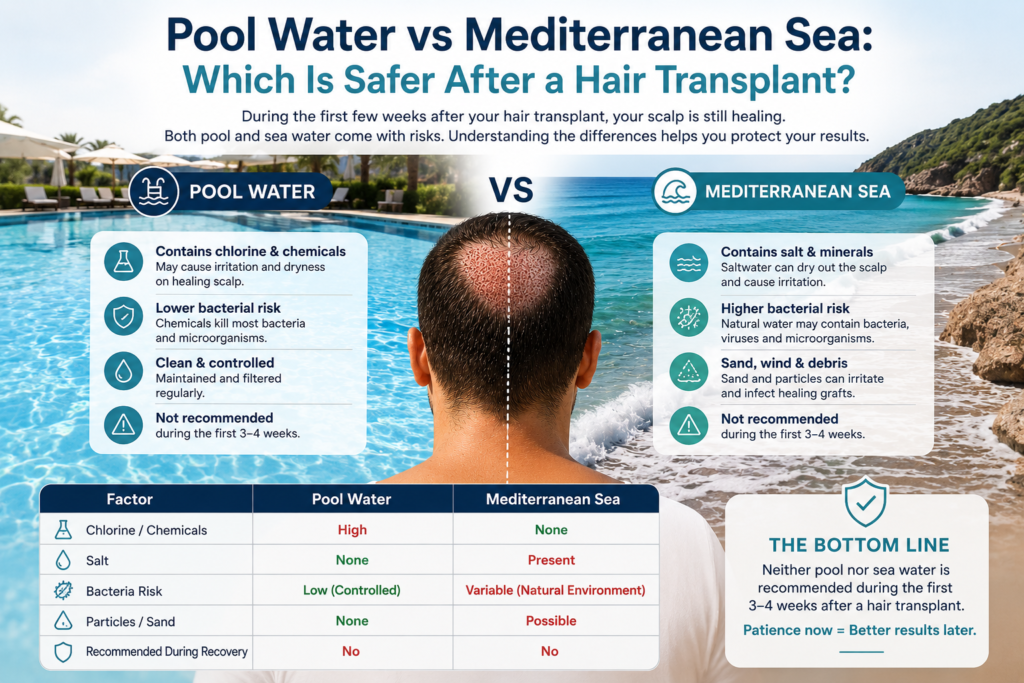
This is perhaps the most common follow-up question we hear from international patients.
Many assume the Mediterranean Sea must be the safer option because it is natural.
Others believe chlorinated pools are cleaner and therefore less risky.
The truth lies somewhere in the middle.
Swimming Pools
Modern pools are designed to be hygienic environments.
Chlorine helps eliminate bacteria and maintain water quality.
For healthy skin, this is usually not a concern.
Freshly transplanted skin is different.
Potential issues include:
- Chemical irritation
- Increased dryness
- Temporary discomfort
- Prolonged redness in sensitive individuals
This does not mean chlorine is dangerous forever.
Once healing is complete, most patients can swim regularly without any concern.
The issue is timing.
Mediterranean Sea
The Mediterranean is one of Antalya’s biggest attractions.
Patients staying near Konyaaltı Beach or Lara Beach are often tempted to take a quick swim, especially during the warmer months.
Sea water introduces different considerations.
These include:
- Salt content
- Sand particles
- Marine microorganisms
- Environmental contaminants
- Friction from waves
Again, none of these factors are particularly problematic once recovery is complete.
During the healing phase, however, they provide no benefit and introduce variables that are best avoided.
Pool vs Sea Comparison
| Factor | Swimming Pool | Mediterranean Sea |
|---|---|---|
| Chlorine | Present | None |
| Salt | None | High |
| Bacteria Exposure | Controlled | Variable |
| Sand Exposure | None | Possible |
| Recommended During Recovery | No | No |
The conclusion is straightforward.
During the first few weeks after a hair transplant, neither option is preferable.
The safest choice is simply allowing the scalp enough time to heal before returning to the water.
The Most Common Mistakes We See at Hair Legends
After treating patients from the UK, Ireland, Germany, and across Europe, certain recovery mistakes appear again and again.
Interestingly, these mistakes rarely come from bad intentions.
They usually happen because patients feel better sooner than expected.
One of the most common examples is returning to swimming too early.
A patient feels great after ten days.
The weather is perfect.
The hotel pool looks inviting.
They convince themselves that one quick swim cannot possibly matter.
In most cases, nothing catastrophic happens.
But recovery is not about avoiding disaster.
It is about creating the best possible conditions for growth.
Other mistakes include excessive sun exposure, aggressive scab removal, and returning to intense exercise too quickly.
The patients who achieve the smoothest recoveries are often the ones who remain patient even after they start feeling normal.
Can Swimming Affect Hair Growth Results?
This is ultimately the question most patients care about.
Can swimming actually affect the final outcome?
The honest answer is that occasional exposure does not automatically mean graft failure.
However, early swimming introduces variables that are completely avoidable.
If irritation occurs, healing may take longer.
If infection develops, graft survival could potentially be affected.
If recovery is disrupted unnecessarily, the scalp may remain inflamed for longer than necessary.
When viewed this way, avoiding swimming for a few weeks becomes an easy decision.
You have invested time, money, and trust into your hair transplant journey.
Protecting those results during the recovery phase is simply part of the process.